

Why Electricians Need AI Dispatch Software in 2026
The electrical trade runs on precision: correct wire sizing, proper torque values, NEC compliance. The business side of most electrical shops still runs on clipboards. Whiteboards for scheduling. Text threads for dispatch. Paper job walks that sit in a truck for three days before becoming an estimate. QuickBooks entries typed twice because the field software doesn't talk to accounting.
In 2026, that gap costs electrical shops real money: missed appointments, underbid change orders, crews arriving without the right materials, invoices that sit unpaid for 60 days. Generic field service platforms built for HVAC or plumbing don't solve this. They don't understand that a 400-amp service upgrade requires a different crew than a recessed lighting retrofit. They don't know that a commercial tenant improvement job walk needs different documentation than a residential panel swap.
Ace Watt was built differently. It is electrical contracting software that combines AI-powered CRM, estimating, scheduling, dispatching, job tracking, invoicing, and QuickBooks-ready exports, designed for how electrical contractors actually work across the United States.
What Makes Ace Watt Different From Generic Field Service Tools
Most field service management platforms treat every trade the same. They offer a calendar, a map view, and a work order form. For electrical contractors, that is not enough.
Electrical work has dependencies generic tools ignore:
- Licensing tiers: You cannot send an apprentice alone on a service call that requires a journeyman sign-off.
- Material specificity: A "lighting job" might need 277V drivers, 0-10V dimmers, emergency battery backups, and IC-rated housings, not a line item that says "materials."
- Inspection sequencing: Rough-in, temporary power, and final each require different crew skills and timing.
- Code-driven documentation: NEC 110.14, 210.12, and 300.22. Job notes need to capture compliance details, not just "completed work."
Ace Watt's data model is built around electrical workflows. Crew records include license type, certifications (OSHA 30, NFPA 70E, state-specific CE hours), and skill tags such as conduit bending, fire alarm, and EV charger commissioning. Job types carry default inspection checklists aligned with NEC sections. The AI estimating engine references material databases with electrical-specific assemblies, not generic line items.
This is vertical software that speaks the trade's language, not a horizontal tool with an electrical skin.
Smarter Crew Scheduling and Dispatching for Electrical Work
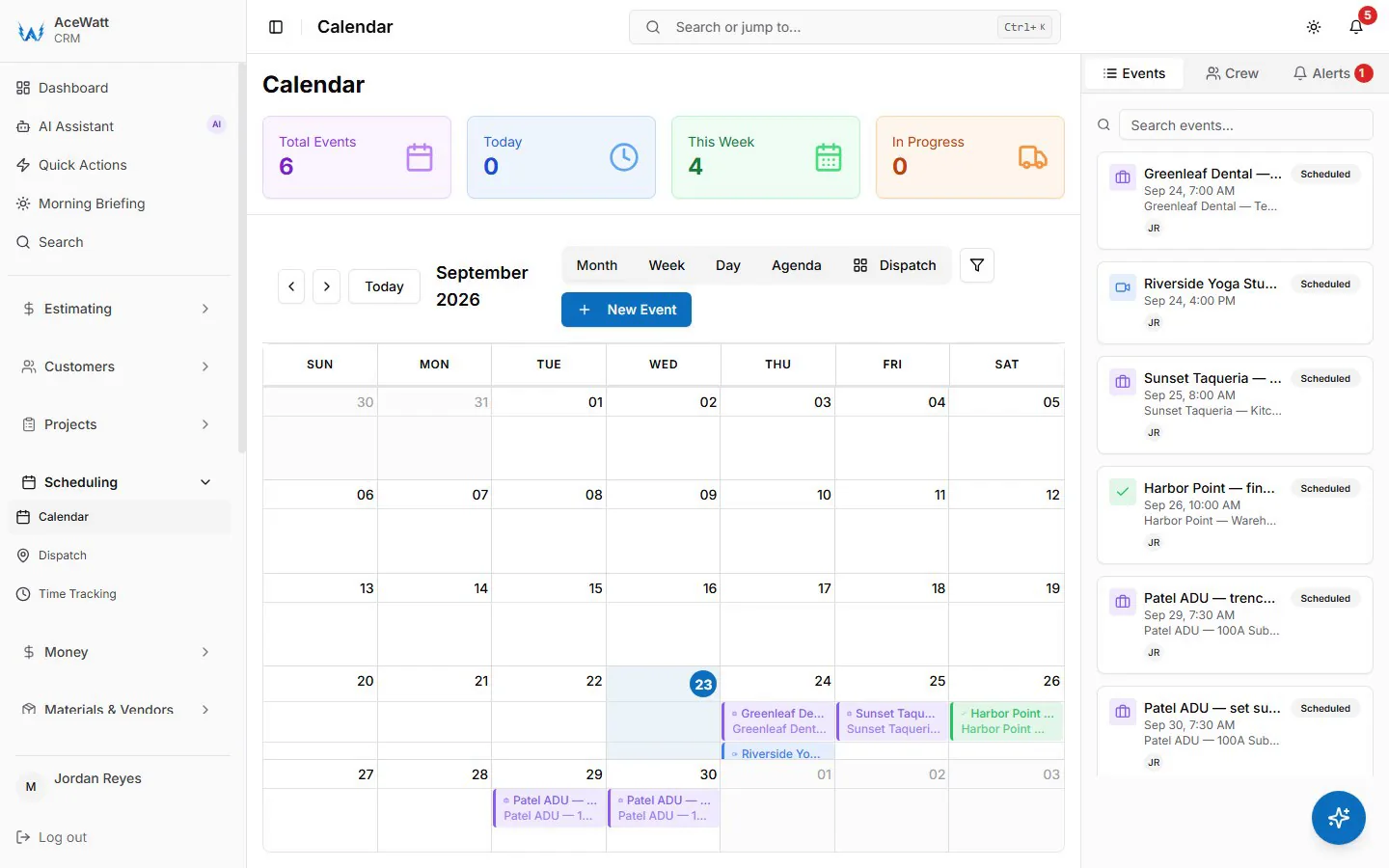
The daily dispatch decision is where profit leaks. A shop with five trucks and eight technicians faces dozens of valid schedule permutations every morning. Who takes the emergency service call? Which two-person crew handles the commercial rough-in? Does the apprentice ride with the right journeyman for the EV charger install?
Ace Watt's Crew Scheduling and Dispatching engine evaluates:
- Technician skills, turned into skill-based suggestions on the drag-and-drop dispatch board
- Skill matching for conduit bending, panel building, low-voltage, solar, and generator work
- Geographic efficiency with straight-line route optimization on the Scale plan, whether your territory is a dense metro or a three-county rural area
- Job priority and SLA: emergency service versus scheduled rough-in versus warranty callback
- Vehicle and tool allocation: bucket truck, pipe threader, megohmmeter, thermal imager
The result is dispatch decisions in seconds instead of 20 minutes of phone calls and group texts. Crews receive mobile notifications with full job packets (drawings, permit numbers, material pick lists, customer access notes) before they leave the shop or the previous site.
For solo electricians, the same engine handles self-scheduling: blocking time for estimating, supplier runs, license renewal courses, and personal commitments while keeping the calendar realistic for incoming service requests.
Turn Job Walks Into Estimates Faster With AI Estimating
The lag between job walk and delivered estimate is where electrical contractors lose bids. General contractors want numbers immediately. Homeowners compare three quotes by Tuesday. The electrician who submits a detailed, code-accurate estimate first usually wins.
Ace Watt's AI Estimating closes that gap. During the job walk, the electrician speaks observations directly into the mobile app using AI Voice and Job Walk Documentation: "200-amp panel upgrade, existing SE cable undersized per 230.42, need 4/0 copper, meter base relocation of 18 inches, AFCI/GFCI combo breakers for 12 circuits, permit with the county." The AI transcribes, structures, and tags each item with NEC references and local amendment flags.
Back at the desk, or in the truck between calls, the estimator opens a pre-populated estimate with:
- Labor and material prices from your company pricebook
- Assembly templates for your common scopes, so line items are not typed from scratch
- Permit fee schedules for the specific jurisdiction
- Subcontractor line items for trenching, concrete, or low-voltage work if needed
The estimator reviews, adjusts markup, and sends.
Automated Follow-Up and AI Voice Documentation for Electricians
Electrical customers, whether GCs, property managers, homeowners, or facility directors, expect communication. They want appointment confirmations, arrival windows, completion summaries, and invoice reminders. Manual follow-up does not scale past a few dozen active customers.
Ace Watt handles the billing side of that cadence, by email:
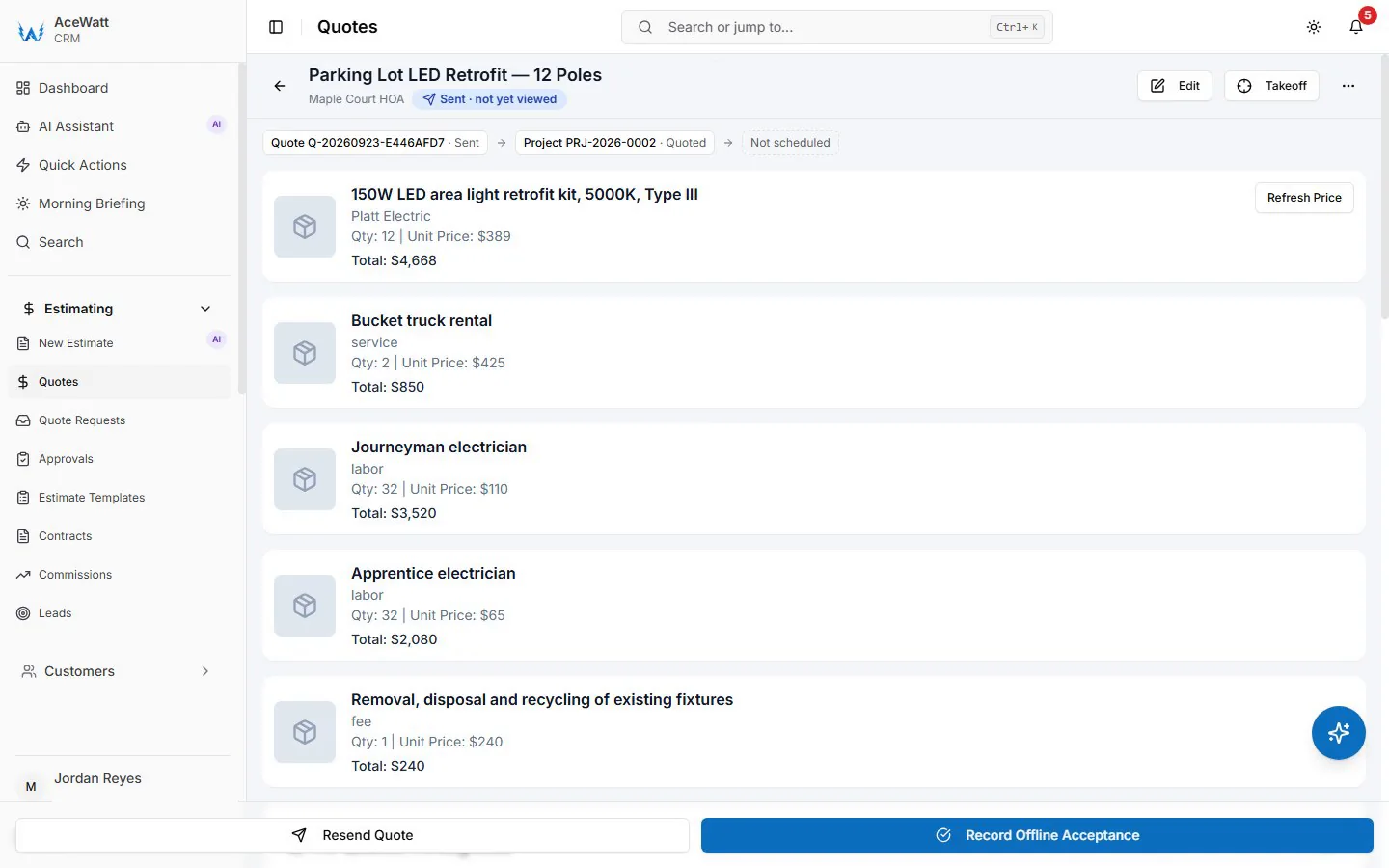
- Deposit invoice: emailed with a pay link when the customer accepts the quote
- Final invoice: created from the accepted quote's line items and emailed automatically (as the balance after a deposit, if you took one), with no re-typing
- Invoice delivery by email with a pay link, due date, and project reference
- Overdue flag: unpaid invoices are marked overdue and show up in the aging report
- Overdue reminders: Automated Follow-Up emails the customer at 1, 7, 14 and 30 days late
Payment cycles shorten.
AI Voice extends beyond job walks. Technicians dictate:
- Safety observations: "GFCI tripping on circuit 14, shared neutral violation of 210.4(B)."
- Material changes: "Swapped 12/2 for 12/3 for a multi-wire branch circuit."
- Inspection notes: "Rough-in passed. Inspector flagged NM cable support spacing per 334.30."
These become searchable, timestamped project records, which are critical for warranty disputes, callback defense, and insurance audits.
Job Tracking, Invoicing, and QuickBooks-Ready Exports for Growing Electrical Shops
A growing electrical shop lives or dies by job costing. Did the tenant improvement run 12 percent over on labor? Was the generator install profitable after the concrete subcontractor's change order? Which foreman consistently hits estimated hours?
Ace Watt's Job Tracking captures real-time labor versus budget by phase (rough-in, trim-out, service, low-voltage), material usage versus estimate, and change order impact. Field crews log time against the job on mobile. Project managers see variance dashboards daily, not at month-end close.
Invoicing and Payment Tracking eliminates double entry:
- Milestone (percentage-of-completion) billing on projects
- Accepted quotes are invoiced and emailed automatically (a deposit invoice first, if the quote asks for one), with the quote's line items copied
- Customers pay online by card, or by ACH when your Stripe account has it enabled
- Overdue invoices are flagged, with an aging report from 0–30 to 120+ days
QuickBooks-Ready Exports give your bookkeeper your invoice list as a spreadsheet and your payroll hours as a QuickBooks-format CSV. There is no native, real-time, bidirectional sync today; full sync is in development. The bookkeeper works from a spreadsheet instead of paper tickets, and job-level labor and material variance stays visible in Ace Watt's Job Tracking.
What to Look for in Dispatch Software for Electricians
Not every platform marketed as dispatch software for electricians delivers what the trade actually needs. Evaluate against these criteria:
| Capability | Why It Matters for Electrical Contractors |
|---|---|
| License-aware scheduling | Prevents illegal crew assignments and tracks continuing education expirations |
| NEC-aligned job templates | Rough-in, service, trim-out, fire alarm, and solar scopes, each with the correct inspection sequence |
| Material assemblies | Pre-built BOMs for common scopes: 200A panel swap, 40-circuit subpanel, EV charger, generator transfer switch |
| Permit jurisdiction data | Auto-populates fees, inspection types, and lead times by jurisdiction |
| AI estimating from voice and photo | Reduces estimate cycle from days to hours and captures field conditions accurately |
| Line-level QuickBooks handoff (bookkeeper-owned export) | Eliminates re-typing and preserves job costing integrity |
| Mobile field app with offline mode | Works in basements, mechanical rooms, and rural sites without cell signal |
| Multi-location and multi-entity support | Handles shops with service, construction, and low-voltage divisions or multiple branches |
How Ace Watt Helps US Electrical Contractors Scale Profitably
Scaling an electrical business is not about adding trucks. It is about adding profitable trucks. That requires consistent estimating so every bid covers overhead and target margin, efficient dispatch so billable hours stay high and windshield time stays low, visible job costs so problems surface mid-project instead of at closeout, faster cash flow so payroll and material accounts stay current, and documented compliance so callbacks, disputes, and audits never become emergencies.
Ace Watt delivers all of it as a unified platform, not a patchwork of point solutions held together by Zapier and hope. One login. One database. One workflow from lead to final payment.
The trade is evolving toward EV infrastructure, solar plus storage, building electrification, smart panels, and microgrids. The contractors who win this decade will run on software that understands electrical work.
Ace Watt is that software.
Ready to see how Ace Watt fits your shop? Schedule a live demo with an electrical workflow specialist (not a generic sales rep) and bring your current scheduling board, estimate spreadsheet, and QuickBooks file. We will show you the difference.