

T&M, Fixed Price, and the Hybrid Jobs In Between: How Electrical Contractors Should Bill in 2026
Why Electrical Contractors Bill Both Ways: T&M Service Calls and Fixed-Price Projects in 2026
Most electrical shops do not choose between time and material and fixed price. The work chooses for them. A no-power call on a 1970s ranch, an intermittent trip on a shared kitchen circuit, a ground fault somewhere in 200 feet of buried feeder: these are unknowns, and you cannot responsibly quote a fixed price on a fault you have not found yet. So diagnostic and repair work bills T&M. Meanwhile, panel upgrades, EV charger circuits, recessed lighting packages, and generator transfer switches have a defined scope, and homeowners want a number before you start. Those jobs get quoted fixed price or pulled from a flat-rate book.
The flat rate versus time and material debate in electrical work is really a debate about information. The more you know about scope, the more fixed price makes sense. In 2026 that tension is tighter than ever: copper and device pricing are still volatile, customers expect price certainty, and the 2026 NEC is entering state adoption cycles on top of expanded GFCI and AFCI requirements many jurisdictions adopted from the 2023 code. Shops that bill both ways, often on the same job, need one system that handles both. That is exactly what we built our platform to do.
The Double-Entry Problem: When Estimating, Job Tracking, and Invoicing Live in Separate Systems
Here is the setup at a lot of growing shops: the estimate lives in a spreadsheet, crew hours arrive by text message, material receipts ride around in the truck, and the invoice gets typed into a separate app three to six days after the job closes. Every handoff between those systems is a leak, and the leaks are measurable.
- Unbilled labor. Techs round down. A 15-minute material run, a phone call with the inspector, 20 minutes cleaning up the panel: three unlogged hours per tech per week at a $120 service rate is roughly $18,700 a year per technician.
- Missed material markup. Breakers, devices, and wire pulled from van stock get forgotten at invoice time. Miss the markup on $400 of weekly materials at 30 percent and you have lost more than $6,000 a year.
- Change orders that never invoice. A verbal "yes, go ahead and fix that too" from the homeowner, with no document and no signature, is a change order that vanishes. One lost $650 add-on per month is $7,800 a year.
Add those up for a two-tech shop and you are past $50,000 a year in leakage, before you count the added days to payment caused by reconstructing jobs after the fact. The problem is not your techs. The problem is asking humans to rekey the same data across four disconnected tools.
How T&M Billing Should Work for Electricians: Labor Rates, Material Markup, and Trip Charges
Well-run T&M service billing is not improvised arithmetic on the tailgate. It is a rate structure, and it looks like this in most US markets: a trip or diagnostic charge of $99 to $195, a one-hour minimum, billing in 15-minute increments after the first hour, an after-hours multiplier of 1.5x to 2x, and material markup of 20 to 35 percent, often with a minimum line charge of about $10 so a $2.49 receptacle does not get sold at cost.
Our platform handles part of that structure. Because Job Tracking captures clock-in and clock-out on the job from the technician's phone, a T&M ticket pulls logged crew hours automatically instead of asking the office to guess. Material lines are logged at cost (markup is set on quotes, not applied automatically on the invoice), the trip charge and any after-hours premium go on as their own lines, and the office builds the invoice from the job record with a button the same day, without anyone rekeying an hour count. Techs never price from a calculator; they sell from the price book, which protects both margin and consistency, and it keeps your revenue categories clean downstream in QuickBooks.
Fixed-Price and Flat-Rate Electrical Work: Turning AI Estimates Into Signed Proposals
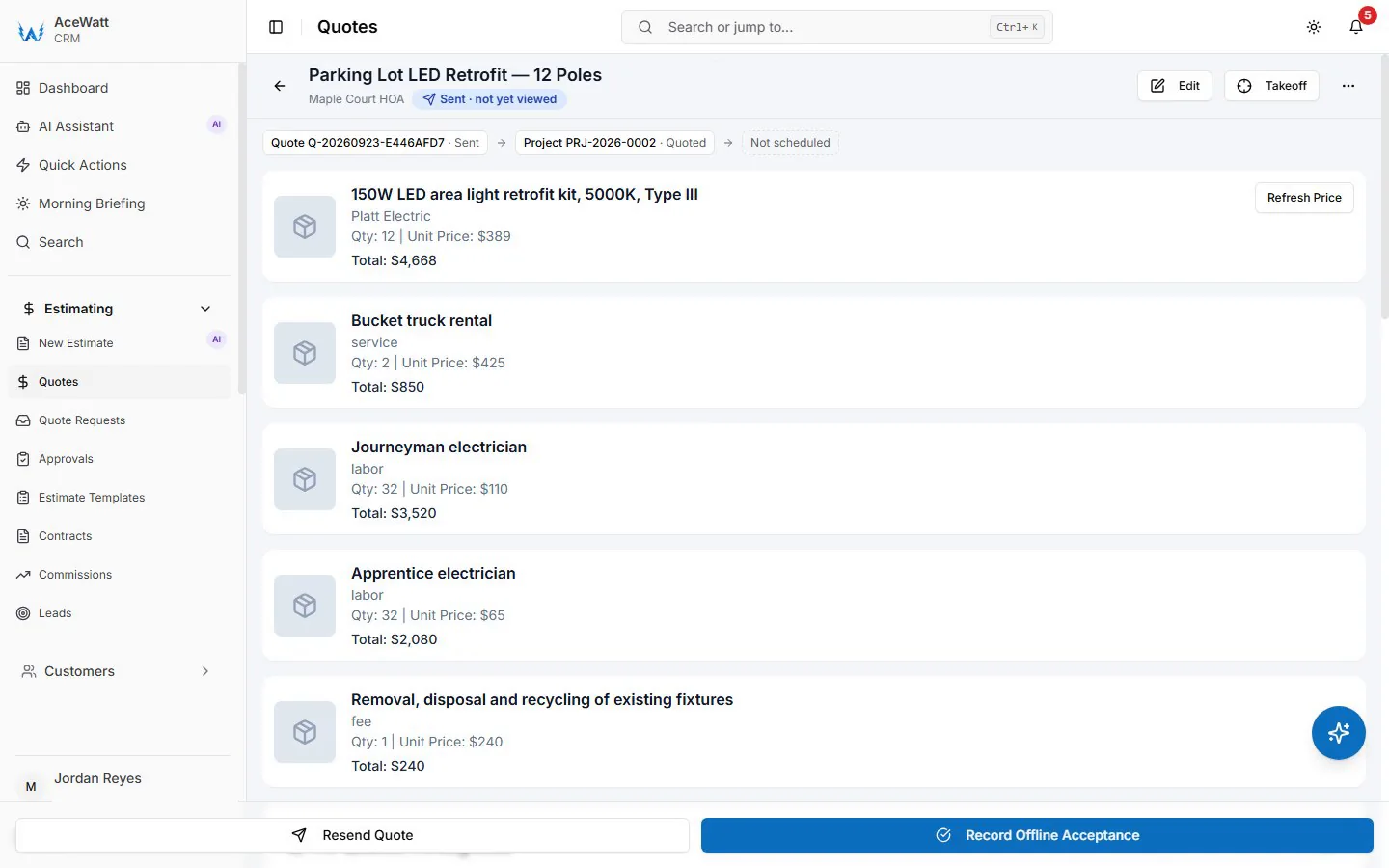
Fixed-price work lives or dies on the estimate, and this is where electrical estimating software earns its keep. Our AI Estimating builds quotes from material and labor assemblies rather than blank templates. A 200A panel upgrade assembly, for example, carries the loadcenter itself (a 40-space main breaker panel runs roughly $300 to $700 depending on brand), permit and inspection fees that commonly run $150 to $350, 8 to 12 labor hours, grounding electrode conductor work to current code under NEC 250.53, and circuit re-identification per NEC 408.4. The quote lands at $2,800 to $4,800 in most metros, higher if the service entrance needs work.
On the residential flat-rate side, common tasks like receptacle replacements, ceiling fan installs, and lighting swaps come off the same book. The estimate converts to a proposal the customer signs on site, with a deposit of 30 to 50 percent collected before material is ordered. Because the estimate and the job record are connected, the materials and hours estimated are the same ones tracked and invoiced. No rekeying between the quote and the invoice, which is precisely where standalone estimating spreadsheets fall apart.
Hybrid Jobs: When a T&M Troubleshooting Call Becomes a Fixed-Price Panel Upgrade
Every electrician knows this job. You are dispatched T&M for a dead circuit. The tech logs an hour and a half tracing it, narrating findings as they go, and lands on the real problem: a Federal Pacific Stab-Lok panel with a burned breaker terminal. Now the job forks. The customer does not want more T&M to patch a known fire hazard. They want a price to replace the panel.
This is the hybrid scenario most electrical contractor time and material billing software fails at, because the systems were never designed to hold two billing methods on one job. In our platform, it works the way the job actually happens: the T&M diagnostic hours convert to a diagnostic fee, commonly credited toward the approved work, and a fixed-price panel replacement proposal is generated from the assembly, presented, and signed on the spot. One job record, two billing methods, deposit collected before the crew leaves.
Change orders get the same treatment. Open a wall and find knob and tube, or replace a receptacle that now requires GFCI protection under NEC 406.4(D): the tech documents it with our AI Voice job walk, prices it from the assembly, and logs the change order for internal approval before the work proceeds. Documenting and invoicing scope changes before the truck leaves is the entire job electrical change order software exists to do, and ours does it inside the same job record.
Field-to-Office Flow: AI Voice Job Walks, Crew Time Capture, and Automated Follow-Up
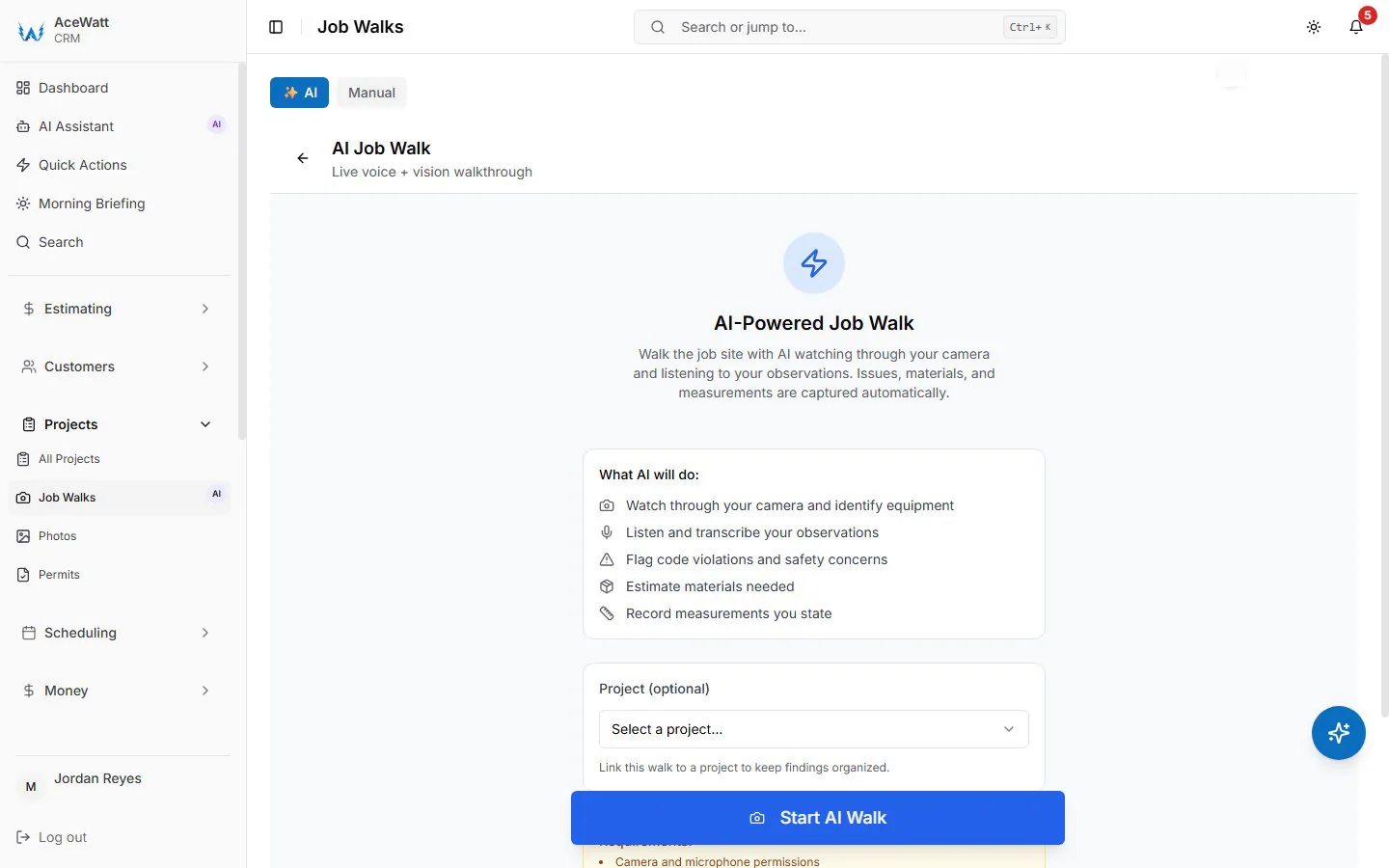
Hybrid billing only works when the field captures what actually happened. Our AI Voice and Job Walk Documentation lets a tech stand at the panel and speak: "200-amp Stab-Lok, corrosion on the neutral bar, grounding electrode conductor is a number 8 to the water pipe, two double-tapped breakers." That narration, with timestamped photos, is attached to the job record as documentation of conditions and scope. It is what backs up a T&M extra months later and what justifies a fixed-price change order before anyone approves it.
Crew Scheduling and Dispatching gets the right tech to the right job, time capture ties their hours to that job automatically, and Invoicing and Payment Tracking closes the loop with deposit invoices, online card payment, and final payment. Automated Follow-Up then does the work nobody has time for: reminding on overdue invoices by email at 1, 7, 14 and 30 days late. For a solo electrician, that means payment reminders go out while you are already under the next panel.
QuickBooks Sync: Clean Job Costing for T&M Hours and Fixed-Price Revenue
Accounting software for electrical contractors only works when the field data feeding it is clean. Our QuickBooks-ready exports support the ledger across both billing models — and to be plain about it, the handoff today is your invoice list as a spreadsheet and your payroll hours as a QuickBooks-format CSV for your bookkeeper, not a native, real-time, bidirectional sync; full sync is in development. Your bookkeeper still books T&M hours as time-billed revenue, material lines as material sales, and fixed-price deposits as customer deposits, a liability, until the final invoice recognizes the revenue.
The payoff for the owner is job costing that actually reflects the business. Revenue versus labor and material costs, per job, across T&M and fixed-price work side by side, side by side in the app instead of a month-end reconciliation of spreadsheets. QuickBooks stays what it is good at, the ledger, and the field system runs the jobs. That division of labor is what "QuickBooks for electrical contractors" should mean in practice.
2026 Checklist: What to Demand From Electrical Contractor Billing Software
A standalone electrician invoice app can send a PDF. That is no longer enough. When you evaluate job management software for electricians in 2026, demand all of the following:
- One job record that supports T&M lines and fixed-price lines on the same job, including mid-job conversion
- Field time capture tied to the job, not hours reconstructed in the office
- Material markup rules and a pre-priced book so techs never price from a calculator
- AI estimating built on electrical assemblies, not blank templates
- Change order creation, documentation, and on-site signature before the crew leaves
- AI voice job walk documentation with photos attached to the job record
- Deposits, progress billing, payment tracking, and card on file
- Automated follow-up on estimates and outstanding invoices
- QuickBooks integration with job-level costing across both billing models (line-level exports or two-way sync)
- Scheduling, dispatch, CRM, and estimating under the same roof as billing
If a vendor cannot check a box, find out exactly how that step gets done instead. Ours, for example, approves change orders internally, sets material markup on the quote, chases only overdue invoices automatically, and hands your bookkeeper QuickBooks-ready exports rather than a two-way sync. The shops winning in 2026 are not working harder per hour. They are running both billing methods, and every hybrid job in between, through one connected system.