The Ultimate Guide to Building a Comparison Content Hub That Converts
What Is a Comparison Content Hub?
When consumers or businesses are on the verge of making a purchase, they inevitably ask one question: "Which option is right for me?" They head straight to Google, typing in queries like "Option A vs. Option B" or "best tools for [specific job]." This is where a comparison content hub comes into play.
A comparison content hub is a centralized, highly organized library on your website that focuses exclusively on side-by-side product, service, or methodology evaluations. Instead of scattering these evaluations randomly across your blog, a hub brings them together into a cohesive, easily navigable ecosystem. By using a structured comparison content strategy, brands can position themselves as the ultimate, objective resource for buyers, capturing bottom-of-funnel search demand exactly when the user is ready to pull out their credit card.
Why Comparison Content Drives High-Intent Traffic
Not all website traffic is created equal. A top-of-funnel blog post titled "What is CRM software?" might generate thousands of views, but those readers are in the research phase. Conversely, traffic driven to your product comparison pages consists of high-intent searchers.
When users search for "vs." queries or "alternatives," they have already identified their problem, know what category of solution they need, and are simply deciding which specific product to buy. By targeting high-intent keywords, you are intercepting the user at the exact moment of decision. Ranking for these bottom-of-funnel queries naturally drives conversions because you are providing the exact information the user needs to make a final purchase. Vs. content SEO is also highly effective because these pages typically boast lower competition and higher conversion rates than broad, generic industry terms.
Planning Your Hub: Topics, Audiences, and Search Intent
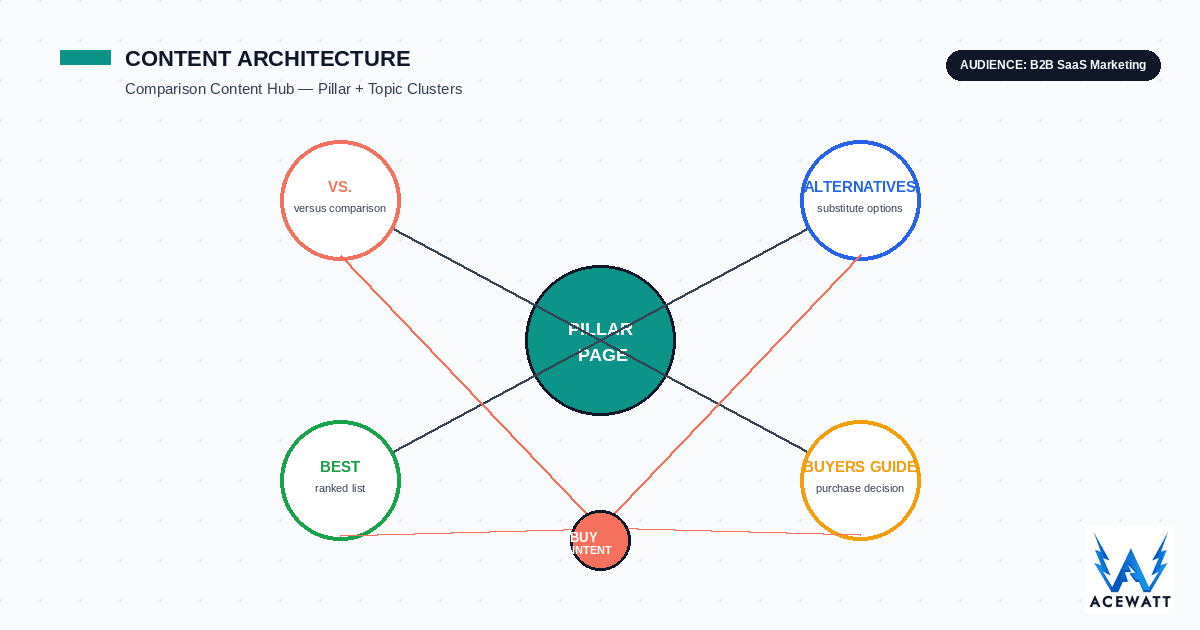
Before you write a single word, you need a blueprint. Successful comparison hubs require careful planning. Start by mapping your content to specific search intents. Buyers generally fall into four distinct query categories:
- "Vs." Queries: (e.g., Your Brand vs. Competitor). The user is comparing two specific solutions head-to-head.
- Alternatives Content: (e.g., Top Alternatives to Competitor). The user is frustrated with a current tool or pricing and is actively looking to switch.
- "Best" Queries: (e.g., Best Solutions for X Industry). The user knows their use case but wants a categorized list of top contenders.
- Buyers' Guides: (e.g., How to Choose an X). The user knows they need a solution but requires help understanding features and pricing models.
Understanding your audience's pain points within these categories is vital. If you sell project management software, your "vs." queries should target your closest competitors, while your "best" queries should segment by industry (e.g., "Best project management tools for marketing agencies").
Structuring the Hub: Pillar Pages, Clusters, and Navigation
To maximize your search engine visibility, you must build your hub using the pillar page structure and topic clusters model. This architecture signals to search engines that your site is an authoritative source on a specific subject.
Here is how to organize it:
- The Pillar Page: This is the core of your hub. It acts as the central directory, offering a high-level overview of the entire category and linking out to the more specific cluster pages.
- Topic Clusters: These are the individual comparison pages (your "vs." and "alternatives" pages) that live beneath the pillar page. They dive deep into the nuances of specific comparisons.
- Navigation: Users must be able to find what they are looking for in seconds. Use clear dropdown menus, sticky sidebars, and interactive filters that allow users to sort comparisons by price, industry, or feature set.
If you look at successful content hub examples from leading SaaS companies, you will notice they all share this highly structured, user-centric architecture.
Creating Comparison Content That Converts
Once your structure is set, it is time to scale your content creation. The secret to scaling efficiently is a standardized content hub template. Using a consistent template ensures fairness, readability, and scalability across all your comparisons.
A high-converting comparison page should include:
- A Concise Executive Summary: Tell the user immediately who each tool is best for. Don't bury the lede.
- Feature-by-Feature Breakdown: Highlight the strengths and weaknesses of each option. Objectivity is crucial here; if you shamelessly plug your own product without acknowledging a competitor's genuine strengths, you will lose the reader's trust.
- Pricing Transparency: Clearly outline how pricing tiers work for each option.
- The Final Verdict: Offer a clear recommendation based on different use cases (e.g., "Choose Option A for budget-conscious teams, and Option B for enterprise scalability").
By maintaining an unbiased, helpful tone, you build brand trust. When consumers trust your content, they are highly likely to choose your product if it fits their needs.
SEO Best Practices for Comparison Hubs
Creating great content is only half the battle; the other half is ensuring search engines can find, crawl, and rank it. To optimize your hub:
- Target Featured Snippets: Google loves comparison pages for generating quick answers. Optimize for featured snippets by placing clear HTML comparison tables high up on the page. Keep the formatting clean and use concise summaries to answer the "who is better" question directly.
- Implement Schema Markup: Use Product and Review schema markup to ensure rich snippets appear in search results, making your links more clickable.
- Optimize Metadata: Craft title tags and meta descriptions that directly address the search query. For example, instead of "Comparing Tool A and Tool B," use "Tool A vs. Tool B: Which is Better in 2024?"
Internal Linking and UX Considerations
A content hub is only as strong as its internal web of links. Strict internal linking best practices ensure that link equity flows from your high-authority pillar pages down to your cluster pages, and vice versa. Ensure every comparison page links back to the main pillar, and that related comparison pages link to one another (e.g., a "Best CRM" page should link to "HubSpot vs. Salesforce").
User experience (UX) plays a massive role in conversion rates. Implement breadcrumbs so users always know where they are within the hub. Use a sticky table of contents on longer buyers' guides so users can easily jump to the sections they care about. Finally, include clear, compelling Call-to-Action (CTA) buttons. If a user reads a comparison and decides your product is the winner, make it frictionless for them to start a free trial or contact sales immediately.
Once your pages are ranking organically, maximize their reach by promoting the hub across email newsletters, social media channels, and partner networks. This diversified traffic signals continuous value to search engines.
Measuring Success: KPIs and Iteration
The digital landscape is constantly shifting. Competitors update their pricing, new players enter the market, and search algorithms evolve. To ensure your comparison content strategy remains effective, you must relentlessly track your performance and iterate.
Focus on these Key Performance Indicators (KPIs):
- Organic Traffic Growth: Monitor how much organic traffic is flowing to your cluster and pillar pages.
- Conversion Rate: Track how many users click your CTA or sign up for a demo after reading a comparison.
- Keyword Rankings: Monitor your positioning for target high-intent keywords.
- Engagement Metrics: Keep an eye on bounce rate and time-on-page to gauge if your content is genuinely satisfying user intent.
Comparison content is not a "set it and forget it" asset. Schedule quarterly audits to update outdated pricing, add new features, and refresh your insights. By continually refining your approach and keeping the user's needs at the center of your strategy, your comparison content hub will become a tireless, 24/7 revenue engine for your business.