

FSM Software for Electrical Contractors in 2026: The Complete Comparison for Shops From Solo to 10 Techs
Most shops evaluating FSM software for electrical contractors in 2026 are not shopping for a generic field service tool. You are looking for electrical estimating software that handles material volatility, an electrical invoice app that bills time and material correctly, and a dispatch board that gets the right license holder to the right job. This guide compares the platforms electricians actually evaluate, including ServiceTitan, Jobber, Housecall Pro, and Service Fusion, against the capabilities we build into our own platform, so you can match features to your shop size and specialty.
What FSM Software for Electrical Contractors Actually Covers in 2026
Field service management stopped being a digital work order folder years ago. For an electrical shop in 2026, the core stack covers five connected functions:
- CRM and lead management. Every call, web form, and Google Local Services lead lands in one pipeline with source tracking and instant response, so a $900 panel inspection lead never sits overnight in an inbox.
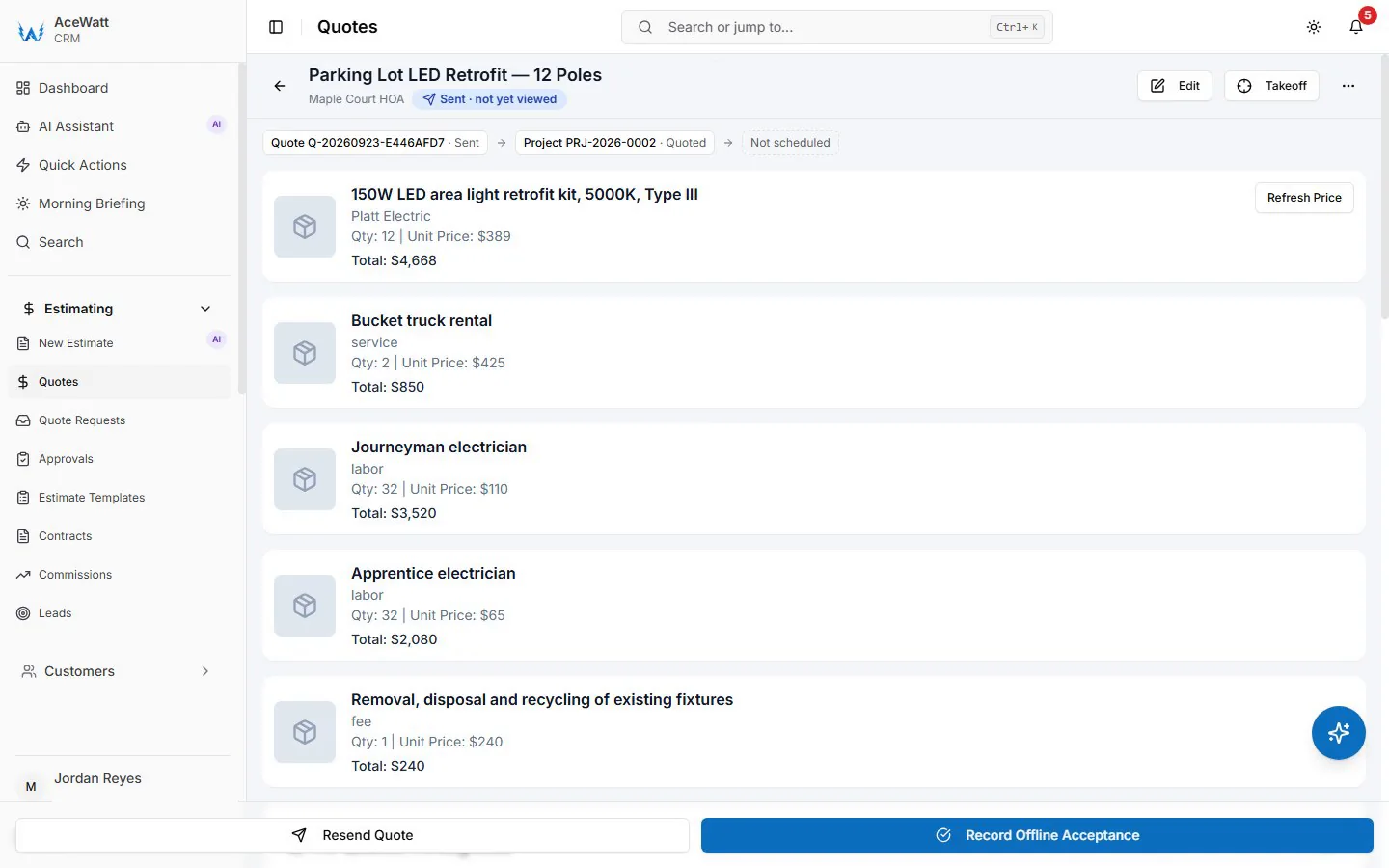
- Estimating. Job walk details convert into priced estimates using labor-hour assemblies and current material costs, not last year's spreadsheet prices.
- Crew scheduling and dispatching. A live board that accounts for licenses, certifications, service area, and drive time, not just who is free.
- Job tracking. Check-in and check-out timestamps, job status, photos, and notes that feed directly into billing.
- Invoicing, payment tracking, and accounting sync. Invoices built from tracked time and materials, deposits collected at quote acceptance, and accounting integration that eliminates double entry, whether through line-level exports or true two-way sync.
The platforms below cover these functions with very different depth. That difference is where the buying decision gets made.
How We Evaluated the Top FSM Platforms for Small Electrical Crews
We scored each platform against seven criteria weighted for shops with one to ten technicians:
- Electrical estimating depth: labor-hour assemblies (panel upgrades, EV charger circuits, romex pulls), material price updating, and quote turnaround speed.
- Dispatch precision: drag-and-drop scheduling, tech skill and license tagging, GPS tracking, and geofenced check-in.
- T&M billing: whether dispatch and job tracking timestamps automatically populate invoice labor lines.
- QuickBooks integration: native two-way sync versus one-way export versus CSV workaround.
- AI documentation: on-site voice capture of panel conditions, code violations, and load calculations.
- Mobile usability: one-handed operation, glove-friendly screens, offline capture in basements and attics.
- Pricing transparency: published rates versus quote-only sales processes that favor larger contractors.
Estimating Compared: AI-Powered Electrical Estimating Software vs. Static Templates and Spreadsheets
Electrical estimating fails for three trade-specific reasons, and most platforms address none of them.
Material price volatility. Copper wire pricing can swing by double digits between quarterly price book updates. A #12 THHN circuit estimated from a spreadsheet built eight months ago can lose money on every pull of a whole-house rewire. Our AI Estimating pulls from your maintained price book and flags material lines that need a cost refresh before the quote goes out.
Labor-hour assemblies. Accurate electrical estimates are built from assemblies, not line-item guessing. A 200A service upgrade is typically 8 to 12 labor hours including the meter can swap, grounding electrode conductor work, and inspection, plus gear. A 48A Level 2 EV charger install is a 60A branch circuit sized to 125 percent of the continuous load per NEC 625, typically #6 copper THHN, and a load calculation per NEC 220.87 on existing dwellings, which drives 3 to 4 hours when the panel has capacity and more when it does not. Our platform stores these assemblies with your labor rates and material costs so the math is consistent across every estimator and every tech.
Turnaround speed. Bid work tolerates a one to three day turnaround. Service calls do not. The homeowner standing in the garage wants a priced option sheet before the tech leaves. With AI Estimating, the details captured during the job walk, panel brand, available spaces, load calculation results, become a draft quote for your review in minutes. Following up on quotes that go silent is still on you, and it is where most small shops quietly lose 20 to 40 percent of their quote volume; Automated Follow-Up covers overdue invoices, with email reminders at 1, 7, 14 and 30 days late.
ServiceTitan offers a strong price book but is priced and implemented for larger operations. Jobber and Housecall Pro provide solid quote templates with limited assembly logic. Static spreadsheets provide none of the above and depend entirely on whoever last updated them.
Scheduling and Dispatch Compared: Getting the Right Electrician to the Right Job
Electrical dispatch software has a constraint most trades do not: the license on the truck matters. A service upgrade in most jurisdictions requires a master or journeyman electrician on site. An EV charger install on a commercial property may need a tech with specific certifications. Our Crew Scheduling and Dispatching lets you tag each technician with skills and specialties, and the drag-and-drop board offers skill-based suggestions; it does not check license class, so confirming a qualified tech on a 200A service change stays with you. Drag-and-drop rescheduling, straight-line route optimization on the Scale plan, and clock in/out from the phone with location and an at-the-job-site flag round out the dispatch picture.
ServiceTitan's dispatch board is the industry benchmark for multi-crew shops. Service Fusion includes GPS tracking at a competitive price. Jobber and Housecall Pro handle scheduling well for residential service but offer lighter skill-based assignment. For a one to ten tech shop, the deciding factor is usually whether license and certification logic is native or handled with color-coded sticky notes in the notes field.
Invoicing Compared: Time and Material Billing, Deposits, and the Electrical Invoice App
Time and material billing is where electrical work punishes generic invoicing tools. T&M done correctly means the customer is billed labor from the moment the tech clocks in at the site to the moment they clock out, with materials pulled from the same price book used to estimate. On our platform, techs clock in and out from the phone with location and an at-the-job-site flag, so those hours and the material entries are on the job record when you build the invoice. There is no separate timecard, no end-of-day reconstruction from memory, and no padding arguments with the customer because the record shows itself.
Deposits matter equally. Before you order a 200A meter main combo or a subpanel for an addition, you should be holding a deposit. Our Invoicing and Payment Tracking lets you collect a deposit at quote acceptance by card (or ACH, if your Stripe account has it enabled), then tracks the balance against job progress so nothing closes out with money outstanding.
The accounting side is where shops feel the most pain. QuickBooks remains the accounting software for electrical contractors by a wide margin, and most FSM platforms either push data one way or hand you a CSV export. Our QuickBooks handoff today is QuickBooks-ready exports: your invoice list as a spreadsheet and your payroll hours as a QuickBooks-format CSV for your bookkeeper. There is no native, real-time, bidirectional sync today. When a customer pays by card through the invoice's pay link, the payment is recorded against the invoice in the app, and its balance shows on the exported invoice list.
Job Tracking and Documentation Compared: AI Voice Notes and Job Walk Records
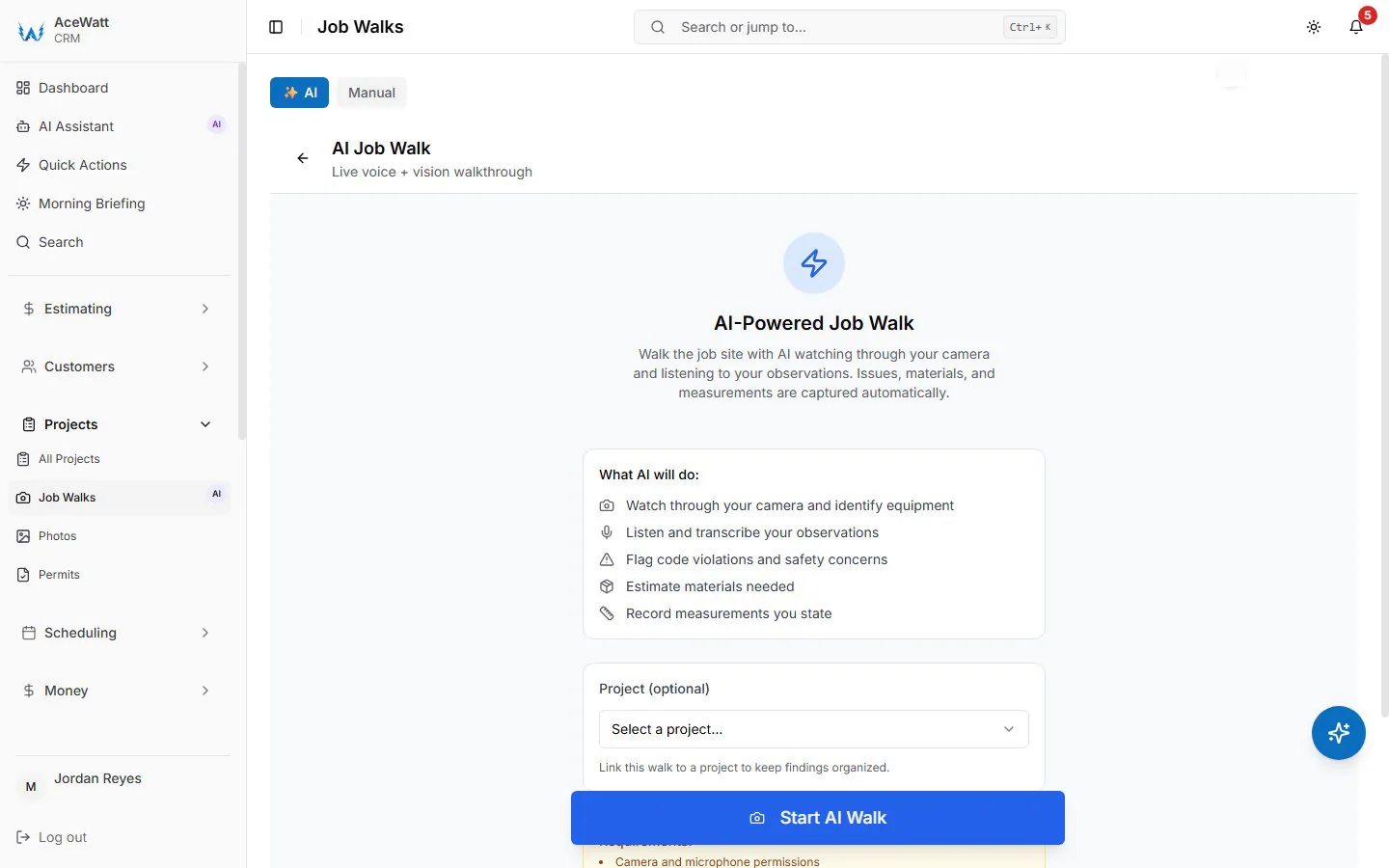
This is the capability gap in 2026. ServiceTitan, Jobber, Housecall Pro, and Service Fusion all track job status. Almost none of them capture what the tech actually found, in the tech's own words, structured into a usable record.
With our AI Voice and Job Walk Documentation, the tech narrates findings on site: panel brand and condition, double-tapped neutrals violating NEC 408.41, missing AFCI protection under NEC 210.12, GFCI gaps under 210.8, aluminum branch wiring, Zinsco or Federal Pacific Stab-Lok panels that insurers flag. The AI converts the narration into a structured job record with photos, load calculation figures, and recommended corrections, priced from your assemblies.
Two things happen as a result. Change orders stop being a hard conversation, because the documented violation plus the priced correction sells itself. And disputes end differently, because when a homeowner claims months later that nobody told them about the panel, the record shows a timestamped voice note from their own property. That documentation is the closest thing this trade has to insurance you write yourself.
Head-to-Head FSM Comparison Table for Small Electrical Shops (Solo to 10 Techs)
| Platform | Pricing Model | Electrical Estimating Depth | Dispatch Features | QuickBooks Integration | AI Documentation |
|---|---|---|---|---|---|
| ServiceTitan | Quote-based, per tech, premium tier with onboarding fees | Strong price book and assemblies, built for larger shops | Full dispatch board, GPS, skill assignment | Native sync, strongest for enterprise accounting | Limited |
| Jobber | Published plans, roughly $40 to $200 per month | Quote templates, limited assemblies | Drag-and-drop, good for residential service | Native one-way push | Limited |
| Housecall Pro | Published plans starting near $50 per month | Template-based quoting | Solid scheduling, lighter skill tagging | Native sync | Emerging |
| Service Fusion | Flat-rate plans including unlimited users, starting in the low hundreds | Price book estimates, moderate depth | GPS tracking, capable board | Native sync | Limited |
| Our platform | Transparent tiers built for small and growing shops | AI Estimating from job walk input, labor-hour assemblies, material price flags | Drag-and-drop board with skill-based suggestions, clock-in with location | Invoice-list spreadsheet and payroll-hours CSV; no native sync yet | AI Voice and Job Walk Documentation, panel and code-violation records |
Published pricing reflects vendor rates as of early 2026. Confirm current figures directly with each vendor before deciding.
How to Choose the Right FSM Software by Shop Size and Specialty
Solo electricians. Your bottleneck is evening paperwork, not crew logistics. Prioritize AI Estimating, the electrical invoice app with T&M automation, and QuickBooks sync. Automated Follow-Up matters more than you think: solo shops lose money simply because there is no time to chase overdue invoices.
Shops with 2 to 5 techs. Dispatch becomes real. You need job management software for electricians with license-aware scheduling, job tracking timestamps feeding invoices, and documentation that keeps every tech's work consistent.
Shops with 6 to 10 techs. Reporting, follow-up automation, and documentation across crews become the priority. This is where the best electrical software tools for scheduling and dispatch separate from basic calendar apps, and where ServiceTitan becomes a legitimate comparison on depth, if not on price.
By specialty. Residential service shops live on quote speed and follow-up. Commercial and bid work live on assembly-based estimating and change order documentation. New construction focuses on job costing and labor-hour tracking. Our platform is built for the small and growing electrical shop across all three, which is exactly the segment the larger platforms price out.
FAQ: What Electricians Ask Before Switching FSM Software in 2026
Can I migrate customers and estimates from spreadsheets or another platform? Yes. Customer records, price books, and open estimates import during onboarding, and our team runs the migration with you rather than handing you a CSV template and wishing you luck.
Does the QuickBooks sync work both ways? Not today, and we say that plainly. What ships now is QuickBooks-ready exports: your invoice list as a spreadsheet and your payroll hours as a QuickBooks-format CSV for your bookkeeper. Native two-way sync is in development.
What happens in a basement with no cell service? Clock in/out, new leads, field notes, expenses and project notes queue offline and send when signal returns; the rest of the app, including photos, needs a connection. Those notes are not lost to a dead zone under a house.
Is implementation a months-long project? For a solo or small crew shop, most are running estimates and invoices within the first week. Enterprise implementations measured in months belong to enterprise platforms.
See It Run on a Real Job Walk
The fastest way to evaluate any of this is to watch a job walk turn into a priced estimate, a dispatched tech, and a paid invoice. Book a 20-minute demo and bring your toughest recent job: a panel upgrade, an EV charger quote, a T&M service call that went sideways. We will run it through the platform live.
Explore the capabilities in depth: AI Estimating, Crew Scheduling and Dispatching, and Invoicing and Payment Tracking.
Comparing tools is easier when you can see the whole feature set side by side: start from the AceWatt features overview.