
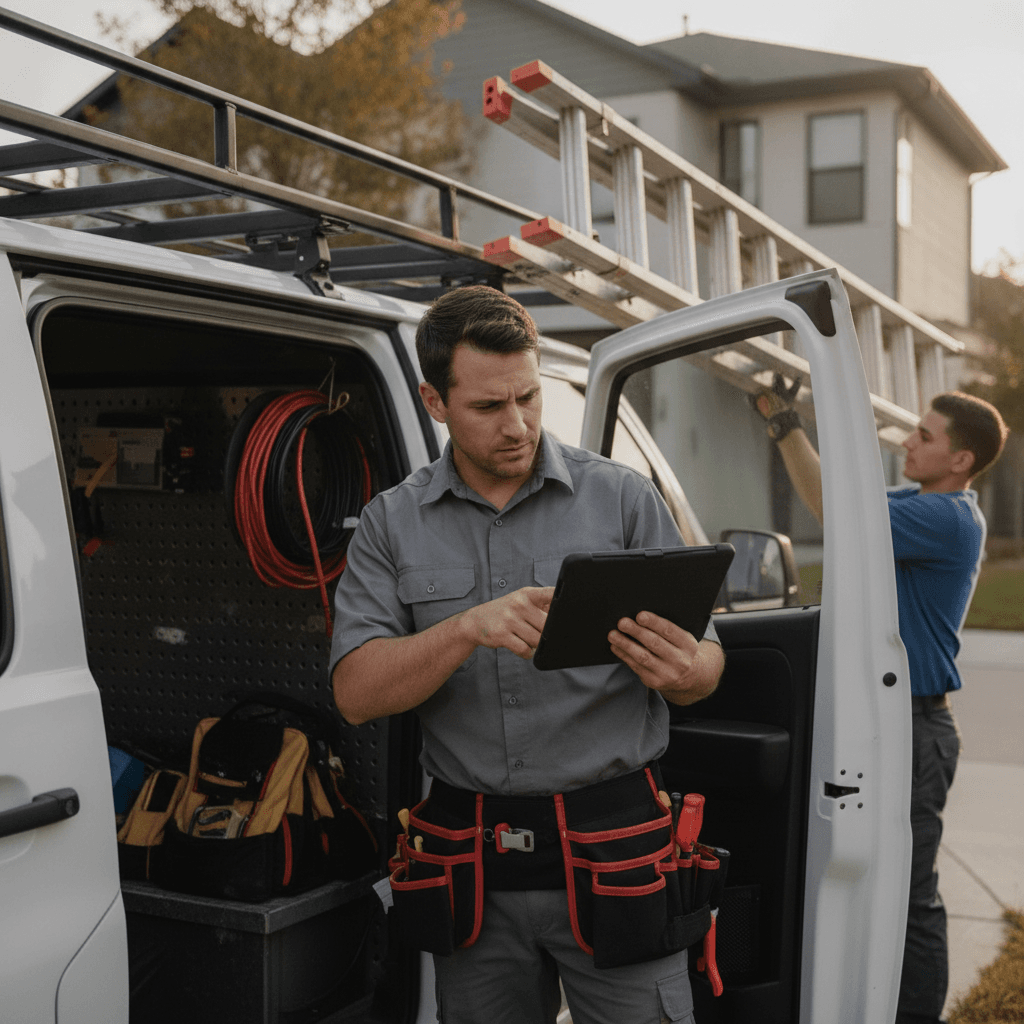
The Dispatching Dilemma: Balancing Licensed Electricians and Apprentices on the Job Site
Every electrical contractor knows the sinking feeling: a crew arrives at a commercial panel upgrade, the inspector shows up, and the apprentice running conduit is the only one on site with a valid journeyman card. The job shuts down. The GC calls. The margin evaporates.
This isn't a scheduling error, it's a compliance failure. And it happens because most shops still dispatch from a whiteboard, a group text, or a spreadsheet that doesn't know the difference between a Master Electrician license and an Apprentice registration number.
Navigating State Regulations: Journeyman-to-Apprentice Ratios and Code Compliance
The National Electrical Code (NEC) sets the baseline, but enforcement lives at the state and local level. California requires a 1:1 journeyman-to-apprentice ratio on commercial jobs. Texas allows 1:3 for residential but tightens to 1:1 for work over 600 volts. Florida mandates direct supervision by a certified contractor for any apprentice pulling wire. New York City? You need a Master Electrician on site for any permit pull, period.
Miss the ratio by one body, and the Authority Having Jurisdiction (AHJ) red-tags the project. That means:
- Failed inspection fees: $250, $750 per re-inspection depending on municipality
- Liquidated damages: $500, $2,000/day on commercial GC contracts
- License jeopardy: Repeat violations trigger board hearings, up to $10,000 fines and suspension in states like Illinois and Washington
Most contractors don't ignore ratios on purpose. They just can't see them in real time. A dispatcher juggling 12 trucks across three counties doesn't know that Jason's journeyman card expired last Tuesday, or that Maria's apprenticeship hours haven't been logged in six months.
Where Electrical Crew Scheduling Software Fits With License and Certification Tracking
The platform's Crew Scheduling and Dispatching feature handles the skills side of this: a drag-and-drop dispatch board with skill-based suggestions. It does not check licenses, ratios or expiry dates, so those stay on your own compliance list.
Keep these on your own compliance list, outside the dispatch board:
- License type: Master, Journeyman, Residential, Limited Energy, Apprentice (with year)
- State/county jurisdiction: which credentials are valid where the job site sits
- Expiration date: a reminder 90, 60, and 30 days out
- Continuing education status: CEU completion for states like Colorado (24 hours/3-year cycle) and Oregon (24 hours/2-year cycle)
- Specialty endorsements: Fire alarm (NICET), solar (NABCEP), EVSE (UL 2202), high-voltage splicing
When a dispatcher drags a 400A service upgrade onto the board, the skill-based suggestions help, but the dispatcher still confirms the lead has:
- Active Master or Journeyman license in that county
- No expiration within the project window
- Documented experience with gear from the specified manufacturer (Eaton, Square D, Siemens)
An apprentice can still be assigned, but only as a second body under a qualified lead, and only if the ratio math works for that jurisdiction. That check is yours; the software does not block the dispatch.
Simplifying Multi-Tech Dispatching for Residential and Commercial Electrical Projects
Residential service calls and commercial build-outs demand different dispatch logic. A panel swap in a 1960s ranch needs one journeyman + one apprentice (4, 6 hours). A 50,000 sq ft warehouse lighting retrofit needs three journeymen, two apprentices, and a foreman, phased over three weeks with material deliveries staged to the lift schedule.
The dispatching engine handles both:
- Service calls: Skill-based suggestions on the drag-and-drop board, with the live dispatch map (while the app is open) showing who is nearby
- Project crews: Builds multi-week crew plans with role-based slots (Foreman, JW, Apprentice 1, 4) and shift rules (8hr vs 10hr, per diem triggers)
- Emergency re-dispatch: When a tech calls out at 6:15 AM, you drag the job to someone else on the board, guided by skill-based suggestions rather than just the next warm body
For shops running both service and construction divisions, the board separates views but shares the labor pool. A journeyman finishing a generator install at 2 PM can roll to a trouble call at 3 PM, if his hours, license, and drive time all clear.
Connecting Dispatching to AI Estimating and Job Tracking for Seamless Operations
Labor is the single largest variable cost on any electrical bid. Master electrician at $145/hr fully burdened. Apprentice at $48/hr. Blend them wrong, and a $42,000 lighting retrofit bleeds $6,000 in labor overrun.
AI Estimating drafts the quote for your review from the job walk, photos, a typed description or the PDF plan set, pricing labor hours from your pricebook and assembly templates. Once the customer accepts, the dispatcher schedules from that scope. No "close enough" guesswork.
When the job ships to the field, Job Tracking ties actuals to the plan:
- Phase coding: Rough-in, trim, gear, testing, commissioning
- Daily logs: Foreman enters crew hours by task code via mobile, auto-synced to the schedule
- Variance alerts: If rough-in runs 18% over estimated hours at day 3, the PM gets flagged before the overrun hits payroll
This loop, estimate → dispatch → track → feedback → next estimate, is how shops move from 12% net to 18% net. The data compounds.
Improving Cash Flow: Linking Crew Schedules with Invoicing and QuickBooks-Ready Exports
Dispatching drives revenue recognition. If a crew completes a generator start-up on Friday but the work order sits on a clipboard until Wednesday, the invoice doesn't hit QuickBooks until Thursday. That's 5, 7 days of float on a $12,000 invoice.
The platform closes that gap:
- Field completion → Foreman taps "Job Complete" with photo sign-off
- Invoice from the quote → The accepted quote is invoiced and emailed automatically (a deposit invoice first, if you take one); materials are logged at cost, and markup is set on the quote
- QuickBooks-Ready Exports → Invoice list (status, total, balance, due date) as a spreadsheet for your bookkeeper; full sync in development
For commercial jobs, milestone (percentage-of-completion) billing does the work. When "Gear Installation" hits its milestone in Job Tracking, the PM bills that percentage, reviews, and sends, same day.
Enabling Growing Electrical Shops with Automated Follow-Up and AI Voice Documentation
The job isn't done when the crew leaves. It's done when the permit closes, the warranty is registered, and the referral arrives.
Automated Follow-Up covers one thing today: email reminders on overdue invoices at 1, 7, 14 and 30 days late. The rest of the after-job sequence is yours to run:
- Residential service: 48-hour satisfaction text → 30-day review request → 11-month panel health check reminder
- Commercial: Punch list completion → O&M manual delivery → 1-year thermal imaging upsell
- Generator/EVSE: Commissioning report → Annual maintenance contract proposal (recurring revenue)
AI Voice and Job Walk Documentation captures the site reality before the estimate. The estimator walks the 200A panel upgrade, speaks into the app: "Federal Pacific Stab-Lok panel, 12 circuits active, 2-inch SE cable, meter base rusted, needs utility coordination." The AI transcribes, structures, and attaches to the job, creating a report with a materials list that AI Estimating can turn into a draft quote for your review.
No more "I forgot to measure the conduit run" change orders. No more "customer said they had a 200A service but it's actually 100A" surprises. The dispatcher sees the same data the estimator saw, and schedules the right crew with the right gear the first time.
Electrical contracting margins are won in the field, but they're protected in the dispatch office. When skills-based dispatch, labor costing, job tracking, invoicing, and follow-up all speak the same language, your language, you stop leaking money on avoidable errors and start scaling with control.
That's what purpose-built electrical crew scheduling software delivers. Not a generic calendar. A margin protector and a growth platform, all wired to the way you actually work.