
An electrical contractor price book is a structured reference for quoting electrical work consistently. A good price book protects margin, speeds up estimates, and reduces quoting errors, whether you use flat-rate pricing, time-and-materials (T&M), or a hybrid approach.
Direct answer: Build your electrical price book around your actual labor costs, material markup, overhead allocation, and profit target. Do not copy generic price lists. Your costs, market, and job mix determine your numbers.
Why Electrical Contractors Need a Price Book
Without a price book, estimates depend on memory, gut feel, or whoever happens to answer the phone. Common problems:
- Inconsistent quotes. Two techs quote the same job at different prices.
- Margin erosion. Forgetting to include overhead, permits, or disposal costs.
- Slow quoting. Rebuilding estimates from scratch for common tasks.
- Underpricing. Not accounting for actual labor burden, truck costs, or callback risk.
A price book solves these by giving every estimator the same starting point, a reference, not a straitjacket. Adjust for job conditions, but start from consistent assumptions.
Flat-Rate vs Time-and-Materials
| Approach | When It Works | Risks |
|---|---|---|
| Flat-rate | Standard tasks with predictable scope (outlet install, panel swap, EV charger). Faster quoting, easier for customers to understand. | Underquotes if scope changes or conditions differ. Requires discipline to update prices. |
| Time-and-materials (T&M) | Complex, troubleshoot, or variable-scope work. Protects margin when unknowns exist. | Harder for customers to budget. Requires accurate time tracking. |
| Hybrid | Use flat-rate for standard tasks, T&M for troubleshoot or change orders. Most shops land here. | Needs clear rules for when each applies. |
Your price book can support both. Define flat-rate prices for common tasks and labor rates for T&M work. When you're ready to manage that catalog in a tool instead of a spreadsheet, our electrical flat-rate software guide compares platforms built for electricians.
Price Book Categories
Organize your price book by job type or service category. Common categories for electrical contractors:
- Service calls / troubleshoot, trip charge, diagnostic, first-hour labor, additional labor
- Panel and service, main panel replacement, sub-panel install, service upgrade (100A to 200A, 200A to 400A), meter base
- EV charger installs, Level 2 charger install, dedicated circuit, conduit runs by length
- Outlets and switches, standard outlet, GFCI, AFCI, USB outlet, dimmer switch, 240V outlet
- Lighting, fixture swap, recessed light install, ceiling fan, under-cabinet, landscape lighting
- Circuits, new 15/20A circuit, new 30/50A circuit, dedicated appliance circuit
- Remodel / rough-in, per-room rough-in, per-circuit rough-in, trim-out per device
- Commercial / industrial, by job type or by circuit class
- Permits and inspections, permit fee pass-through, inspection coordination fee
Labor Rate Formula
Your labor rate is not your electrician's hourly wage. It includes:
| Component | Description |
|---|---|
| Base wage | Hourly wage paid to the electrician. |
| Burden | Payroll taxes, workers' comp, benefits. Often 25, 40% of wage. |
| Overhead allocation | Truck, tools, insurance, office, software, training, callbacks, allocated per labor hour. |
| Profit margin | Your target profit on labor. |
Example formula:
Fully loaded labor rate = (Base wage × Burden multiplier) + Overhead per hour + Profit per hourIf your journeyman earns $35/hr, burden is 30% ($10.50), overhead allocation is $20/hr, and target profit is $15/hr, your internal labor rate is:
$35 + $10.50 + $20 + $15 = $80.50/hrYour billable rate to the customer may be higher depending on market and positioning.
Important: Labor rates vary widely by market, license class, and job type. The numbers above are illustrative. Calculate your own based on your actual costs.
Materials Markup
Materials markup covers:
- Cost of materials
- Shipping and handling
- Inventory carrying cost
- Procurement time
- Risk of waste, damage, or returns
Common markup ranges for electrical contractors:
| Category | Typical Markup Range |
|---|---|
| Standard materials (wire, devices, boxes) | 25, 50% |
| Specialty materials (panels, breakers, fixtures) | 20, 40% |
| Customer-supplied materials | 0% markup, but charge handling or warranty exclusion |
Your markup depends on your supplier pricing, volume, and market. Higher markups are defensible if you carry inventory, guarantee availability, or handle warranty.
Overhead and Risk
Overhead includes everything not directly billed as labor or materials:
- Office rent, utilities, insurance
- Truck payments, fuel, maintenance
- Software subscriptions (CRM, accounting, estimating)
- Licensing and continuing education
- Marketing and lead generation
- Administrative staff
- Callbacks and warranty work
Allocate overhead per labor hour, per job, or as a percentage of revenue. The method matters less than actually including it. Many contractors underquote because they forget overhead.
Risk factors to consider:
- Access difficulty. Attic, crawl space, lift work.
- Permit and inspection uncertainty. Jurisdictions with slow turnaround or re-inspection risk.
- Customer-supplied materials. Warranty and compatibility risk.
- Commercial vs. residential. Different billing cycles, insurance requirements.
Build risk into your price book as adjusters or minimum charges.
Sample Price Book Structure
This is a framework, not a template you should copy. Fill in your own numbers.
| Task | Labor (hrs) | Materials | Flat-Rate Price | Notes |
|---|---|---|---|---|
| Service call / first hour | 1 | , | $____ | Includes trip and diagnostic |
| Standard outlet install | 0.5 | $15 | $____ | Assumes accessible location |
| GFCI outlet install | 0.75 | $25 | $____ | Includes testing |
| 240V outlet (dryer/range) | 1.5 | $40 | $____ | Assumes panel capacity |
| Ceiling fan install (existing box) | 1 | $0 (customer supplies) | $____ | Fan brace extra |
| 200A panel upgrade | 6, 10 | $800, 1,500 | $____ | Permit extra |
| EV charger install (Level 2) | 3, 6 | $200, 400 | $____ | Conduit by length extra |
Do not publish universal fixed prices. Labor rates, material costs, permit fees, and market conditions vary by location and change over time. Build your price book from your costs. Code cycles also shift what a job includes, for example, the NEC 2026 code changes expand GFCI protection and reorganize load calculations, so price-book line items for devices and service work should reflect current requirements.
How Often to Update Your Price Book
- Materials: Review quarterly or when suppliers change pricing.
- Labor rates: Review annually or when wages, burden, or overhead change.
- Flat-rate tasks: Review after completing a batch of similar jobs. Actual time vs. estimated time tells you if the price is right.
- New services: Add pricing when you offer a new service category (EV chargers, solar backup, generator installs).
Keep a log of jobs where the estimate was significantly off. Use that to adjust.
Common Price Book Mistakes
- Copying generic price lists. Your costs are not the same as a contractor in another state or market.
- Forgetting overhead. Every job should carry its share of truck, insurance, and office costs.
- Static pricing. Material costs change. Labor costs change. Review regularly.
- Underpricing troubleshoot. Diagnostic work has high skill requirements. Price accordingly.
- No minimum charge. Small jobs still consume truck time, scheduling, and admin. Set minimums.
How AceWatt Helps Build and Use a Price Book
AceWatt CRM helps electrical contractors turn job data into better estimates:
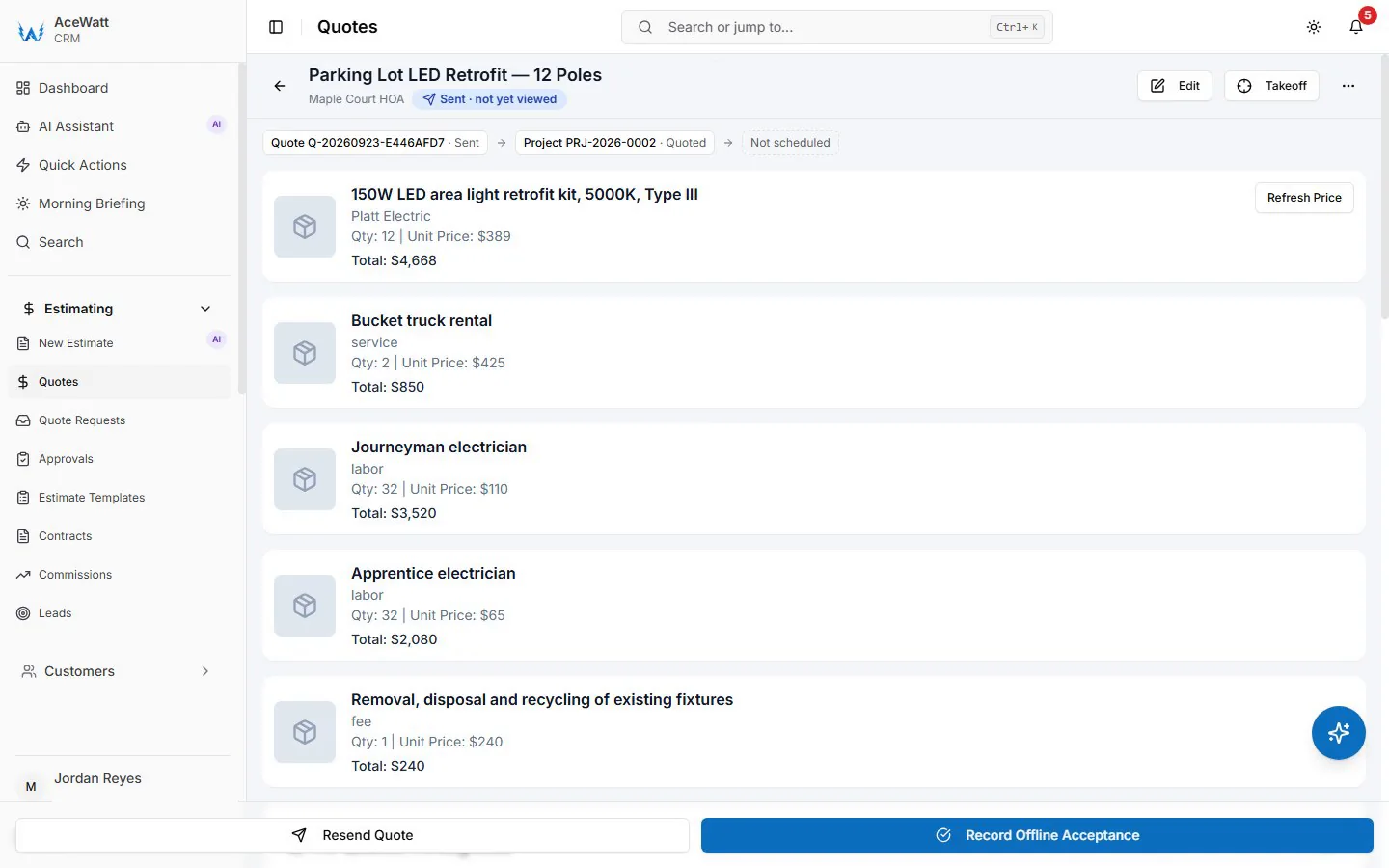
- Estimate builder. Build quotes from saved line items and labor rates. Adjust per job.
- Job costing. Track actual labor and materials against estimates. See where you made or lost margin.
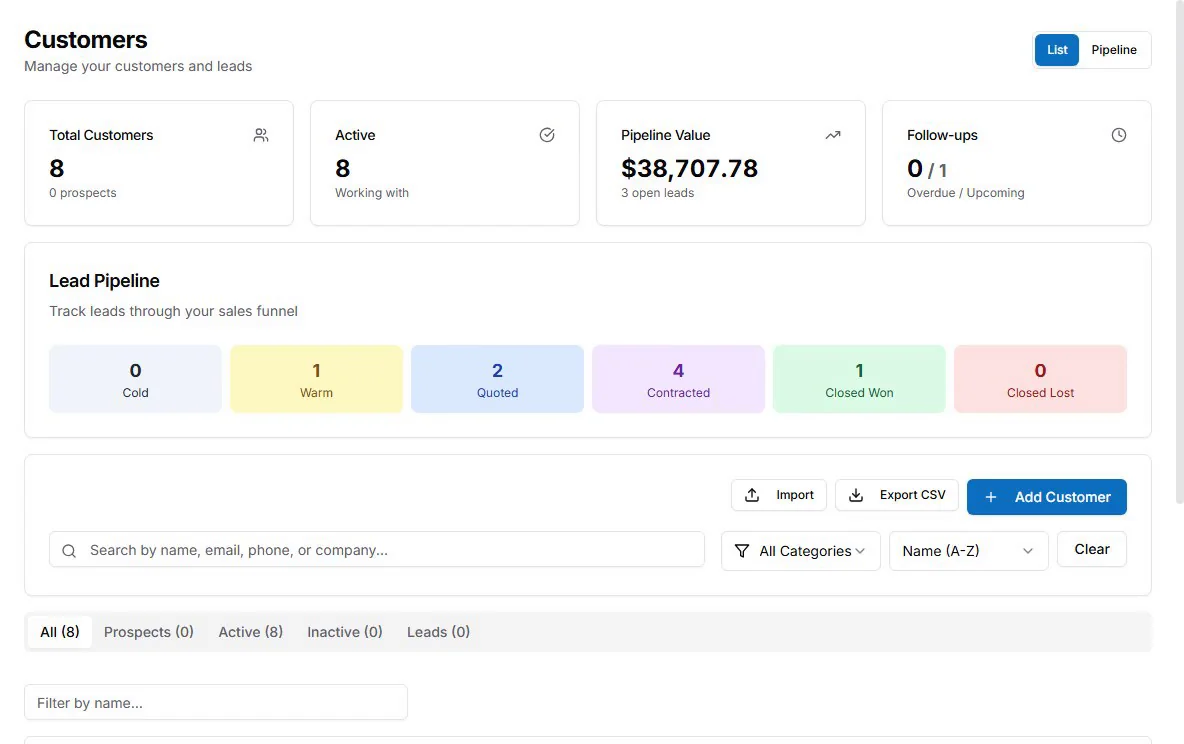
- Customer history. Quote repeat customers from past job records, not from scratch.
- AI job walks. Capture site conditions and scope notes that inform accurate pricing.
- Voice documentation. Dictate scope notes and pricing observations in the field.
For more on quoting workflow, see the electrical estimating software guide and how to estimate electrical work.
FAQ
Should I use flat-rate or T&M pricing?
Most shops use a hybrid. Flat-rate for standard tasks with predictable scope, T&M for troubleshoot, complex jobs, or change orders. Your price book can support both.
How do I calculate my labor rate?
Start with base wage, add burden (payroll taxes, workers' comp, benefits), add overhead allocation per hour, and add profit margin. The result is your internal labor cost, not necessarily your billable rate.
How much should I mark up materials?
Typical ranges are 25, 50% for standard materials and 20, 40% for specialty items. Your markup depends on supplier pricing, volume, inventory carrying cost, and market.
How often should I update my price book?
Review materials quarterly, labor rates annually, and flat-rate tasks after completing batches of similar jobs. Update when actual job costs differ significantly from estimates.
What if my price book prices are too high for my market?
If you consistently lose bids, revisit your overhead allocation and profit margin, but do not undercut to the point where you lose money. Competing on price alone is a race to the bottom. Differentiate on service, speed, or reliability.
Related Resources
- Overview of every electrical contractor software feature AceWatt ships.