Quick answer: what changed in the 2026 NEC?
The NEC 2026 code changes electrical contractors need to care about revolve around a few big themes: electric vehicle charging is getting its most significant rewrite in years, load calculations are being updated to reflect how people actually use power today, and documentation requirements are tightening across the board.
The National Electrical Code is updated every three years, and the 2026 edition (officially NFPA 70, 2026) brings dozens of revisions that affect residential, commercial, and industrial work. For electrical contractors, the practical impact is straightforward: some jobs will cost more to bid, some materials lists will change, and every project will require more thorough documentation than you may be used to.
Here's the short list of the biggest changes:
- EV charging requirements expanded, including new rules for bidirectional power and load management
- Load calculation methods updated to account for heat pumps, EVs, and modern appliance loads
- In-unit disconnect requirements revised for multifamily and commercial buildings
- GFCI protection extended to more locations and circuit types
- Energy storage system (ESS) rules refined with clearer installation and labeling standards
- AFCI protection expanded to additional occupancies and circuit types
- Wire and cable updates affecting NM-B ratings and conduit fill calculations
- Grounding and bonding revisions that clarify existing requirements
- Inspection and documentation requirements strengthened, meaning more paperwork per job
> Important: This article is for informational purposes and does not constitute legal or code compliance advice. The NEC is a model code; it only becomes enforceable when your state or local Authority Having Jurisdiction (AHJ) adopts it. Always verify with your local AHJ and the official NEC 2026 text before changing your installation practices.
The biggest 2026 NEC changes affecting electrical contractors
The major revisions one by one, focusing on what actually changes for your crews in the field and your estimators at the desk.
EV charging and bidirectional power requirements
EV charging continues to be the fastest-moving area of the NEC, and the 2026 edition delivers the most substantial rewrite of EV-related provisions in multiple code cycles. If your shop does any residential or commercial EV charger installations (and these days, most shops do), these changes will affect your bids, your material orders, and your inspection outcomes.
Key areas of change include updated GFCI protection requirements for EV circuits, new provisions for bidirectional (vehicle-to-home and vehicle-to-grid) charging systems, and clarified rules for energy management systems that dynamically manage EV loads. We cover these in detail in the deep-dive section below.
Updated load calculations for modern appliances
Article 220 has been revised to better reflect the actual electrical loads of modern homes and buildings. The demand factors and calculation methods in previous editions were based on appliance usage patterns from decades ago, and they haven't kept pace with the proliferation of heat pumps, EV chargers, induction cooktops, and other high-draw devices.
For contractors, this means some jobs that used to pass load calculations comfortably may now require panel upgrades or service upgrades under the new methodology. This is especially relevant for residential remodels and additions in homes with 100-amp or 150-amp services.
New requirements for in-unit disconnects
The NEC has been gradually expanding requirements for disconnecting means at individual dwelling units in multifamily buildings. The 2026 edition continues this trend with clarified language about where in-unit disconnects are required, what type of disconnect is acceptable, and how these disconnects must be labeled and accessible.
For electrical contractors working on multifamily new construction or major renovations, this affects your material lists and your rough-in labor. Make sure your estimators account for the additional disconnect hardware and the labor to install it.
Revised GFCI protection rules
GFCI requirements continue their steady expansion. The 2026 NEC extends GFCI protection to additional locations and circuit types, closing gaps that previous editions left open. Areas seeing changes include kitchen island and peninsula receptacles, laundry areas, and outdoor accessible receptacles.
These changes are relatively straightforward from an installation standpoint, but they can surprise contractors who are still working off older code editions. If your jurisdiction adopts NEC 2026, you may find that circuits you've been running without GFCI protection for years now require it, and that means different breakers or receptacles on your material order.
Energy storage system (ESS) code updates
Energy storage systems, from residential Powerwall-style batteries to commercial-scale installations, have been a moving target in recent NEC cycles. The 2026 edition brings more clarity to ESS installation requirements, including updated rules for spacing, ventilation, labeling, and disconnecting means.
If your shop does any battery storage work, whether standalone or paired with solar, these revisions affect your installation procedures and the documentation you need to provide for inspection.
Arc-fault circuit interrupter (AFCI) expansion
AFCI requirements continue to expand to additional occupancies and circuit types in the 2026 NEC. While AFCI protection has been required in most residential sleeping areas and living spaces for several code cycles, the new edition extends requirements to additional rooms and building types.
For contractors, the main impact is on material costs, since AFCI breakers are significantly more expensive than standard breakers, and on troubleshooting, since AFCI circuits can be more sensitive to certain types of loads and wiring conditions.
Wire and cable changes (NM-B, conduit fill)
The 2026 NEC includes revisions to provisions governing NM-B (Romex) cable ratings and conduit fill calculations. While these changes are typically more technical and less dramatic than the EV or GFCI updates, they can affect your material selections and your ability to pull wire in certain configurations.
Pay particular attention if you work in high-ambient-temperature environments, as some of the NM-B rating changes are related to temperature derating.
Grounding and bonding revisions
Grounding and bonding requirements have been clarified and refined in several areas. These are generally not wholesale changes but rather language updates to address ambiguities in previous editions. However, grounding and bonding mistakes are among the most common causes of inspection failures, so any change here is worth reviewing carefully.
Electrical inspection and documentation requirements
One of the broader trends in the 2026 NEC is an increased emphasis on documentation and inspection readiness. Several articles now require more detailed labeling, record-keeping, and as-built documentation than previous editions. For electrical contractors, this means your paperwork burden per job is increasing, and if you don't have a system for tracking it, you will feel the pain.
This is where the right electrical contractor software tends to earn its keep. Being able to document code-relevant details on every job (photos, notes, material specifications) and tie them to specific projects makes inspection time far less stressful.
EV charging and bidirectional power (deep dive)
EV charging is the single biggest growth area for electrical contractors, and the 2026 NEC changes reflect that. Here are the details.
What changed in Article 625
Article 625, which covers EV charging systems, has been significantly restructured. Key changes include:
- Updated GFCI protection requirements for EV charging circuits, aligning with the 5mA Class A threshold used in other wet-location applications
- Revised definitions for EV supply equipment (EVSE) and related components
- Clarified installation requirements for different charging levels and configurations
These changes affect every EV charger installation you do. The GFCI requirement, in particular, means you can no longer rely solely on the protection built into the EVSE unit itself: the circuit must have its own GFCI protection at the breaker or receptacle level.
Bidirectional EV charging: new equipment and installation requirements
Bidirectional EV charging, where the vehicle can supply power back to a home or the grid, is now commercially available from multiple manufacturers, and the 2026 NEC addresses it for the first time in a comprehensive way.
New provisions cover:
- Interconnection requirements when an EV functions as a power source, including coordination with utility interconnection rules
- Safety disconnect requirements for bidirectional power flow
- Equipment certification and listing requirements for bidirectional charging equipment
- Load management coordination between bidirectional charging and building electrical systems
If you're not already getting questions about bidirectional charging from your clients, you will be soon. Understanding these requirements now, before your jurisdiction adopts NEC 2026, gives you a head start on the competition.
Load management systems: mandatory for multi-unit dwellings
One of the most practical changes for contractors doing multi-unit residential work involves energy management systems (EMS). The 2026 NEC clarifies when and how EMS devices can be used to dynamically manage EV charging loads, and in some multi-unit dwelling scenarios, load management systems are now effectively required to make EV charging feasible without massive service upgrades.
This is good news for contractors: it opens up more jobs where you can add EV charging to existing buildings without the cost of a full service upgrade. But it also means you need to understand the EMS options available and how to design systems that meet the new code requirements.
Load calculation changes (deep dive)
Load calculation revisions in the 2026 NEC are some of the most impactful changes for residential and light commercial contractors. Here's what you need to know.
Revised demand factors for modern appliance loads
Article 220's demand factors have been updated to reflect the reality of modern electrical loads. Previous editions used demand factors derived from older appliance usage patterns that didn't account for the simultaneous use of multiple high-draw devices that are common in today's homes.
The revised demand factors are generally more conservative, meaning your calculated loads will often be higher for the same set of appliances. This can push more projects into needing panel upgrades or service upgrades that wouldn't have been required under the previous calculation method.
Heat pump and electric vehicle load calculations
Two specific load types are driving much of the change:
- Heat pumps are replacing gas furnaces at an accelerating rate, and their electrical loads are significant: often 40 to 80 amps for a whole-house system, plus backup heat strips
- EV chargers add 30 to 50 amps of continuous load per vehicle, and many homes now have two EVs
The 2026 NEC provides updated guidance on how to calculate these loads, including when demand factors can and cannot be applied to EV charging circuits and heat pump loads.
How this affects panel sizing and service upgrades
The practical impact is straightforward: more of your residential projects will require panel upgrades or service upgrades under the 2026 NEC than under previous editions. This is especially true for:
- Homes with 100-amp services adding EV charging
- Homes adding heat pumps that replace gas heating
- Older homes with multiple appliance circuits that were marginal under the old calculations
For your estimating process, this means you should run load calculations early in every residential bid, before you quote a price. A surprise service upgrade mid-project is an expensive change order that strains client relationships.
If you want to tighten up your estimating process so you catch these issues early, check out our guide to electrical estimating software that helps you build more accurate bids.
How 2026 NEC changes affect your electrical business operations
Code changes don't just affect what you install; they affect how you run your business. Here are the operational impacts electrical contractors should prepare for.
More documentation required per job
The 2026 NEC increases documentation requirements across multiple article areas. This isn't just about filling out permits. It's about maintaining records of what was installed, how it was installed, and what code provisions applied.
Contractors who already have strong documentation habits will adapt quickly. Those who have been getting by with minimal paperwork will struggle. If documenting your jobs still means snapping a few photos on your phone and hoping you remember what they were for later, it's time to upgrade your process.
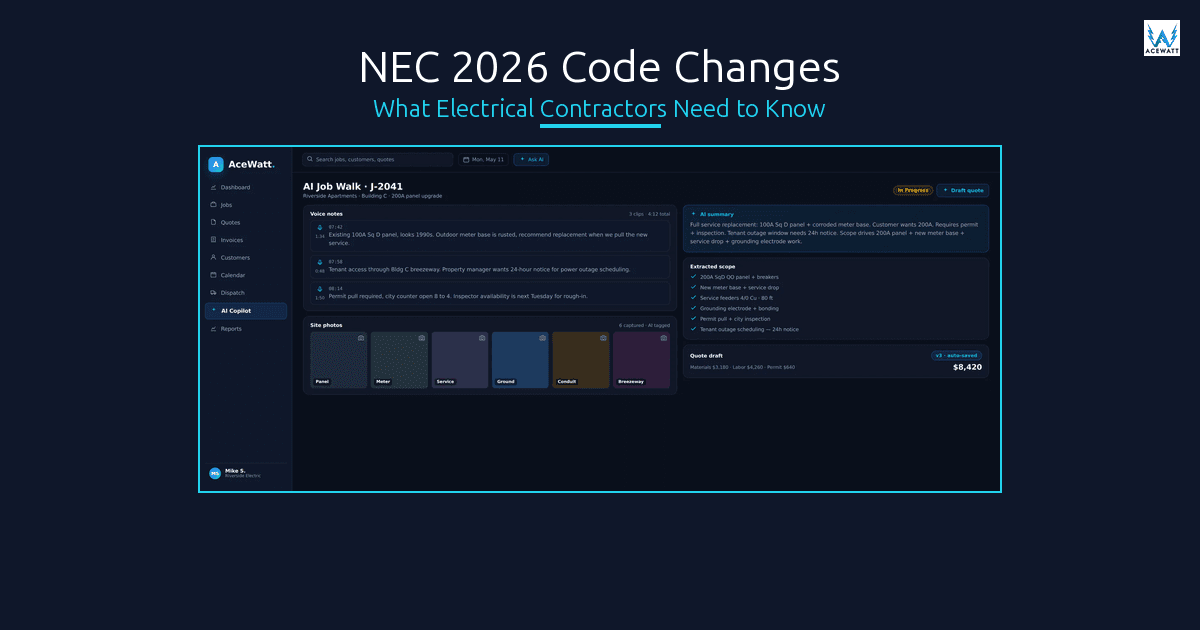
Tools like AceWatt's job walk documentation make it easy to capture photos, voice notes, and measurements on-site and attach them directly to the job file, so when the inspector asks for documentation, you have it organized and ready.
Inspection checklist updates
Every code cycle means updated inspection checklists. Inspectors in jurisdictions that adopt NEC 2026 will be checking for new requirements: the expanded GFCI locations, the updated disconnect requirements, the revised load calculations.
If your crews are still using inspection checklists from three code cycles ago, update them. This is one of those unglamorous tasks that saves you from failed inspections and callback costs.
Change-order frequency increases on legacy-code projects
Here's a scenario that will become more common: You bid a project under NEC 2023, the jurisdiction adopts NEC 2026 mid-project, and suddenly you need to install GFCI protection on circuits you hadn't planned for, or add disconnects that weren't in your original scope.
This isn't theoretical; it happens every code cycle. The solution is to have a clean change-order process that lets you document the additional scope, communicate it to the client, and get paid for the extra work. Our article on managing an electrical contracting business covers how to set up change-order workflows that protect your margins.
Managing compliance across multiple jurisdictions
If your electrical contracting business works across multiple cities, counties, or states, you're probably already dealing with different NEC editions in different jurisdictions. The 2026 adoption cycle will make this more complex before it makes it simpler, because some jurisdictions will adopt quickly while others lag years behind.
You need a system to track which code edition applies on every active job. This isn't something you can keep in your head once you have more than a handful of projects going simultaneously.
How electrical contractor software helps with NEC compliance documentation
To be clear, software doesn't replace knowing the code. But the right software makes it much easier to document your compliance with the code on every job, which is increasingly important as NEC requirements get more detailed and inspection scrutiny increases.
Document code-relevant details on every job walk
Every job starts with a walk-through, and that's when you should start documenting code-relevant details. What's the existing service size? What's the panel schedule? What loads are already on the system? Are there any obvious code issues with the existing installation?
With voice-activated job walk tools, you can narrate these observations hands-free while you walk the site. The software transcribes your notes, tags them to the job, and stores them alongside your photos. When it's time to write the estimate or prepare for inspection, everything is in one place.
Track which code cycle applies per project and jurisdiction
One of the most practical features of a modern CRM for electricians is the ability to tag each project with the applicable NEC edition. This sounds simple, but when you're juggling 15 active jobs across three jurisdictions (some on NEC 2020, some on NEC 2023, and some transitioning to NEC 2026), you need this information at your fingertips, not buried in a permit folder somewhere.
Photo and voice documentation for inspection readiness
Inspectors love documentation. When you can show up to an inspection with a complete photo record of the rough-in, organized voice notes documenting what was installed and why, and a clear record of which code provisions applied to the installation, inspections go faster and smoother.
This kind of documentation also protects you in disputes. If a homeowner or general contractor claims you didn't install something correctly, your photo and voice records provide clear evidence of what was actually done.
Automated change-order creation when code requirements change scope
When a code change mid-project requires additional work, you need to generate a change order quickly. Modern electrical contractor software can help by:
- Flagging jobs in jurisdictions that are transitioning to a new NEC edition
- Providing templates for change orders that reference specific code provisions
- Tracking change-order approval status so nothing falls through the cracks
This is far more efficient than scrambling to create change orders manually while your crews are standing around waiting for direction.
How AceWatt supports NEC compliance documentation
AceWatt is a job documentation and CRM platform built for electrical contractors. While AceWatt is not a NEC compliance tool, it supports your compliance documentation workflow by giving you a centralized place to:
- Record job walk observations with photos, voice notes, and structured data
- Tag projects with the applicable code edition and jurisdiction
- Store inspection records, permits, and as-built documentation organized by job
- Generate change orders quickly when code requirements add scope to a project
- Track project status from estimate through completion, with full documentation at every stage
For a full overview of what AceWatt can do for your electrical contracting business, visit our features page or check our pricing to find the right plan for your shop.
NEC 2026 adoption timeline by state
The NEC is a model code. It doesn't become law until a state or local jurisdiction adopts it, and adoption timelines vary enormously. Here's what contractors should know about the 2026 adoption landscape.
States adopting NEC 2026 immediately
Some states have adoption processes that trigger automatically or on a short cycle. These states tend to adopt the latest NEC edition within 6 to 12 months of the NFPA publication date. States in this category often include those with strong building code enforcement infrastructures and established adoption cycles.
However, "immediately" in the world of code adoption still means months, not days. Even fast-adopting states typically have a rulemaking process that includes public comment periods and effective dates.
Texas adopts the 2026 NEC effective September 1, 2026
Texas is the first major state with a confirmed, dated adoption. On July 28, 2026, the Texas Commission of Licensing and Regulation voted unanimously to adopt the 2026 NEC as the statewide electrical code, and it took effect September 1, 2026 (IEC Fort Worth / TDLR). What this means for Texas contractors:
- The 2026 NEC is now the statewide minimum standard for non-exempt electrical work, both inside municipal boundaries and in unincorporated areas
- Texas electrical licensing examinations are now based on the 2026 NEC — if you have an exam scheduled, study the new edition
- Texas retains its amendment to NEC 210.8(F): GFCI protection is not required for outlets supplying listed outdoor dwelling HVAC equipment, and the adopted amendment removes the September 1, 2026 expiration from that exception
- Which code applies to a project depends on timing: per TDLR guidance, when no permit is required, the installation follows the state-adopted code in effect when installation begins; when a permit is required, it generally follows the code in effect when the permit was obtained
- Municipalities may still set their own permitting requirements and adopt local amendments to the state code, so verify with your AHJ before every job
If you bid work in Texas, update your estimate templates and job documentation to reference the 2026 NEC now — the effective date has already passed.
States on delayed adoption cycles
Many states take 18 to 36 months to adopt a new NEC edition, or longer. Some states are still enforcing NEC 2017 or NEC 2020 as of mid-2026. In these states, the NEC 2026 changes won't affect your work for years.
A few states have no statewide electrical code at all, leaving adoption entirely to local jurisdictions. In these states, you may find different cities within the same state enforcing different NEC editions.
How to check your state and jurisdiction adoption status
The most reliable way to check which NEC edition your jurisdiction enforces is to:
- Contact your local building department or electrical inspections office: they'll tell you exactly which edition they're enforcing
- Check your state's building code agency website: many maintain current adoption information online
- Verify before every permit: don't assume the code edition hasn't changed since your last project in that jurisdiction
The NFPA also maintains adoption information, but local jurisdictions may have amendments or variations that aren't reflected in the NFPA records. Always verify with your AHJ.
> Reminder: Always verify with your local AHJ (Authority Having Jurisdiction) and the official NEC 2026 text. This article is for informational purposes and does not constitute legal or code compliance advice.
Preparing your electrical shop for NEC 2026
Whether your jurisdiction adopts NEC 2026 next month or next year, here's how to get your shop ready.
Training and certification updates
Make sure your electricians, especially foremen and lead estimators, understand the key changes. This doesn't mean everyone needs a formal NEC 2026 certification course (though those are available). It means your team needs to know:
- Which requirements are new or changed
- How those changes affect common job types your shop performs
- What additional materials, time, or documentation the changes require
Many IBEW local unions, IEC chapters, and independent training providers offer NEC 2026 update courses. Industry associations and trade publications are also good sources of change summaries. AI tools for electrical contractors can help you organize and distribute training materials across your team.
Update your estimate templates and job checklists
Go through your standard estimate templates and job checklists and update them to reflect NEC 2026 requirements. Specifically:
- Add GFCI breakers to templates for jobs in jurisdictions adopting NEC 2026 where they weren't previously required
- Update load calculation worksheets to use the new methodology
- Add in-unit disconnects to multifamily project templates
- Include bidirectional charging provisions in EV charger installation templates
- Update inspection checklists with the new requirements
This is tedious but essential work. Doing it once, before you're in the middle of a bid, saves you from costly oversights.
Review material lists against new requirements
Code changes often affect material specifications. Review your standard material lists to make sure you're ordering the right products for NEC 2026 jobs:
- GFCI breakers for circuits that now require GFCI protection under the new edition
- AFCI breakers for newly covered circuit types and occupancies
- Disconnect hardware for multifamily in-unit requirements
- EV charging equipment certified to meet the updated Article 625 provisions
- ESS components that meet the revised energy storage requirements
Your supply house should be able to help you identify which products meet the new code requirements, but don't rely on them exclusively. It's your license on the line.
Set up software for code-cycle tracking
If you haven't already, configure your electrical contractor CRM to track the applicable NEC edition for each project. This should be a standard field on every job record, right alongside the client name, job address, and project type.
When a jurisdiction transitions to a new code edition, you should be able to run a report showing all active projects in that jurisdiction that may be affected. This lets you proactively address code changes rather than getting blindsided by them at inspection time.
FAQ
When does the 2026 NEC take effect?
The NEC 2026 edition was finalized by the NFPA with a national model-code effective date. However, the NEC is a model code: it only becomes enforceable when your state or local Authority Having Jurisdiction (AHJ) formally adopts it. Adoption dates vary by jurisdiction. Some states adopt within months of NFPA publication; others take years. Contact your local building department to confirm which NEC edition they currently enforce. For a concrete example: Texas adopted the 2026 NEC statewide effective September 1, 2026, and its licensing exams switched to the new edition on the same date.
Do I need to redo work completed under the previous NEC?
Generally, no. Electrical work that was installed in compliance with the NEC edition enforced at the time of installation typically does not need to be updated when a new edition is adopted. However, there are exceptions, particularly when existing work is modified, extended, or triggers "substantial improvement" requirements in certain jurisdictions. Always check with your local AHJ for specific guidance.
What are the biggest cost impacts of NEC 2026?
The cost impacts vary by job type, but the most significant include:
- GFCI breakers on newly covered circuits add $30 to $80 per circuit in material costs
- AFCI breakers on expanded circuit types add $30 to $50 per circuit
- In-unit disconnects for multifamily projects add hardware and labor per unit
- Load calculation changes may trigger panel upgrades or service upgrades on residential jobs that wouldn't have required them under previous editions
- EV charging documentation and equipment requirements add both material and administrative costs
For contractors using electrical contractor software to manage estimates, these cost changes are easier to incorporate systematically into your bids.
How do I know which NEC edition my state uses?
Contact your local building department or electrical inspections office; they are the definitive source for which NEC edition is enforced in your jurisdiction. You can also check your state's building code agency website. The NFPA maintains adoption maps, but local amendments and variations mean you should always verify locally.
What is bidirectional EV charging and why does NEC 2026 address it?
Bidirectional EV charging allows an electric vehicle to send power back to a building (vehicle-to-home, or V2H) or to the electrical grid (vehicle-to-grid, or V2G). This turns the EV battery into a backup power source or grid resource. NEC 2026 addresses bidirectional charging for the first time in a comprehensive way because the technology is now commercially available: multiple automakers and charger manufacturers offer bidirectional-capable systems. The new code provisions cover safety disconnects, interconnection requirements, equipment certification, and coordination with building electrical systems.
Bottom line: The 2026 NEC code changes electrical contractors need to care about are significant but manageable. The key moves are: understand what changed, update your templates and checklists, train your team, and put systems in place to track which code edition applies to every job. Having the right electrical contractor software in your corner makes the documentation and tracking side of code compliance far less painful. The same code-aware approach matters in fast-growing verticals; see our guides on EV charger installation software (NEC Article 625) and solar installation software for electricians (NEC Articles 690 and 706).
> Disclaimer: This article is for informational purposes and does not constitute legal or code compliance advice. Always verify with your local AHJ (Authority Having Jurisdiction) and the official NEC 2026 text before making installation decisions.