
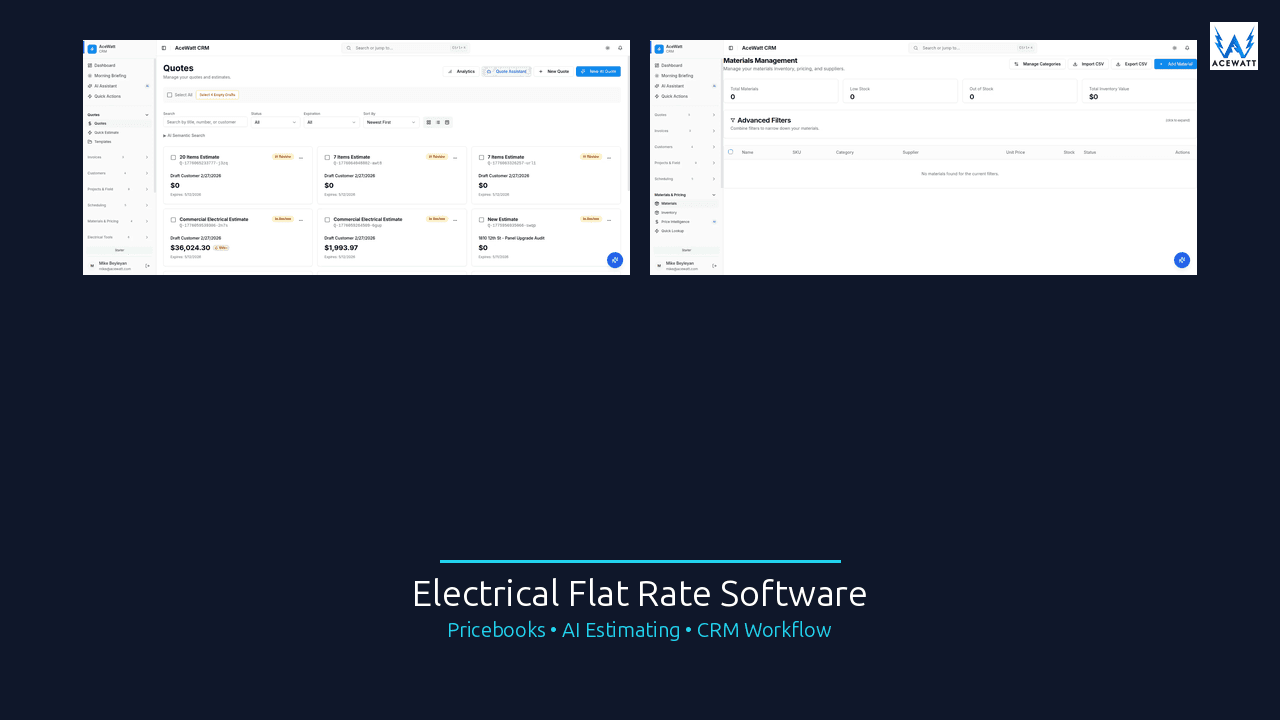
Electrical flat-rate software helps contractors quote common service work faster without rebuilding every estimate from scratch. The goal is simple: give customers clear, consistent prices while still protecting your labor, material, overhead, permit, and profit assumptions. The right setup is not a magic button, and it does not replace licensed electrician review. It is a disciplined pricebook, estimating workflow, and customer approval path that keeps your team from guessing on every call.
If your service techs are still texting the office for prices, searching old invoices, or quoting from memory, flat-rate pricing can remove a lot of friction. But it only works when the numbers are maintained. An illustrative $425 outlet job, $1,200 circuit, or $4,800 panel replacement can turn unprofitable fast if copper, breakers, travel time, attic access, or inspection requirements are ignored. This guide breaks down how electrical flat-rate software works, where it fits, what to compare, and how AceWatt supports a reviewed, human-controlled quoting process.
What is electrical flat-rate software?
Electrical flat-rate software is a digital system for building, maintaining, and using pre-priced electrical services. Instead of pricing every job from a blank spreadsheet, your team selects pricebook items, adjusts for the job conditions, and turns the reviewed scope into a customer-ready quote.
A strong flat-rate system usually includes three parts: an electrical contractor price book, estimating logic for labor and markup, and a CRM workflow for approvals, follow-up, invoicing, and payment.
Flat-rate pricing in one sentence
Flat-rate pricing means the customer sees a fixed price for a defined scope of work before the job begins, based on your reviewed labor, material, overhead, and margin assumptions.
For example, "replace one standard GFCI receptacle in an accessible location" is a defined flat-rate task. "Troubleshoot intermittent nuisance tripping across three panels in an older commercial building" is not the same kind of task.
How it differs from time-and-material billing
Time-and-material billing charges for actual labor time plus material used. Flat-rate pricing charges for the result described in the scope. The customer does not need to understand every labor unit or material markup; they need to understand what is included, what is excluded, and what changes the price.
That customer clarity is the benefit. The contractor risk is that your flat rate must be accurate enough to absorb normal variation without hiding real constraints.
When flat-rate works best for electrical service calls
Flat-rate works best when the scope is repeatable: device replacements, dedicated circuits, ceiling fans, recessed lights, EV charger circuits, small panel work, inspection corrections, and common service call packages. It works poorly when troubleshooting is open-ended, access is unknown, plans are incomplete, or the authority having jurisdiction may require additional work.
Why electrical contractors use flat-rate pricebooks
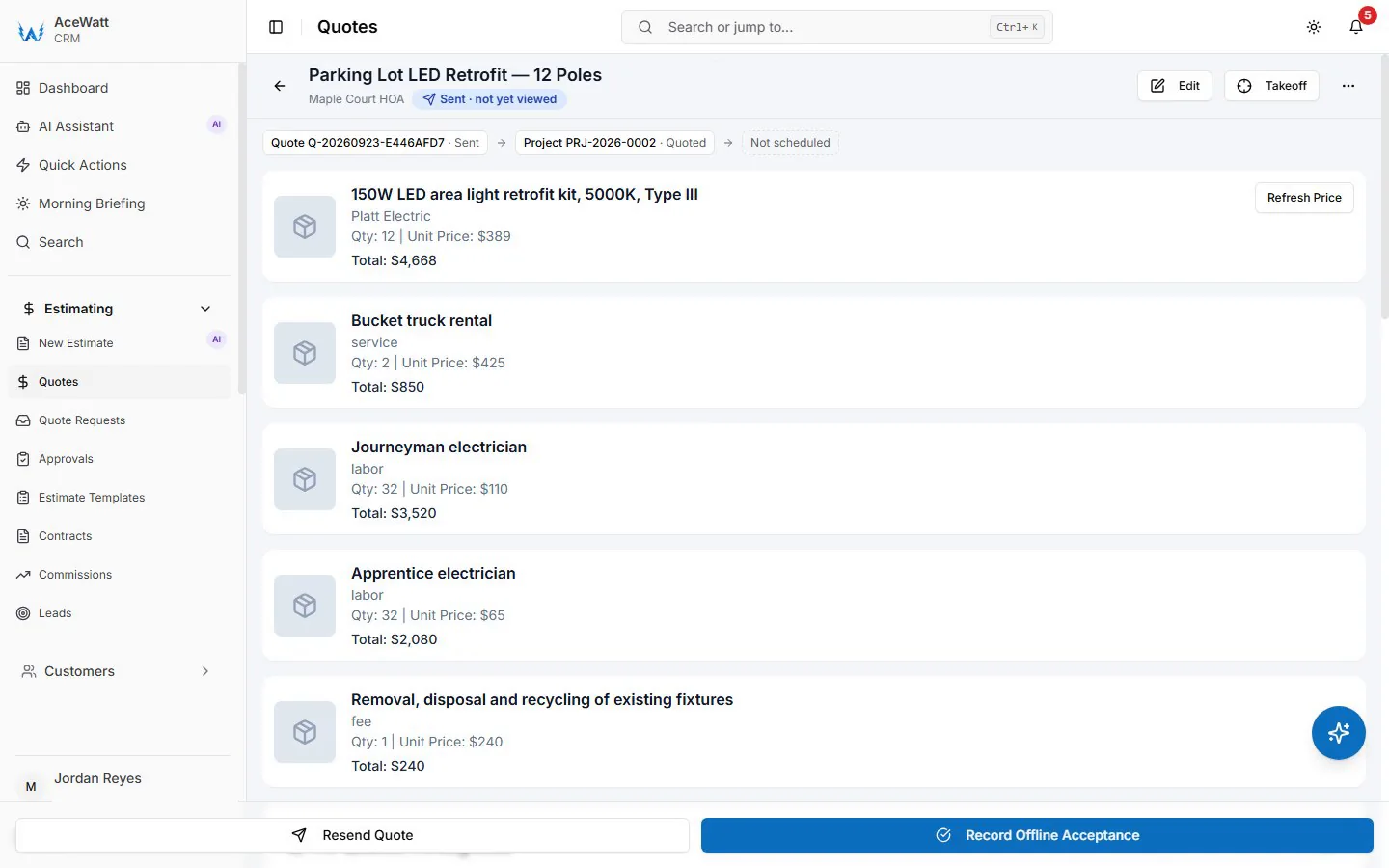
Contractors adopt flat-rate pricebooks because they reduce guessing. A pricebook gives everyone the same starting point, whether the quote is built by the owner, a service manager, or a technician in the driveway.
Consistent customer-facing prices
Inconsistent pricing creates customer distrust and internal arguments. If one tech quotes $375 and another quotes $525 for the same defined task, the customer sees the difference before they see your craftsmanship. Flat-rate price book software for electricians helps standardize the presentation while still allowing approved adjustments for site conditions.
Faster field quoting
Speed matters on small jobs. A homeowner who needs a new outlet, panel label correction, or ceiling fan installation does not want to wait two days for a basic quote. With the right electrical estimating software, an authorized tech can capture notes, select pricebook items, review the scope, and send a clean quote before leaving the site.
Better margin discipline
Flat-rate pricing is not about charging random round numbers. It is about forcing the business to define what must be covered: labor burden, truck cost, callbacks, permit handling, supplier runs, insurance, software, admin time, and profit. If those items are not built into the pricebook, they will show up later as margin leaks.
Easier technician training
Newer techs should not have to memorize every service price. A well-maintained pricebook turns pricing into a process: inspect, document, select the correct assembly, note constraints, review with a licensed electrician or manager when needed, and present options clearly. That process is easier to coach than "use your best judgment."
Flat-rate vs time-and-material pricing for electricians
Most electrical contractors should not treat flat-rate and time-and-material as enemies. The practical answer is usually a hybrid model: flat-rate for repeatable work, T&M for unknowns, and custom estimates for larger scoped projects.
| Job type | Flat-rate fit | T&M fit | Practical guidance |
|---|---|---|---|
| Standard residential service | High | Medium | Use flat-rate when access and scope are clear. |
| Troubleshooting | Low to medium | High | Use diagnostic blocks, then quote repairs after findings. |
| Small commercial repairs | Medium | Medium | Define exclusions for after-hours, access, and tenant rules. |
| Larger panel/service work | Medium | Low to medium | Use flat-rate assemblies as a starting point, then review site conditions. |
Residential service calls
Residential service calls are where electrical flat rate pricing software shines. Customers like knowing the price before work starts, and common tasks repeat often enough to standardize. The key is scope language: one device, accessible box, existing compliant wiring, normal business hours, no drywall repair, permit handled separately if required.
Small commercial work
Small commercial jobs can use flat-rate pricing when the work is clearly defined, such as replacing devices, adding a dedicated circuit, or correcting a punch-list item. Be careful with building rules, ceiling access, lifts, shutdown windows, parking, badges, and tenant coordination. Those details can change the real cost.
Emergency calls
Emergency calls need clear premium rules. A flat diagnostic fee, after-hours surcharge, and reviewed repair quote can work well. Avoid promising a fixed repair price before the electrician understands the failure, parts availability, and safety condition.
Panel upgrades and larger scoped jobs
Panel upgrades, service changes, generator interlocks, and multi-circuit projects may start from flat-rate assemblies, but they deserve estimator review. Existing grounding, utility coordination, permit requirements, working clearance, meter condition, and local inspection expectations can all affect scope.
Features to look for in electrical flat-rate software
The best electrical flat-rate software is not just a static list of prices. It should help your team maintain the pricebook, build options, collect approvals, and hand off work to invoicing without duplicate entry.
Electrical assemblies and labor units
Look for electrical assemblies that bundle the normal parts and labor for repeatable work. A dedicated 20-amp circuit might include wire, breaker, staples, box, receptacle, cover, label, testing, and labor units. You should be able to edit those assumptions to match your production rates and local practices. For a deeper pricing process, see how to estimate electrical work.
Material-cost update workflow
Your software should make material updates easy. That could mean importing supplier pricing, updating common items monthly, or flagging high-volatility materials for review. Copper wire, panels, breakers, conduit, and specialty devices should not sit untouched for a year.
Margin and markup controls
Flat-rate estimating software for electricians should separate material cost, material markup, labor cost, overhead allocation, and target profit. If all you can do is type a final price, you are not managing margin; you are saving a price list.
Good/better/best option building
Customers often need choices. Good/better/best options might compare a basic repair, a recommended replacement, and a preventive upgrade. For example: replace one failed GFCI, replace all exterior GFCIs on the circuit, or add weather-resistant devices with in-use covers where appropriate. Each option still needs reviewed scope and code-aware judgment.
Mobile quoting and customer approval
The field workflow matters. A tech should be able to capture notes, add photos, select items, build options, and request approval from a phone or tablet. Customer approval should record the accepted scope, price, signature or confirmation, and timestamp.
Estimate-to-invoice handoff
After approval, the quote should become a job and then an invoice without retyping. That handoff prevents missed line items and keeps office staff from chasing paper. It also makes job costing cleaner because quoted scope, approved changes, payments, and customer history live together.
How AI changes flat-rate electrical estimating
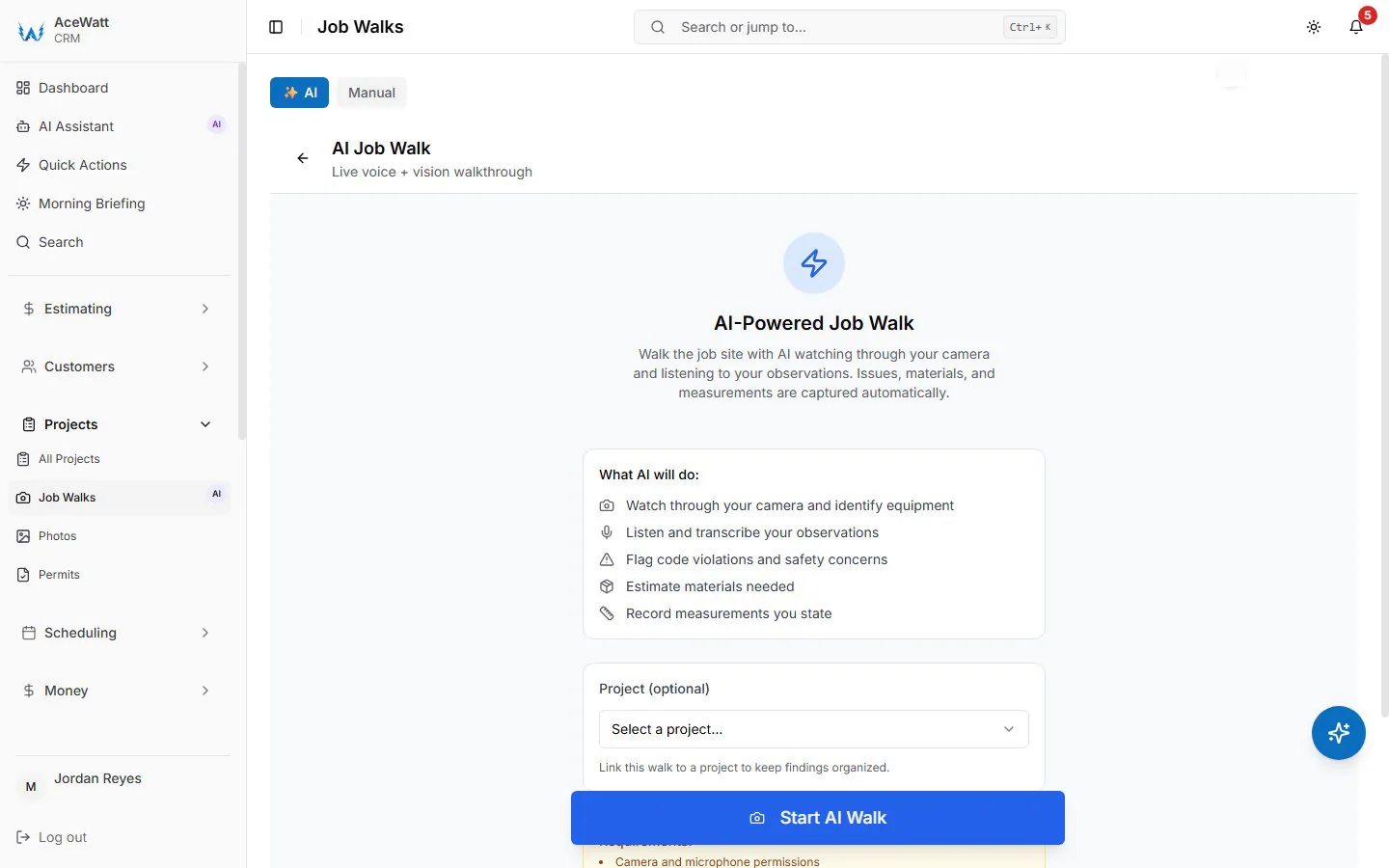
AI can make flat-rate workflows faster, but it must stay in the right lane. AI can summarize notes, suggest pricebook items, and organize follow-up. It should not independently decide code compliance, safety requirements, or final customer pricing without human review.
Turning voice notes and photos into scope notes
During a job walk, an electrician can record voice notes such as, "Panel is in garage, accessible, adding one 50-amp circuit to opposite wall, surface conduit likely." Paired with photos, AI can turn that into structured scope notes so the estimator does not start from a blank page.
Suggesting pricebook items for human review
AI can suggest likely pricebook items based on the notes: dedicated circuit, breaker, conduit run, receptacle, permit note, and inspection reminder. A qualified person still reviews the selection, adjusts quantities, and confirms whether the scope fits the flat-rate item.
Flagging missing materials or permit notes
AI is useful for reminders. If a quote mentions an EV charger but no permit note, disconnect requirement, load calculation reference, or customer-supplied equipment disclaimer, the system can flag the missing context for review. That is support, not a substitute for electrician judgment.
Creating follow-up-ready customer summaries
After the estimate is reviewed, AI can help draft plain-English customer summaries: what was found, what option one includes, why option two is recommended, and what happens after approval. Clear summaries reduce confusion and improve follow-up quality.
Flat-rate software comparison checklist
Software categories overlap, so compare workflow before comparing logos. A large field service management platform, a legacy printed flat-rate book, a pricebook-only app, and an electrical CRM can all claim to support flat-rate pricing. They do not solve the same problem.
FieldEdge vs ServiceTitan vs legacy flat-rate books vs AceWatt
FieldEdge and ServiceTitan are established field service management platforms. Legacy flat-rate books offer prebuilt task pricing. AceWatt focuses on electrical contractor CRM, AI-assisted job walks, estimating support, follow-up, invoicing, and payments. If competitor pricing matters to your decision, verify directly on each vendor page before budgeting.
| Option | Best fit | Strength | Watch-out |
|---|---|---|---|
| FieldEdge | Service businesses wanting broad FSM tools | Dispatch, customer history, pricebook workflows | Confirm electrical-specific estimating depth and current pricing directly on vendor page. |
| ServiceTitan | Larger field service organizations | Enterprise FSM, reporting, call center workflows | Implementation and process overhead may be more than a small electrical shop needs. Verify current pricing directly on vendor page. |
| Legacy flat-rate books | Shops wanting a starting price list | Fast to understand, familiar categories | Static prices can go stale and may not match your costs or market. |
| AceWatt | Electrical contractors wanting CRM-connected estimating | AI job-walk capture, reviewed quote workflow, CRM follow-up | Your team still owns pricebook setup, cost updates, and licensed review. |
Enterprise FSM vs lightweight electrical CRM
| Question | Enterprise FSM | Lightweight electrical CRM |
|---|---|---|
| Team size | Often best for larger, multi-role operations | Strong fit for solo electricians and growing crews |
| Setup | More configuration and rollout planning | Faster to adopt when workflow is focused |
| Scope | Dispatch, call center, reporting, multi-department processes | Leads, quotes, job notes, follow-up, invoices, payments |
| Decision point | You need enterprise controls | You need faster quoting without extra complexity |
If your shop has dispatchers, call center scripts, multiple trades, and complex reporting needs, enterprise FSM may fit. If your biggest problem is turning site notes into reviewed quotes and follow-up, an electrical CRM may be the cleaner choice.
Pricebook-only tool vs CRM-connected estimating
A pricebook-only tool can help standardize line items, but it may not manage the full customer journey. CRM-connected estimating ties the pricebook to the lead, job walk, quote, approval, invoice, payment, and future service history. That connection matters when you want to know which quotes are open, which customers need follow-up, and which job types need pricebook updates.
Mistakes that make flat-rate pricing unprofitable
Flat-rate pricing fails when contractors treat it as a shortcut instead of a management system. The pricebook needs ownership, review rhythm, and field feedback.
Stale material prices
If your material costs change and your flat rates do not, your margin changes automatically. Review high-impact items frequently, especially wire, breakers, panels, disconnects, conduit, and specialty devices. Even simple jobs can be underpriced when the pricebook uses last season's costs.
Ignoring drive time and access constraints
A task that takes 45 minutes in an open garage may take half a day in a tight attic, downtown high-rise, or locked commercial building. Build rules for travel zones, parking, lift rental, attic/crawl access, after-hours work, and customer delays.
One-size-fits-all pricing
Flat-rate does not mean every customer or job condition gets the same number. Define versions of common tasks: accessible vs difficult access, standard hours vs after-hours, customer-supplied materials vs contractor-supplied materials, permit required vs no permit required, short run vs long run.
Letting AI publish prices without electrician review
This is the most avoidable mistake. AI can organize information and suggest draft line items, but final scope, code considerations, safety requirements, and price must be reviewed by a qualified human. For electrical work, that review boundary protects the customer, the contractor, and the license.
How AceWatt fits the flat-rate workflow
AceWatt is built for electrical contractors that want quoting, customer management, and follow-up in one workflow. It is not a replacement for your estimator or licensed electricians. It helps your team capture better information, apply pricebook discipline, and move from quote to invoice with less manual work.
AceWatt pricing currently starts at $49/month on the published pricing page, with plan details available there for verification before you buy.
AI job-walk capture
AceWatt AI Job Walk helps electricians capture voice notes and photos during the walkthrough. The value is not that AI "knows" the final answer. The value is that scope context is organized before it gets forgotten: panel location, access notes, customer concerns, visible conditions, and follow-up items.
Automated estimating support
AceWatt automated estimating supports the estimate-building process by turning captured job context into a more structured draft for review. Your team can use it alongside your electrician pricing software process and internal pricebook rules.
Bid calculator / pricebook discipline
The AceWatt bid calculator gives contractors a disciplined way to think through labor, material, markup, overhead, and profit assumptions. All of these are collected under free electrical contractor tools. It is especially useful when building or auditing flat-rate items because it forces the question: "What cost are we actually trying to recover?"
Follow-up, invoice, and payment path
Flat-rate quoting does not end when the estimate is sent. AceWatt connects the quote to customer follow-up, invoice creation, and payment workflow so approved work does not get lost between the field and the office. If you are comparing broader estimating options, see electrical contractor estimating software for how estimating connects to operations.
FAQ
Is flat-rate pricing legal for electrical work?
In general, contractors can offer fixed prices for defined electrical scopes, but licensing, disclosure, consumer protection, permitting, and contracting rules vary by state and local jurisdiction. Use clear written scope, exclusions, permit language, and change-order rules. When in doubt, confirm requirements with your licensing board, attorney, or local authority.
Does flat-rate software replace an estimator?
No. Flat-rate software supports estimators and service teams by organizing pricebook items, labor assumptions, materials, and approvals. A qualified human still reviews scope, quantities, job conditions, code-related requirements, and final pricing before anything is sent to the customer.
What electrical jobs should not use flat-rate pricing?
Avoid fixed flat rates for open-ended troubleshooting, hidden-condition work, incomplete plans, unusual existing wiring, industrial controls, large commercial bids, or jobs with uncertain permit and utility requirements. Use diagnostics, allowances, T&M, or custom estimates when the scope is not predictable.
How often should pricebook costs be updated?
Review high-volume and high-volatility items at least monthly, and review the full pricebook on a regular schedule that matches your purchasing rhythm. Also update prices after supplier changes, wage changes, insurance increases, fuel changes, or repeated job-cost misses.
Can AI create electrical estimates safely?
AI can help create draft scope notes, suggest pricebook items, flag missing context, and prepare customer summaries. It should not be allowed to publish final prices, approve code compliance, or make safety decisions on its own. A licensed electrician or qualified estimator should review the work before customer approval.
Related Reading
- Overview of every electrical contractor software feature AceWatt ships.