
If you're an electrical contractor, you've heard "AI" thrown around a hundred times this year. Every software company slaps an "AI-powered" badge on their product. Half of them just added a chatbot and called it innovation.
Here's what actually matters: AI tools are now helping real electrical contractors cut estimating time from hours to minutes, chase down unpaid quotes without lifting a finger, and walk job sites with nothing but their voice and a phone.
Not someday. Right now. In 2026.
This guide cuts through the noise. We'll show you exactly how AI is being used in electrical contracting today, concrete workflows, real numbers, and honest answers about what's ready and what isn't.
What AI Actually Means for Electrical Contractors
Let's keep it simple. Artificial intelligence in electrical contracting means software that can understand, decide, and act, instead of just storing data.
A regular CRM records what happened. An AI-powered CRM makes things happen.
Think about it this way:
- Traditional software: You type in a customer's info, manually build an estimate line by line, set a reminder to follow up, and hope you remember to send the quote.
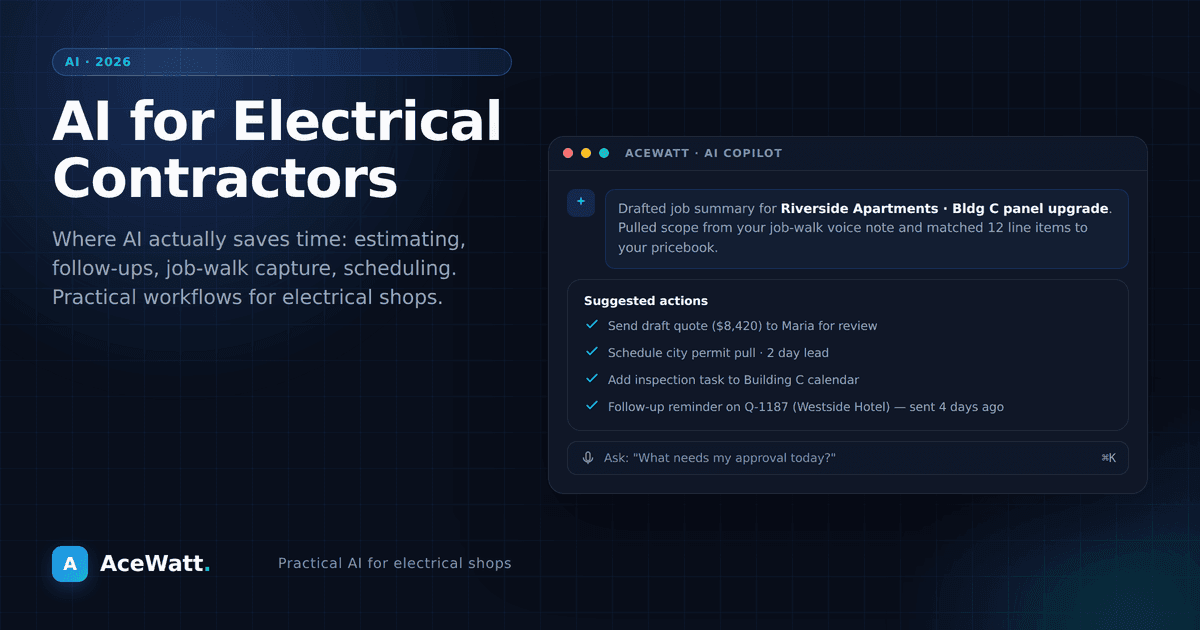
- AI software: You walk a job site, describe what you see out loud, and the software drafts estimate line items, applies your saved pricing and labor rules, helps send the quote, and queues follow-up tasks if the customer hasn't responded.
That's not a fantasy. That's what purpose-built AI tools are doing right now for electrical contractors.
And here's the important part: AI is not replacing electricians. It's replacing the paperwork that keeps electricians at their desks instead of on job sites. The average electrical contractor spends 30% of their work week on administrative tasks, estimating, follow-ups, scheduling, invoicing, data entry. AI can automate most of that.
7 Ways Electrical Contractors Are Using AI Right Now
1. AI-Powered Estimating and Takeoffs
This is where AI often delivers the fastest return. Instead of manually building every estimate in a spreadsheet, electrical contractors are using AI to draft line items, organize scope details, and move quotes out faster.
Voice-powered estimating lets you describe a job in plain English: "Two hundred amp panel upgrade, residential, need to replace the main breaker, add a grounding electrode conductor, and run new SER cable from the meter to the panel." The AI turns that scope into draft line items, applies your saved labor and material assumptions, and gives you a quote to review faster than starting from scratch.
Photo-backed job walks take it further. Snap photos during a site visit and pair them with voice notes so the AI can summarize field context, suggest materials, and support takeoff work from your notes, photos, and uploaded documents.
The speed difference matters beyond convenience. Faster response times help you stay top-of-mind while the customer is still comparing options. If you're still building quotes at your kitchen table at 9 PM, you're giving faster competitors an opening.
2. Smart Job Walks and Site Documentation
A traditional job walk goes like this: you show up with a clipboard, scribble notes about what you see, take a few photos with your phone, drive back to the office, and spend an hour typing everything into a system. Half your notes are illegible by then.
An AI job walk goes like this: you open the app, start talking. "This is a 200-amp residential panel, Square D QO series, 42 spaces, 30 circuits currently in use. Customer wants to add an EV charger circuit in the garage." You snap photos of the panel, the service entrance, and the garage subpanel location. The AI transcribes your notes, keeps photos tied to the job context, and drafts a job site report you can review back at the truck.
This isn't some future roadmap feature. AceWatt's AI Job Walk is built specifically for electrical contractors and available today.
3. Automated Follow-Ups and Lead Nurturing
Here's a painful statistic: the average electrical contractor follows up on fewer than 40% of their estimates. Not because they don't want to, because they're busy running jobs and forget.
Dedicated follow-up tools fix this. When you send an estimate, such a tool can automatically:
- Send a confirmation text or email immediately
- Follow up in 3 days if the customer hasn't opened the quote
- Send a second nudge after 7 days with a different angle
- Alert you when the customer views the quote so you can call while it's top of mind
- Start a win-back sequence after 30 days for unsold estimates
This is a high-use AI application for many contractors because it requires very little behavior change. You send the estimate like you always do. The AI helps keep the follow-up cadence from falling through the cracks.
4. AI Dispatching and Scheduling
If you're still scheduling jobs on a whiteboard or in a spreadsheet, you're leaving money on the table. AI-powered scheduling considers factors humans can't juggle simultaneously:
- Technician skills and certifications (don't send a residential guy to a commercial panel upgrade)
- Geographic routing (minimize drive time between jobs)
- Job urgency (emergency calls get priority automatically)
- Estimated job duration (based on historical data from similar jobs)
- Customer preferences (morning vs afternoon appointments)
The result? Less windshield time, fewer missed appointments, and happier customers. Field service companies using AI-optimized scheduling report 15-20% more jobs completed per day with the same number of technicians.
5. Voice Commands for Field Techs
Electricians work with their hands. They wear gloves. They're on ladders, in crawl spaces, balancing on rafters. The last thing they want to do is pull out a phone, tap through six menus, and type a status update with freezing fingers.
Voice AI lets field technicians update job status, log hours, record material usage, and communicate with the office, all hands-free. Simple commands like "heading to next job," "finished at the Smith residence," or "log two hours overtime on the Garcia project" keep the dispatch board updated in real-time without anyone touching a screen.
This is why voice AI is the killer feature for trades. Electricians speak at 130 words per minute but type at 20. That's a 6.5x speed difference. When your input method matches how you actually work, everything gets faster.
6. Predictive Job Costing
You know that sick feeling when a job you thought would be profitable ends up costing you money? It usually happens because your estimate was based on a guess, not data.
AI job costing analyzes your historical project data to predict what a job will actually cost, materials, labor hours, and overhead, before you submit your bid. If your last three panel upgrades averaged 6.5 labor hours but you've been estimating 5, the AI flags the discrepancy.
Over time, the system learns your crew's actual production rates, common material waste factors, and which types of jobs tend to run over budget. Your estimates get more accurate with every completed job.
7. Compliance and Safety Documentation
Electrical work is heavily regulated. NEC compliance, permit applications, inspection checklists, safety documentation, it's paperwork that takes time but can't be skipped.
AI tools can now auto-generate permit applications from job estimates, cross-reference your scope of work against NEC requirements, and produce safety documentation templates tailored to the specific job type. Some platforms even flag potential code violations during the estimating phase, before you've committed to a scope of work.
This doesn't replace knowing the code. It catches the things you might miss when you're rushing an estimate at 7 AM before heading to your first job.
From Site Visit to Signed Quote in Minutes: A Real Workflow
Let's walk through what a typical job looks like with AI-powered tools:
8:15 AM, Arrive on site. You open the app and start an AI Job Walk. You snap photos of the existing panel and service entrance. You describe the scope: "Customer wants to upgrade from 100-amp to 200-amp service. Need to replace the panel, main breaker, grounding system, and SER cable. Existing feed is overhead, about 80 feet from the weather head to the panel."
8:20 AM, AI drafts the estimate. The software turns your voice notes and job photos into organized scope notes, suggests likely materials from your configured pricebook, applies your labor rates, and adds your standard overhead and profit margin for review.
8:22 AM, Review and send. You review the line items, adjust anything the field context missed, and tap "Send Quote." The customer receives a professional, branded estimate without your office retyping the job from scratch.
8:25 AM, Drive to next job. The customer has a portal link to review the quote and can e-sign it from there when they're ready.
Three days later, Customer calls. They want to proceed. One tap converts the estimate to a job, creates the work order, and schedules it on your calendar.
That entire workflow, from first site visit to a closed deal, used to take days of back-and-forth for many shops. With AI-assisted notes and estimating, the quote can move much faster.
ChatGPT vs. Purpose-Built AI: What Electricians Need to Know
We get this question a lot: "Can't I just use ChatGPT for this?"
Yes and no. ChatGPT is a powerful general-purpose AI. Here's what it can do for electrical contractors:
- Answer NEC code questions
- Write customer emails and estimate follow-ups
- Generate template proposals
- Explain technical concepts
- Draft marketing copy
Here's what it can't do:
- Connect to your CRM and customer database
- Use your saved material pricing and pricebook context
- Turn job photos, voice notes, and uploaded documents into takeoff support
- Schedule jobs on your calendar
- Track payments and send invoices
- Send automatic email reminders on overdue invoices
ChatGPT is like having a smart assistant who can answer questions and write documents. Purpose-built AI for electricians, like AceWatt, is like having a smart assistant who also happens to run your entire back office.
The contractors getting the best results use both. ChatGPT for research and writing. Trade-specific AI for the actual business workflows.
AI for Electrical vs. Generic Field Service Software: Why It Matters
Most field service software was built for plumbers and HVAC companies, then adapted for electrical. That matters more than you might think.
Electrical work has unique requirements that generic FSM tools don't handle well:
- NEC code compliance isn't the same as plumbing code or HVAC code
- Load calculations are electrical-specific, no other trade does them
- Panel configurations vary by brand, series, and amperage in ways generic software doesn't track
- Material pricing for electrical supplies (wire, conduit, breakers, fittings) moves differently than plumbing or HVAC materials
- Permit requirements for electrical work are distinct from other trades
When your CRM doesn't understand the difference between a Square D QO breaker and a Siemens breaker, or doesn't know why derating matters when you've got nine current-carrying conductors in one conduit, you end up fighting the software instead of benefiting from it.
AceWatt was built specifically for electrical contractors from day one. The AI understands your trade, your terminology, your materials, and your workflows. It doesn't need to be "configured for electrical", it was designed for electrical.
How to Get Started with AI in Your Electrical Business
Don't try to adopt everything at once. Here's a practical four-week plan:
Week 1: Start with estimating. This is where many teams feel value first. Set up your account, configure your labor rates and material markup, and run your next 5 estimates through the AI. Compare them to what you would have built manually.
Week 2: Add AI Job Walks. Use the voice and photo documentation on every site visit. Build the habit. Within a week, you'll wonder how you ever did job walks with a clipboard.
Week 3: Turn on automated follow-ups. This requires almost no effort, just enable the feature. Over the next 30 days, the system emails a reminder on every invoice that goes overdue (1, 7, 14 and 30 days late).
Week 4: Measure the results. Track three numbers: time per estimate, quotes sent per week, and close rate. Compare to your pre-AI baseline. The numbers will make the case for you.
Realistic expectations: Expect AI to reduce repetitive admin and make estimating/follow-up more consistent. The biggest gains come from removing manual retyping and missed handoffs, not from replacing trade judgment.
Common Questions About AI for Electrical Contractors
Will AI replace electricians? No. AI replaces paperwork, not skilled trade work. Electricians who use AI will outcompete electricians who don't, but the AI itself doesn't pull wire or bend conduit.
Is AI accurate enough for electrical estimating? When trained on electrical-specific data, yes. The key is using tools built for your trade, not generic AI. An AI that understands NEC requirements and electrical material pricing is far more accurate than a general-purpose chatbot.
Do I need to be tech-savvy? If you can use your phone, you can use modern AI tools. Voice-first interfaces mean you literally just talk to the software. No typing, no menus, no learning curve.
What about my data security? Reputable platforms use bank-level encryption and cloud hosting. Your customer data and pricing information should be protected by the same standards as financial software. Ask any vendor about their security certifications before signing up.
How much does it cost? AI-powered CRM tools for electrical contractors range from $50-300/month depending on features and team size. Evaluate ROI against your own estimate volume, admin hours, follow-up consistency, and rework. See AceWatt's pricing →
The Bottom Line
AI for electrical contractors has moved past the hype phase into the "this actually works" phase. The contractors adopting it now are estimating faster, following up consistently, closing more jobs, and spending their evenings with their families instead of catching up on paperwork.
The ones waiting for AI to "mature" are watching competitors respond to leads in minutes while they're still building quotes at 10 PM.
AceWatt is the AI-powered CRM built specifically for electrical contractors, not adapted from plumbing software, not a generic tool with an AI chatbot bolted on. Voice estimating, AI Job Walks, automatic overdue-invoice email reminders, smart scheduling, and electrical pricebook support. All in one platform.
Ready to put AI to work in your electrical business? Start your 14-day AceWatt landing-page trial signup. Bring a real job, review the AI-assisted estimate, and see where it fits your workflow. Paid plan selection happens later through Stripe.
Related reading: AI agent for electricians, AI answering service for electricians, AI CRM for contractors, voice AI for electrical contractors, and AI for electricians: how AI is changing the trade.
Last updated: May 2026
Related reading: AI for Electrical Contractors: 7 Ways to Win More Bids.