_Last updated: June 2026._
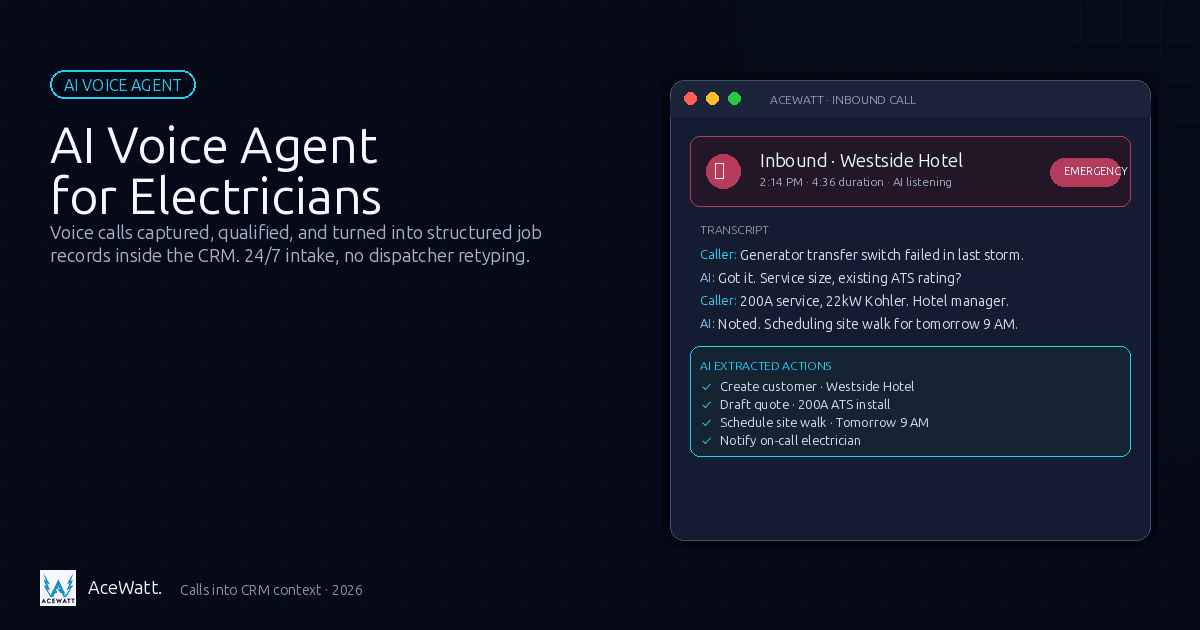
Quick answer: An AI voice agent for electricians is a voice-driven system that answers calls, talks through job details with the caller, qualifies urgency, and hands the result off to a human, calendar, or CRM. AI voice agents for electricians are the front-door layer for the shop; the structured job record lives on the back end. For electrical shops, the right setup is a voice partner on the front end and a structured job record on the back end. AceWatt sits on the back end. It is not a live voice agent. It captures the call transcript or job context from your existing phone system or voice partner and turns it into a structured job record with customer info, scope notes, photos, and follow-up tasks.
That distinction matters. The voice agent is the caller-facing voice. The voice-aware CRM is the system that knows what to do with the call once it ends. Most shops need both, and few vendors do both well. AI voice agents for electricians handle the front door; the CRM handles the back office.
Quick answer: what is an AI voice agent for electricians?
An AI voice agent for electricians is software that holds a real-time spoken conversation with a caller, gathers the details a shop needs to act, and either completes an action or escalates to a human. The voice layer is built on speech-to-text, a language model, and text-to-speech, wired to a phone number.
The "for electricians" part is the hard part. Generic voice agents miss the vocabulary and the safety cues. Electrician calls include panel sizes, service amperage, EV charger models, fault descriptions, property types, and a steady stream of hazards. A voice agent that does not know what an AFCI is, or that "sparking at the meter base" is not a sales lead, will create more work than it saves.
The buying lens this guide uses is not "which vendor has the smoothest demo," but "which voice setup actually fits how an electrical shop runs." For the wider AI picture, the AI agent for electricians overview is a useful starting point.
Voice agent vs AI answering service vs phone agent
The terms get used like they mean the same thing. They do not. Here is the working distinction based on what these products actually do in 2026.
| Capability | AI answering service | AI phone agent | AI voice agent |
|---|---|---|---|
| Primary job | Capture the call and send a summary | Answer, ask scripted intake, route the call | Hold a free-flowing voice conversation and act on it |
| Conversation style | Branching menu or short Q&A | Scripted intake with dynamic follow-ups | Open conversation, follow-ups, clarification questions |
| Typical actions | Send a transcript, SMS summary, or ticket | Book a slot, page a tech, transfer the call | Book, update CRM, send quote follow-up, trigger handoff |
| Best fit | Low call volume, basic after-hours coverage | Shops that want intake, not full conversation | Shops that want calls handled end-to-end with a human in the loop |
| Common risk | Drops context that the office has to retype | Sounds robotic on edge cases | Over-promises, hallucinates, or commits to unsafe guidance |
If you have read our AI phone agent for electricians and AI answering service for electricians guides, the short version is this: an answering service is a notepad, a phone agent is a receptionist, and a voice agent is closer to a junior dispatcher who never sleeps. When evaluating AI voice agents for electricians, none of them are a licensed electrician, and none of them should be, every quote, code call, and scope decision they draft still needs a qualified human reviewer, consistent with NFPA electrical safety guidance.
Why the label matters for your shopping list
Sales pages blur these categories on purpose. A "voice agent" may only be an answering service. An "AI receptionist" may be a full voice agent with a friendlier name. Ask vendors which row of the table their product actually lives in, and what happens to the transcript after the call ends. The honest answer tells you almost everything.
What "good" looks like for AI voice agents for electricians
Most voice agent demos feel impressive for five minutes. The real test is what happens on the second Tuesday of the month when the caller is panicking about a partial outage, two dogs are barking, the call drops, and the office has to pick up the pieces. Here is the checklist a shop should run every vendor through.
- Service-area awareness. The agent should know your dispatch zones, your response times, and your service hours. If the agent says "we can have someone there in 20 minutes" for a service area that takes 90 minutes to reach, the vendor is overselling.
- Electrical vocabulary, not just generic intake. The agent should at least recognize the common terms: panel, breaker, AFCI, GFCI, subpanel, service entrance, meter base, EV charger, hot tub, generator transfer switch, tenant improvement, retrofit.
- Emergency routing that does not diagnose. A burning smell, a visible arc, water near a panel, a downed service drop, or a shock incident should escalate fast and skip the diagnostic script. The agent should tell the caller to contact the utility or 911 where appropriate and then page a human.
- Honest about what it cannot do. The agent should not promise pricing, code compliance, permit timelines, or warranty outcomes. It should tee those up for a human follow-up.
- Structured handoff. The transcript should land in the job record with caller name, callback, address, property type, scope, urgency, access notes, and any photos or texts the caller sent. A paragraph of text is not a handoff; a structured record is.
- Owner override. The owner or on-call tech should be able to jump on a live call, take it back, or change routing in real time.
- Local recording and privacy compliance. Shops are bound by state one-party or two-party consent rules. The vendor should make the disclosure script clear and editable.
- Spam and vendor filtering. Electrical offices get pitched by suppliers, recruiters, and SEO agencies all day. The voice layer should not waste your time on those.
If a vendor passes all eight without waffling, they are worth a real pilot. If they stumble on emergency routing or structured handoff, the office will be redoing the work the voice agent was supposed to save. This is the gap that separates usable AI voice agents for electricians from impressive-looking demos.
The 2026 voice-agent feature checklist
Buying criteria moved fast in the last year. Here is what the strongest 2026 setups include, and what is still rare.
| Feature | What it means for an electrician | Status in 2026 |
|---|---|---|
| Real-time voice in natural language | Caller can describe the problem in their own words, no menu tree | Table stakes |
| Bilingual or multilingual support | Spanish at minimum in most US service areas | Common, quality varies |
| Tool calling into CRM and calendar | Voice agent creates or updates a lead, job, or appointment | Common on mature platforms |
| SMS or photo handoff mid-call | Caller can text a panel photo or gate code during the call | Available, underused |
| Owner take-over mid-call | Owner can grab the call from the AI on a bad moment | Common, sometimes buried in settings |
| Voicemail fallback with transcription | After-hours and overflow calls still produce a record | Standard |
| Custom electrical scripts and FAQs | Vendor lets you edit the script, vocabulary, and triage rules | Common, depth varies |
| Call recording with consent script | Records calls with editable disclosure language | Standard, double-check your state |
| Per-minute or per-call pricing | Clear usage-based pricing instead of seat licenses | Common |
| Integration with field service or CRM | Connects to a real CRM, not just a transcript inbox | Mixed, ask for a live demo |
| Permit, code, or inspection-aware routing | Understands jobs that need a permit pull or utility coordination | Rare, but emerging |
| Multi-tech dispatch awareness | Routes based on tech skill, location, and current job | Rare on voice side, more common on dispatch side |
The last two rows are where most shops run into trouble. Voice agents are good at the call. They are weak at knowing that a 400-amp service upgrade needs the utility on the schedule, that a multi-tech commercial build-out needs a project manager looped in, and that a panel swap in a two-week inspection backlog jurisdiction should not be quoted for next Tuesday. Those are workflow problems, not voice problems, which is exactly why a CRM and dispatch layer still matters.
Voice agent comparison: AI voice agents for electricians
Below is a vendor-level view based on public marketing pages and product docs. We did not name prices, because vendors update them without notice and most are quote-only. Treat this as a starting map, not a final decision.
| Vendor | What it is | Strength | Honest weakness for an electrical shop |
|---|---|---|---|
| Benetics | Industry-specific voice agents for home services | Tuned for trades vocabulary | Smaller electrician footprint than Benetics' HVAC play |
| Voiceflow | Voice agent builder platform | Flexible for shops that want to build their own | Not a turnkey receptionist; you build the workflow |
| IncorporatingAI | AI receptionist and call-handling service | Easy onboarding, decent summaries | Limited electrical-specific tuning out of the box |
| Waboom | AI receptionist and lead capture | Quick setup, SMB-friendly | Generic intake; light on trade vocabulary |
| Phonely | AI receptionist for service businesses | Strong call handling, calendar integration | Emergency routing and custom scripts need work |
| ElevenLabs | Voice and speech platform | Best-in-class voice quality | You build the agent; not a turnkey receptionist |
| Bland | AI phone agent platform | Programmable, scales for multi-location shops | Less SMB hand-holding; you wire it up |
| Retell | Voice agent platform with tool calling | Strong conversational quality, good API | You build and host the workflow |
| AceWatt (context) | CRM and workflow layer with voice documentation | Captures the call transcript into a structured job record | Not a live caller-facing voice agent |
We put AceWatt in the table on purpose. Most buyers compare a voice agent against a CRM, when the more useful question is which voice agent pairs cleanly with which CRM. The strongest AI voice agents for electricians are the ones that hand off cleanly to the back office. AceWatt is the CRM and workflow side; the voice part comes from a partner or your existing phone system. The voice AI for electrical contractors guide and the AI CRM for contractors guide are both worth reading alongside this one. Our pricing page shows how the workflow side breaks down.
Where AI voice agents for electricians fall short
A voice agent that demos well in a quiet office is not the same as one that survives a year in a real electrical business. The gap shows up in four places.
Code, permits, and dispatch
Electrical work is gated by code cycles, permit timelines, utility coordination, and inspection windows. AI voice agents for electricians do not know that a service upgrade sits on a two-week inspection backlog, that the utility is scheduling cutovers three weeks out, or that a panel swap needs a load calc, not just a parts list. It also routes by "is anyone available" rather than by skill, license level, location, vehicle, and current job. For a one-tech residential shop that is fine. For a multi-crew commercial and service mix, who is closest, who is licensed, who has the right test gear, and who is not mid-install is dispatch logic, not voice logic. The electrical contractor software features guide covers the operational gaps beyond the phone call, and the voice job walk documentation app page covers the field side.
Scope drift, change orders, and the human floor
A residential service call can become a panel upgrade. A tenant improvement can become a service change and a lighting redesign. AI voice agents for electricians commit to the original scope, then drop the ball when the field tech discovers the actual situation. A workflow system that supports change orders, scope notes, and follow-up documentation keeps the office from retyping the same job three times. A voice agent should also never tell a caller an energized condition is safe, confirm code compliance from a phone call, or downplay a hazard to keep a sale moving. Voice can capture and route. It cannot diagnose or clear.
How AceWatt fits beside an AI voice agent
AceWatt is the CRM, scheduling, quoting, job-walk, and reporting layer for electrical shops. It is not a live caller-facing voice agent. What it does well is take whatever the voice partner on the front end produces and turn it into a structured job record with the right fields, photos, and follow-up tasks. This is what makes AI voice agents for electricians actually pay off, the back end has to understand what the call captured. The voice documentation feature page is the most direct description of that workflow.
In practice, the pairing looks like this.
- The voice agent or answering service takes the call and produces a transcript plus a structured summary.
- AceWatt receives the summary and creates or updates the lead, contact, and job record.
- The lead lands in the right pipeline stage (new lead, callback, emergency, quote request) with the right urgency tag.
- The office or on-call tech reviews the record and triggers the next step: job-walk, quote draft, dispatch, or callback.
- Field-side voice job walk notes add the site context the voice agent never had.
- The job moves through quote, contract, schedule, work order, invoice, and follow-up without the office retyping the call.
The voice agent is the front door. AceWatt is the back office. The CRM for electricians overview walks through the rest of that picture. AceWatt does not pretend to be the voice agent. We will not claim our software picks up the phone, or invent pickup rates, revenue lift numbers, or call-conversion percentages we have not measured. If you are already paying for a voice partner or answering service, the bigger leak is usually on the back end, where the office retypes the call into a CRM that does not understand electrical scope.
Implementation checklist
Clean rollout matters more than a flashy vendor. Here is the order to use when bringing on one of the AI voice agents for electricians and connecting it to AceWatt for the first time.
- Map your real call types. List the 8 to 12 most common reasons people call your shop, emergencies, service, residential, commercial, and the weird calls you get every month. The voice agent's script is only as good as this list.
- Write the human floor rules first. Before the vendor touches your script, decide what the agent must never say, what it must escalate, and what it must hand off. Code, safety, permits, pricing, and warranty are the usual "never say" categories.
- Decide the CRM fields you need at intake. Caller name, callback, address, property type, service category, urgency, access notes, photo status, and preferred contact window are a reasonable starter set. Avoid a 30-field form; callers hang up.
- Pick the voice partner with the CRM hook. If the vendor cannot pass a clean structured summary into AceWatt, your office will be retyping. Ask for a live demo of the integration, not a slide.
- Run a 14-day shadow week. Let the voice agent run, but keep a human reviewing transcripts. The first two weeks expose almost every edge case.
- Tune the script with real transcripts. Use the actual calls, not the imagined ones. Your callers will not talk like the vendor's demo callers.
- Connect the back end. Wire the call summaries into the AceWatt lead and job pipeline. This is where the time savings show up. Review the pricing options to see how the workflow side fits.
- Train the office on the new handoff. The office is the reviewer. If nobody is reading the AI's output, the lead still leaks.
- Set a 30-day and 90-day review. Look at call volume, after-hours coverage, lead-to-quote conversion, and time-to-callback. Adjust the script, routing, and CRM fields based on what you actually see.
- Document the safety and compliance language. Recording consent, privacy, and emergency escalation need to be in writing. If you operate in a two-party consent state, your disclosure script matters even more.
Frequently Asked Questions
Is AceWatt an AI voice agent for electricians?
No. AceWatt is a CRM and workflow platform for electrical contractors. The closest live capability is voice documentation and voice job-walk capture, which turn spoken notes into structured job records. For the caller-facing voice layer, pair AceWatt with one of the AI voice agents for electricians that fits your call volume and budget.
What is the difference between an AI voice agent and an AI phone agent?
A phone agent is a broader category covering AI-assisted call handling, including scripted intake and menu-based answering. A voice agent is a more specific product that holds a real-time spoken conversation, asks follow-up questions, and acts on the answers. When comparing AI voice agents for electricians specifically, the terms get used interchangeably in marketing, so ask each vendor what their product actually does on a live call.
Do I need a voice agent if I already have an answering service?
An answering service is fine if your main pain is just capturing the call and getting a summary. A voice agent is worth the upgrade if you want the call to be interactive, with intake, urgency triage, calendar booking, and structured CRM updates. If the office is still retyping transcripts, the bottleneck is on the back end.
How much do AI voice agents for electricians cost?
We are not going to quote prices, because vendors update them often and most are quote-only. Expect a mix of per-minute usage fees, per-call fees, and setup or platform fees for AI voice agents for electricians. The right comparison is total cost of ownership against the time your office currently spends on after-hours calls, missed-call callbacks, and lead retyping.
What features matter most for an electrical shop?
Service-area awareness, electrical vocabulary, emergency escalation that does not diagnose, structured CRM handoff, owner take-over, and clean recording-consent scripts. Deep multi-tech dispatch, complex IVR trees, and elaborate tool chains matter less for a small shop. Among AI voice agents for electricians, a focused, well-tuned setup usually beats the most powerful platform on the market.
Will an AI voice agent replace my office staff?
No, and any vendor who claims otherwise is overselling. AI voice agents for electricians take the first layer of intake and routing off the office's plate. A qualified human still needs to review the call, confirm scope, handle emergencies, manage dispatch, talk to GCs and property managers, and close the job. A voice agent makes the office faster, not smaller.
How does AceWatt connect to a voice agent or answering service?
AceWatt is the back end. The voice partner produces a transcript and a structured summary, which AceWatt turns into a lead, contact, and job record with the right fields, urgency, and follow-up tasks. The voice documentation feature page describes the closest live capability. The exact integration depends on which of the AI voice agents for electricians you choose as your partner.
What about privacy, consent, and legal liability?
This is not legal advice. Voice AI in the US is governed by a mix of federal and state rules around recording consent, privacy, telemarketing, and AI disclosure. One-party and two-party consent states treat call recording differently, and some states have specific rules around AI-generated voices on consumer calls. Your safest path with AI voice agents for electricians is a clear disclosure script, a recorded-consent step, a written transcript retention policy, and a human-in-the-loop review before any commitment is made. Talk to a licensed attorney in your state for advice specific to your business.
_Disclaimer: This article is for general informational purposes only and is not legal, tax, insurance, or safety advice. AI voice agents for electricians are evolving quickly, and their capabilities and limitations change. Always verify the current features, consent rules, and integration setup of any vendor before relying on it for live customer calls. Electrical work is governed by the National Electrical Code, local amendments, utility rules, and permit requirements that no voice agent can interpret or apply on a phone call. Use voice AI to capture and route, not to diagnose, price, or commit._