
Electrical contractor insurance tracking software is the tooling that manages the documents, dates, and compliance obligations that surround every electrical job, certificates of insurance (COIs), policy renewals, subcontractor coverage verification, lien waivers, and bonding requirements. For electrical contractors, insurance tracking software replaces the spreadsheet-and-email approach that lets an expired policy slip through, an uninsured subcontractor step on a site, or a missed lien-waiver deadline cost a contractor their lien rights. The software tracks each document against each job and each party, flags expirations before they become problems, and produces the evidence a general contractor or building owner requires before a crew is allowed to work.
If you handle this on a phone in the field, see our guide to the best mobile app for electrical safety inspections first — it covers the workflow end to end.
Why Electrical Contractors Need Insurance Tracking Software
The risk surface for an electrical contractor is wider than most trades. You handle energized systems, work at heights, and operate on sites where multiple contractors overlap. Insurance is not a formality, it is the financial backstop for when something goes wrong. The tracking problem is real:
COI expiration gaps. A general contractor requires you to maintain a current certificate of insurance on file before you can mobilize. If your policy renews and the new COI does not reach the GC's compliance desk before the old one expires, your crew can be pulled off the site. That is lost time, a strained relationship, and in some cases a breach-of-contract claim. Software that tracks the expiration date and sends an automatic renewal reminder prevents the gap.
Subcontractor compliance. If you use subcontractors, common on large commercial pulls, you are typically required to verify that each sub carries their own general liability and workers' compensation coverage. If a subcontractor's policy lapses mid-project and an injury occurs on your job, the liability can cascade to you. Tracking each subcontractor's COI expiration, coverage limits, and additional-insured endorsement is not optional due diligence, it is contractually required on most commercial work. The tax side belongs in the same operating file, which is why 1099 subcontractor tracking for electrical contractors should sit next to COI tracking.
Lien waiver deadlines. Many states tie mechanic's lien rights to specific lien waiver exchanges, conditional waivers on progress payments, unconditional waivers on final payment. Miss a deadline or fail to exchange the right waiver, and you can lose the right to file a lien for unpaid work. Insurance tracking software that also manages lien waiver timing keeps that right intact. This connects to broader electrical contractor project management but is specialized enough to warrant its own tracking.
Bonding and license renewals. Electrical contractors operating in multiple jurisdictions may hold state electrical licenses, local business licenses, and surety bonds, each with its own renewal cycle. An expired license can invalidate a permit or void a contract. Tracking these alongside insurance keeps the compliance surface in one view rather than scattered across calendars and inboxes.
What Insurance Tracking Software Should Do
The useful tools go beyond a digital filing cabinet. They actively manage the lifecycle of each document and each obligation.
Centralized COI management. Upload, store, and retrieve certificates of insurance for every party, your own policies, your subcontractors, and the additional-insured endorsements required by each project owner. The software should surface the coverage limits, the policy effective and expiration dates, and the named additional insureds without requiring you to read a PDF every time.
Automated expiration alerts. The single most valuable feature. The software tracks every expiration date and sends alerts, typically 30, 60, and 90 days out, to the right person. An alert 30 days before a subcontractor's workers' comp policy expires gives you time to request a renewal COI before the policy lapses. This is the difference between managing compliance and reacting to a crisis.
Job-specific document linking. Each COI, lien waiver, and bond should be linked to the specific job and party it covers. When a GC asks for "your current COI for the Riverside project," you produce it in seconds, not after ten minutes of searching email. This job-level linking mirrors how daily reports and change orders are tied to a job in a connected CRM.
Subcontractor verification workflow. Before a subcontractor starts work, the software should verify that their COI is current, that the coverage limits meet your contract requirements, and that the additional-insured endorsement names the right parties. A workflow that blocks subcontractor mobilization until verification is complete prevents the most common compliance failure.
Audit-ready reporting. If a building owner, an insurance auditor, or a state board asks for proof of coverage on a specific date for a specific job, the software should produce it instantly. Reporting that shows every document, every party, every job, and every expiration in one view turns a multi-day audit into a one-hour export.
How Insurance Tracking Fits the Broader CRM Workflow
Insurance tracking is not a standalone function. It sits inside the project lifecycle, and the most useful software connects it to the surrounding workflow.
Pre-job onboarding. Before a job starts, the compliance checklist includes your own COI uploaded to the project, any subcontractor COIs verified, the contract signed, and the bonding in place. Insurance tracking software that ties into the job onboarding process ensures no job mobilizes with an incomplete compliance file.
Progress payment verification. On many commercial projects, each progress payment requires a current COI on file and a conditional lien waiver exchanged. If the COI has expired between payment cycles, the payment can be held. Software that flags the expiration before the payment cycle keeps cash flow moving, connecting to your broader electrical contractor invoicing software workflow.
Final closeout. Final payment typically requires an unconditional lien waiver, a final COI, and sometimes a bond release. The closeout checklist in the software should confirm every document is in place before the final invoice is submitted, the same closeout discipline that governs punch list completion.
Customer communication. When a property manager or GC requests an updated COI, the request and the response should live in the customer record, not in a separate email thread that disappears when a team member leaves. This is the same centralized customer communication that powers electrical contractor client portals.
Common Insurance Tracking Mistakes
Accepting a COI without checking the details. A certificate that shows "General Liability: $1,000,000" is not the same as one that shows "$2,000,000 per occurrence / $4,000,000 aggregate." Coverage limits matter. Additional-insured endorsements matter. Subrogation waivers matter. If you file the COI without verifying the specifics against your contract requirements, you are carrying risk you think you transferred.
Letting a subcontractor's policy lapse unmonitored. Subcontractor policies renew on their own cycle. If you collected a COI at the start of a six-month project and never checked it again, the policy may have expired in month three. A mid-project audit or an incident exposes the gap, and the liability may fall on you. Automated expiration tracking is the fix.
Confusing insurance with bonding. Insurance covers liability for damage or injury. A surety bond guarantees performance of the contract. They are different instruments with different requirements. Tracking them in the same system is fine, treating them as interchangeable is not. Verify with your insurance broker and surety agent which instruments each project requires.
Missing lien waiver timing. Lien waiver rules vary by state. In some jurisdictions, exchanging a conditional waiver is a prerequisite to receiving a progress payment. If the tracking software does not manage lien waiver timing alongside insurance, the contractor can lose lien rights without realizing it. This is a legal-obligation boundary, consult a construction attorney for the rules in your jurisdiction.
Choosing Electrical Contractor Insurance Tracking Software
Trade-specific document types. The software should handle the documents that matter to electrical contractors, COIs with additional-insured endorsements, workers' comp certificates, surety bonds, state electrical licenses, and local permits. A generic document manager that treats every PDF the same misses the compliance logic.
Integration with job and customer records. Insurance documents are tied to jobs and parties. The software should link each document to the job record and the subcontractor or customer record, the same structure that powers electrical contractor CRM workflows. Standalone insurance tracking that does not connect to the job forces duplicate data entry.
Automated, configurable alerts. The alert system should let you set reminder windows per document type, 30 days for a COI, 60 days for a license renewal, 90 days for a bond. One-size-fits-all alerts are less useful than configurable ones that match the real lead times of each obligation.
Audit and reporting depth. The reporting should answer: which jobs have a current COI on file? Which subcontractors have a policy expiring in the next 60 days? Which liens waivers have been exchanged for this project? If the software cannot answer these in one report, it is a filing cabinet, not a tracking system.
AceWatt and Insurance Tracking
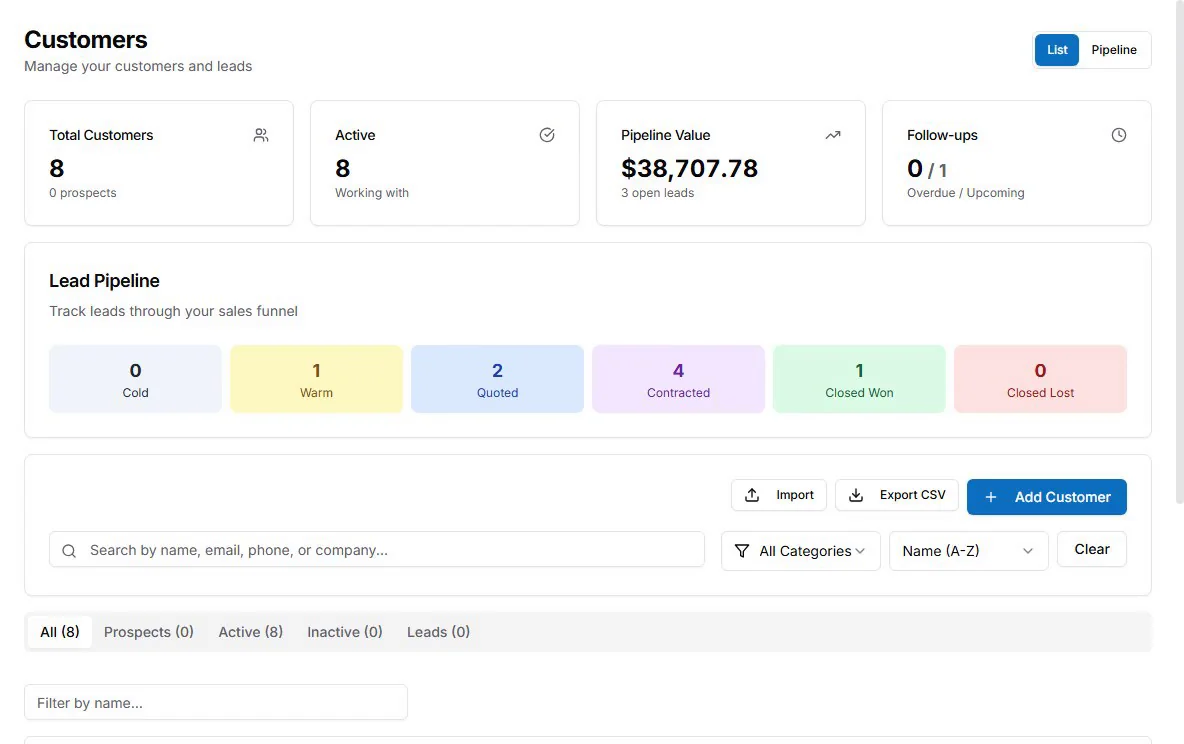
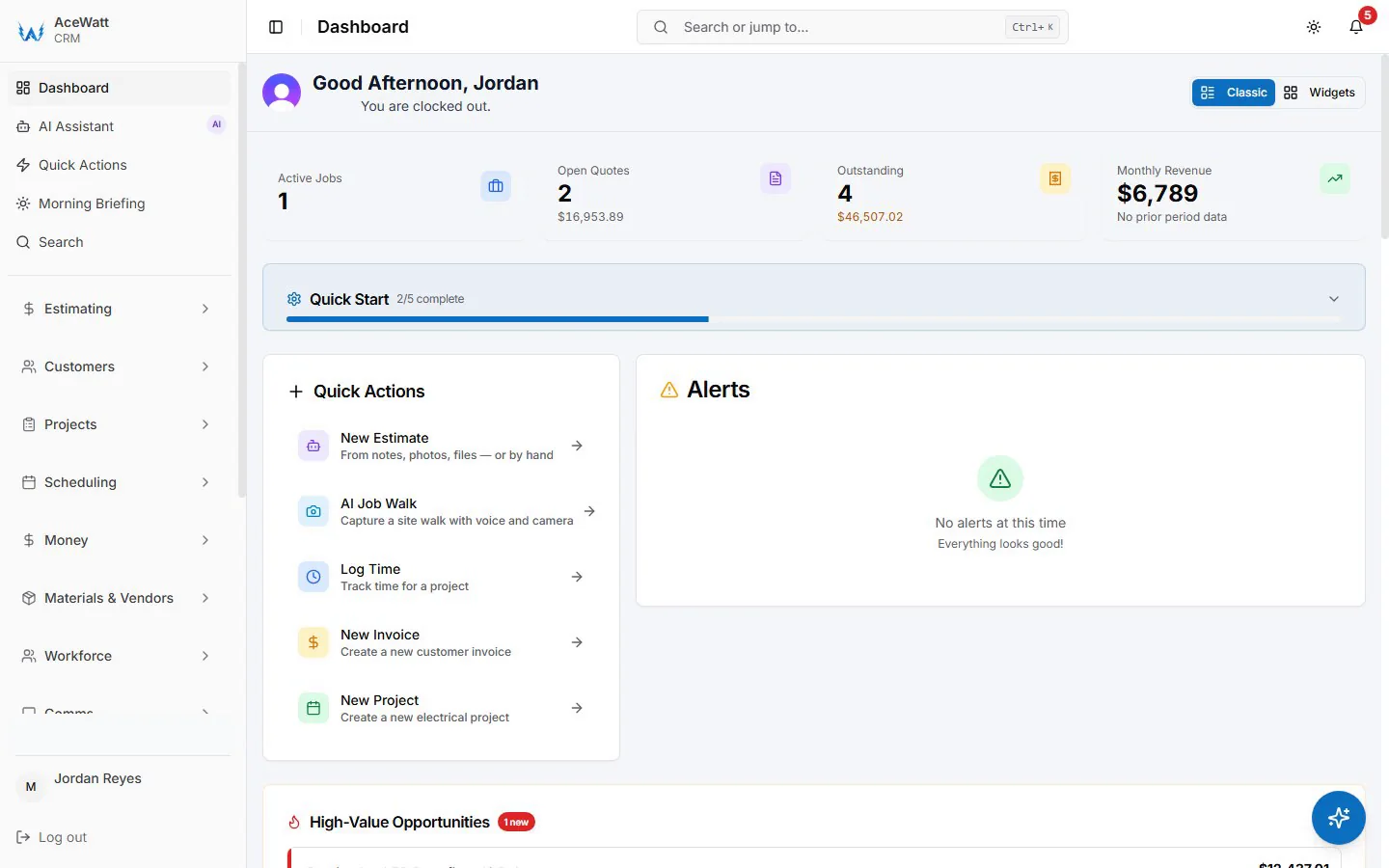
AceWatt's CRM is built around the job and customer record, the estimate, the schedule, the daily report, the invoicing, and the communication all connect. Insurance tracking in AceWatt is narrower than a document system: your own company's insurance expiry date and bond number live in Settings, and each subcontractor record carries an insurance-expiry date that shows as Expired once it passes. AceWatt does not store COI or certificate documents and does not send expiry alerts, so the certificates themselves stay in your document system.
AceWatt does not replace your insurance broker, your surety agent, or your construction attorney. Coverage limits, additional-insured requirements, lien waiver rules, and bonding obligations involve professional judgment that software supports but does not replace. What AceWatt provides is a visible expiry date for your own policy and for each subcontractor, alongside the rest of the project records; reminders and document storage need another tool. Plans start at $49/month with a 14-day free trial.
Frequently Asked Questions
What is electrical contractor insurance tracking software?
Electrical contractor insurance tracking software is the tooling that manages the insurance and compliance documents tied to electrical jobs, certificates of insurance, subcontractor COIs, workers' comp certificates, surety bonds, state licenses, and lien waivers. It tracks expiration dates, sends renewal reminders, links documents to specific jobs and parties, and produces audit-ready reports.
Why do electrical contractors need COI tracking?
General contractors and project owners require a current certificate of insurance on file before a crew can work. If a policy expires and the renewal COI is not submitted before the old one lapses, the crew can be pulled off the site. COI tracking software monitors expiration dates and sends automatic reminders so the renewal reaches the compliance desk before the gap occurs.
How does insurance tracking software handle subcontractor compliance?
Before a subcontractor begins work, the software verifies that their COI is current, that the coverage limits meet the contract requirements, and that the additional-insured endorsement names the correct parties. The software then tracks the subcontractor's policy expiration and alerts the contractor before the policy lapses, so an uninsured subcontractor does not work on the job.
Does insurance tracking software replace an insurance broker?
No. Insurance tracking software manages the documents and dates, it does not set coverage limits, write policies, or provide coverage advice. Your insurance broker determines the appropriate coverage, your surety agent handles bonding, and your construction attorney handles lien waiver and contract compliance. The software keeps the tracking organized so those professionals can do their work without document chaos.
Can AceWatt track insurance documents?
Partly. AceWatt stores your own company's insurance expiry date and bond number in Settings, and each subcontractor record carries an insurance-expiry date that shows as Expired once it passes. It does not store COI or certificate documents and does not send expiry alerts, so keep the certificates themselves in your document system. Insurance coverage decisions, lien waiver legal requirements, and bonding obligations remain the responsibility of the contractor's licensed professionals.
What is the difference between a COI and a surety bond?
A certificate of insurance documents that a liability policy is in force, covering damage or injury claims up to the policy limits. A surety bond is a three-party guarantee that the contractor will perform the contract; if the contractor fails, the surety pays the project owner and then seeks reimbursement from the contractor. They are different instruments, often both required on commercial work, and should be tracked separately even if stored in the same system.
Insurance tracking is one module of many: browse them all on the AceWatt features overview.