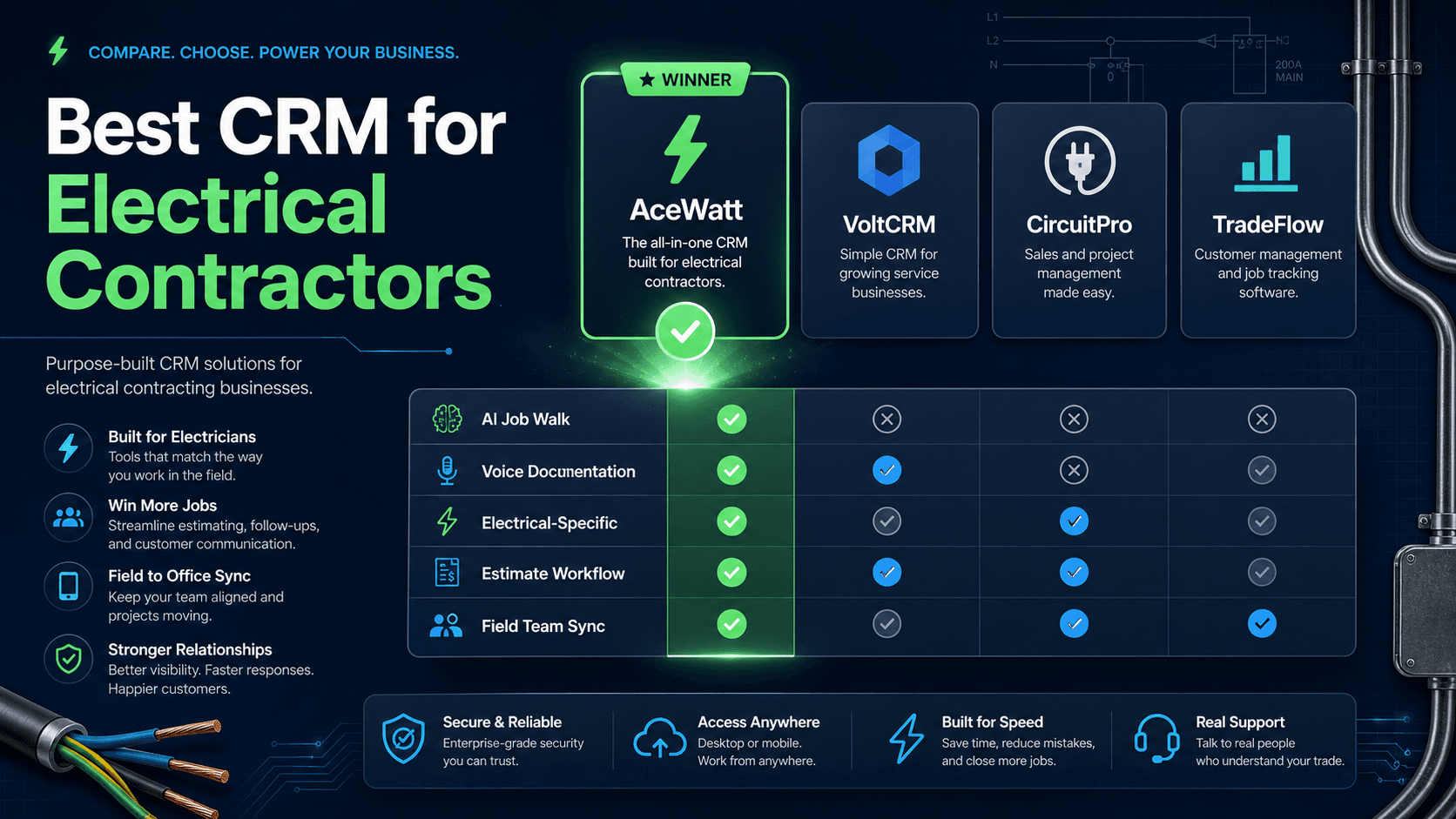
Choosing a CRM for electrical contractors is not the same as choosing a CRM for a software company, a real estate office, or a generic field service business. Electricians have specific workflows (job walks, panel inspections, NEC code references, tiered estimating, permit tracking, staged invoicing) that a generic CRM simply ignores. The best CRM for electrical contractors is one built for how electricians actually run jobs: from the first lead, through the site visit and estimate, into the work order and invoice, with follow-up automation that does not require a dedicated office manager. This guide compares the best CRM for electrical contractors in 2026 so you can choose based on features, pricing, and real fit, not marketing claims.
Quick answer: The best CRM for electrical contractors in 2026 is one built specifically for electrical workflows: AI job walks, tiered estimating, dispatch, invoicing, and follow-up automation in a connected pipeline. AceWatt is among the few CRMs built exclusively for electricians (from $49/mo, 14-day trial). ServiceTitan is the enterprise option for 20+ tech operations. Housecall Pro and Jobber are competent generalist field-service platforms. According to the U.S. Bureau of Labor Statistics, over 700,000 electricians work in the U.S., and the shops winning work are the ones that stop running on clipboards and spreadsheets.
What Electricians Actually Need from a CRM
A generic CRM (HubSpot, Salesforce, Zoho) is built around a sales pipeline: leads, contacts, deals, follow-up tasks. That model works for a company selling software or consulting hours. It breaks down for an electrical contractor because an electrician's "deal" is not a phone call and a contract. It is a site visit, a scope assessment, a tiered estimate, a permit, a crew, materials, and an invoice that has to reflect what actually happened on the job.
What electricians actually need from a CRM is a connected pipeline that covers the full electrical job lifecycle:
- Lead capture and qualification: structured intake that captures service type, urgency, panel details, photos, and service area, not just a name and email
- Job walk documentation: voice and photo capture on site that records scope, conditions, and materials without a clipboard
- Estimating: tiered quotes (good/better/best, or scope variants) generated from field notes, with NEC-aware material and labor context
- Scheduling and dispatch: assigning the right tech with the right materials to the right job, with customer notifications
- Work order execution: digital documentation of what was done, with photos, signatures, and material/labor capture
- Invoicing and payment: invoices that flow from the work order, with online payment and staged billing for larger jobs
- Follow-up automation: AI that flags cold leads, drafts outreach, and triggers warranty or maintenance check-ins without manual babysitting
When electricians try to run this lifecycle on a spreadsheet, a generic CRM, or a patchwork of single-purpose apps (one for scheduling, one for estimating, one for invoicing), the seams are where revenue leaks. The estimate does not match the work order. The work order does not match the invoice. The follow-up lives in someone's head and does not happen. A field-service CRM built for electricians eliminates those seams.
How We Evaluated These Electrician CRMs
This comparison focuses on the best CRM for electrical contractors, meaning tools that are either built for electricians or commonly used by electrical contractors. The evaluation criteria:
- Electrical-specific features: does the tool understand electrical workflows (job walks, panel context, NEC references, tiered estimating) or is it a generic field service tool adapted to trades?
- AI capabilities: does it use AI to reduce back-office work (voice documentation, auto-estimates, follow-up copilot) or is AI just a marketing word?
- Mobile experience: can techs actually use it in the field, on a phone, with gloves on, in a basement with no signal?
- Pricing transparency: is pricing published, or do you have to get on a sales call? Does it scale per-user in a way that penalizes growth?
- Connected pipeline: does estimating flow into invoicing, or are they separate modules that require re-entry?
- Trial availability: can you try it before committing, or is there a mandatory implementation process?
The tools below are the ones electricians actually evaluate and buy. We are honest about where each one excels and where each one falls short, including AceWatt.
Top Electrician CRMs Compared (2026)
AceWatt: AI-Powered CRM Built Exclusively for Electricians
AceWatt is the row in this comparison built specifically and exclusively for electrical contractors. Every feature (job walks, estimating, dispatch, invoicing, follow-up) is designed around how electricians run jobs, not adapted from an HVAC or plumbing template.
Strengths:
- AI Job Walk: voice and photo capture on site that documents scope in minutes, replacing the clipboard job walk
- Voice documentation: techs narrate the work hands-free; the transcript becomes the job record
- Automated estimating: tiered estimates generated from field notes and job walk data
- AI Copilot: flags cold leads, drafts follow-up, surfaces jobs that need attention
- Connected pipeline: estimate → work order → invoice with no re-entry
- Electrical-native throughout: NEC references, panel context, permit awareness built into the workflow
- Transparent pricing starting at $49/month with a 14-day trial
Best for: Electrical contractors from 1 to 20 techs who want AI to handle the back office and want a tool that speaks electrical, not generic trades.
Limitations: Not built for multi-trade shops that also do plumbing, HVAC, or roofing. Not an enterprise-scale dispatch platform for 50+ tech operations. Deep accounting integrations (full QuickBooks sync) should be confirmed with the product team for current status.
ServiceTitan: Enterprise Platform for Large Operations
ServiceTitan is the heavyweight of field service software, a comprehensive platform covering dispatch, accounting, payroll, inventory, marketing, and more. It is used by large electrical, plumbing, and HVAC companies with dedicated office staff.
Strengths:
- Deep feature set across dispatch, accounting, payroll, and inventory
- Handles high-volume, multi-truck operations
- Strong reporting and business intelligence
- Established training and certification ecosystem
Best for: 20+ tech shops with dedicated dispatchers, office managers, and the budget for implementation. Not electrical-specific; it is a general field service platform.
Limitations: Requires significant implementation time and cost. Pricing is not published (sales-call required). Not built specifically for electricians; electrical workflows are supported but not native. Overkill for solo operators and small shops.
Housecall Pro: All-in-One for Home Service Businesses
Housecall Pro is a popular all-in-one field service tool covering scheduling, dispatch, invoicing, and customer communication across multiple trades.
Strengths:
- Clean, user-friendly interface
- Good scheduling and dispatch features
- Solid invoicing and payment processing
- Strong mobile app for techs
Best for: Multi-trade residential shops (electricians who also do plumbing or HVAC) or solo operators who want a simple, competent tool.
Limitations: Not electrical-specific; it is a general home-service platform. Limited AI capabilities compared to newer entrants. Estimating is basic compared to tools built for electrical scoping. Follow-up automation requires manual setup.
Jobber: Popular Field Service CRM
Jobber is a widely used field service management tool with strong brand awareness, scheduling, and a clean mobile app.
Strengths:
- Good scheduling and dispatch
- Clean, intuitive interface
- Strong content and training resources (Jobber Academy)
- Affordable for small teams
Best for: General field service businesses and solo operators who prioritize scheduling and basic job management. Good starting point for a new shop.
Limitations: Not electrical-specific. Estimating features are weaker than dedicated electrical quoting tools. Limited AI capabilities. Work order and invoicing depth is basic compared to AceWatt or ServiceTitan.
QuoteIQ: Electrician-Focused CRM
QuoteIQ is a CRM focused specifically on electricians, with an emphasis on quoting speed and customer self-service features.
Strengths:
- Electrician-specific focus
- Quoting and estimating features built for electrical work
- Customer self-quoting and self-scheduling features
Best for: Residential electricians focused on quoting speed and customer self-service intake.
Limitations: Smaller ecosystem than the generalists. Less depth in dispatch and crew management for multi-tech operations. AI capabilities are more limited than AceWatt's.
FieldEdge: Electrician Software with CRM
FieldEdge is a dispatch-heavy field service platform commonly used by established electrical and HVAC shops.
Strengths:
- Strong dispatch and scheduling features
- Built-in reporting and business intelligence
- Franchise-friendly features
Best for: Established shops with dedicated dispatch operations and a need for structured reporting.
Limitations: Franchise and enterprise orientation. Pricing requires a sales call. Less focus on AI and modern mobile experience than newer entrants.
Feature Comparison Table
When choosing the best CRM for electrical contractors, the comparison table below shows the features that matter most for electrical shops. Use it to identify which platform fits your electrical workflow, from AI job walks to tiered estimating to connected invoicing.
| Feature | AceWatt | ServiceTitan | Housecall Pro | Jobber | QuoteIQ |
|---|---|---|---|---|---|
| Electrical-specific | Built exclusively for electricians | General field service | Multi-trade | General field service | Electrician-focused |
| AI Job Walk | Yes (voice + photo) | No | No | No | No |
| Voice documentation | Yes | No | No | No | No |
| AI-generated estimates | Yes (from field notes) | Limited | No | No | Limited |
| AI follow-up copilot | Yes | No | No | No | No |
| Tiered estimating | Yes | Yes | Basic | Basic | Yes |
| Invoicing + payment | Yes | Yes | Yes | Yes | Yes |
| Mobile app | Yes, mobile-first | Yes | Yes | Yes | Yes |
| Pricing transparency | Yes (from $49/mo) | No (sales call) | Yes | Yes | Yes |
| 14-day trial | Yes | No | Yes | Yes | Varies |
| NEC/code context | Yes | No | No | No | Limited |
What to Look for When Choosing Your Electrical CRM
A CRM for electrical contractors should match how you run jobs. Use this checklist when evaluating any CRM for electrical contractors:
- Is it built for electricians, or adapted from a generic template? Electrical-specific tools understand job walks, panel context, NEC references, and tiered estimating. Generic tools do not.
- Does estimating connect to invoicing? The single biggest efficiency gain is a pipeline where the estimate flows into the work order and the work order flows into the invoice, with no re-entry and no drift.
- Is the mobile app usable by a tech in the field? Large tap targets, voice capture, offline capability, and photo-first design matter. A dispatcher-first interface squeezed onto a phone will not get adopted.
- Is there AI that actually reduces work? Voice documentation, auto-generated estimates, and a follow-up copilot are real AI value. "AI-powered" on a feature page without specific capabilities is marketing.
- Is pricing transparent and scalable? Per-user pricing that penalizes growth is a trap. Published pricing with a trial lets you evaluate before committing.
- Does it handle follow-up automatically? The revenue leak in most electrical shops is the estimate that was sent and never followed up. A CRM that flags cold leads and drafts outreach pays for itself.
- Is there a real trial? A mandatory sales call and implementation process is a red flag for small shops. You should be able to try the tool on a real job before committing.
Warning signs: per-user pricing that doubles your cost when you add a tech, generic templates with no electrical context, no mobile app or a desktop-only interface, and "contact us for pricing" with no published tiers.
Why Electrical-Specific CRM Beats Generic Tools
The argument for the best CRM for electrical contractors over a generic tool (HubSpot, Salesforce, Zoho) or a general field service platform comes down to one thing: the workflow matches the work.
A generic CRM treats an electrical job as a "deal" with a "deal value" and a "close date." An electrical-specific CRM treats it as what it actually is: a lead that needs qualification, a site that needs a job walk, a scope that needs a tiered estimate, a crew that needs dispatching, a job that needs documentation, and an invoice that needs to reflect what actually happened. Every one of those steps has electrical-specific context (panel details, NEC references, permit requirements, material lists, staged billing) that a generic tool cannot capture without custom fields, integrations, and manual workarounds.
The result: shops on electrical-specific CRMs spend less time on back-office work, bill faster, follow up more consistently, and lose less revenue to the seams between tools. Shops on generic CRMs spend their time building workarounds.
AceWatt is built for that workflow. If your shop is electrical-only and you want a CRM that speaks your language, with voice job walks, tiered estimating, AI follow-up, and a connected pipeline from lead to invoice, it is the tool designed for exactly that. Start a 14-day trial and run your next electrical job end to end on it.
Frequently Asked Questions
What is the best CRM for electrical contractors in 2026?
The best CRM for electrical contractors is one built specifically for electrical workflows: lead intake, job walk documentation, tiered estimating, dispatch, invoicing, and follow-up automation. AceWatt is among the few CRMs built exclusively for electricians with AI job walk, voice documentation, and automated estimating. ServiceTitan is the enterprise option for large multi-trade operations. Housecall Pro and Jobber are competent generalists. The right choice depends on your shop size, trade focus, and whether you want AI to handle back-office work.
How much does electrical contractor CRM software cost?
The best CRM for electrical contractors ranges from $49/month for solo shops (AceWatt, with a 14-day trial) to several thousand per month for enterprise platforms like ServiceTitan and FieldEdge that require a sales call and implementation. Housecall Pro and Jobber have published per-user pricing in a similar range to AceWatt. The key is to compare total cost (monthly fee plus per-user scaling, payment processing, and implementation) against the revenue recovered from faster billing, better follow-up, and less back-office work. According to NECA (National Electrical Contractors Association), overhead and back-office efficiency are among the top margin pressures for electrical shops, which is why CRM pricing should be evaluated against the labor hours it recovers, not just the monthly subscription.
Can I use a generic CRM like HubSpot for my electrical business?
You can, but it will require significant customization to match electrical workflows. A generic CRM is not the best CRM for electrical contractors because it is built around sales pipelines (leads, deals, close dates), not field service workflows (job walks, estimates, work orders, invoicing). Most electrical shops that start on a generic CRM end up adding separate tools for estimating, scheduling, and invoicing, which recreates the data-entry problem the CRM was supposed to solve. The best CRM for electrical contractors connects those steps natively.
Does AceWatt integrate with QuickBooks?
For current QuickBooks integration status and capabilities, confirm with the AceWatt product team before committing. Integration availability and depth change over time, and the right answer depends on your QuickBooks version and workflow. AceWatt's invoicing and accounting features handle the billing pipeline natively; QuickBooks sync (if needed for your accountant) should be verified against your specific setup.
What features should an electrical CRM have?
The best CRM for electrical contractors must have: structured lead intake with electrical-specific fields (service type, panel details, photos), mobile job walk documentation with voice and photo capture, tiered estimating from field notes, dispatch and scheduling with customer notifications, digital work orders with signature capture, invoicing connected to the work order, AI follow-up automation for cold leads, and a mobile-first app techs will actually use in the field.
Try an Electrician CRM Built for How You Actually Work
A CRM for electrical contractors is only valuable if it matches how your electrical shop actually runs jobs. The best CRM for electrical contractors is the one that connects lead intake, AI job walks, tiered estimating, dispatch, invoicing, and follow-up into a single pipeline, without the seams where revenue leaks. AceWatt is built for that workflow: voice job walks, AI-generated estimates, a follow-up copilot, and a connected pipeline from lead to invoice. If you are tired of generic tools that do not understand electrical work, start a 14-day trial and run your next job end to end on the best CRM for electrical contractors.