Quick answer: how to get more electrical contractor leads
Direct answer: The most effective approach for electrical contractors in 2026 is a multi-channel lead generation strategy that combines Google Local Services Ads, Google Business Profile optimization, local SEO, referrals, and AI-powered call handling, followed by consistent CRM follow-up so no lead goes cold. Solo electricians can focus on referrals, Google Business Profile, and local SEO. Two- to five-person shops should add Facebook/Instagram ads, Nextdoor, and content marketing. Five- to fifteen-person operations need to layer in LSAs, Google Ads, and structured partnerships.
Electrical contractor lead generation is what ties these workflows together. Lead generation for electrical contractors used to be simple: print your logo on a truck, put some yard signs in people's yards, and wait for referrals. Those methods still work today, but they're no longer enough on their own. Modern customers research online, expect 24/7 availability, and compare options before calling. Meanwhile, lead quality has changed, and it's harder to stand out.
| Lead Source | Cost | Quality | Speed | Best For |
|---|---|---|---|---|
| Referrals | Free | High | Slow | Established shops |
| SEO (organic) | Low ongoing | High | Slow (3-6 mo) | Long-term growth |
| Google Ads | $50-150/lead | Medium | Fast | Immediate pipeline |
| Angi/HomeAdvisor | $30-100/lead | Low-Medium | Fast | Filling gaps |
| Facebook Ads | $20-80/lead | Low-Medium | Medium | Brand awareness |
| Direct mail | $1-3/pc | Medium | Slow | Targeted neighborhoods |
The electrical contractor lead generation landscape in 2026
Why lead generation is harder than 5 years ago
The landscape has shifted in three important ways. First, Google has changed how local service businesses appear in search results. Google Business Profile (formerly Google My Business) is now the center of local discovery, but the space is competitive and requires constant optimization. Second, customer behavior has moved online. People don't call immediately after seeing a sign; they search, read reviews, and compare pricing before calling. Third, more contractors are competing for the same jobs. There are thousands of electrical businesses in most metro areas, and a large portion of them now run ads, post regularly, and track leads. The right electrical contractor lead generation keeps this connected.
This makes electrical contractor lead generation more complex than it used to be, but it also means that contractors who do it right can capture share from competitors who aren't adapting. The biggest opportunity today isn't finding new ways to get leads, it's capturing leads that are already coming in but slipping through the cracks.
The shift from referral-only to multi-channel
The old model: customer calls after a recommendation, contractor accepts the job, gets paid, moves on. A solid electrical contractor lead generation removes that step.
The modern model: customer searches Google, sees multiple electrical contractors, compares online reviews, checks availability, calls, leaves a voicemail, and eventually books with whoever responds first. Good electrical contractor lead generation handles this automatically.
Good contractors now run electrician lead generation campaigns across multiple channels, Google, Facebook, Nextdoor, referrals, and partnerships, all while making sure every incoming call gets answered or captured. This multi-channel approach creates redundancy so if one channel is slow, others can pick up the slack. This is where electrical contractor lead generation earns its cost.
AI's impact on lead capture and follow-up
Artificial intelligence has transformed how electrical contractors handle inbound calls, especially after-hours. AI phone answering services can answer 24/7, capture job details, qualify urgency, and send call notes to the office. For many shops, this eliminates missed calls from jobs, driving, and inspections. It also helps maintain consistency in how information is collected and passed to the rest of the business. That is what well-built electrical contractor lead generation delivers.
The key is that AI should augment your workflow, not replace it. The best setups capture the lead in the CRM and allow your team to follow up naturally, with context about the caller's needs and urgency. The right electrical contractor lead generation keeps this connected.
15 lead generation strategies for electrical contractors
1. Google Local Services Ads (LSAs)
Google Local Services Ads are the colored ads at the very top of Google search results for local services. For electrical contractors, they appear when someone searches for "electrician near me" or "emergency electrician [your city]." You pay per qualified lead, not per click. A solid electrical contractor lead generation removes that step.
LSAs can be very effective for electrical contractors because they're shown to customers who are actively looking for work, and Google vouches for your legitimacy by verifying your license, insurance, and business information. The cost-per-lead is usually higher than standard Google Ads, but the quality is often better because you're paying for actual inquiries, not clicks from people just browsing. Good electrical contractor lead generation handles this automatically.
Things to consider:
- Verify your license and insurance thoroughly. Google will reject applications that are incomplete or have issues.
- Competition varies by metro area. Large cities often have higher costs per lead.
- LSAs don't always show for every search. Local search volume fluctuates.
- You must actually do the work to get reviews, because ratings heavily influence lead volume. Automating the review-request process at job close is covered in our electrical contractor marketing software guide. This is where electrical contractor lead generation earns its cost.
2. Google Business Profile optimization
Your Google Business Profile is your digital storefront. It's the first thing customers see when they search for electrical services in your area. It controls your map listing, business information, website link, and reviews. That is what well-built electrical contractor lead generation delivers.
Optimization steps:
- Complete all sections: services offered, hours, payment methods, photos, and FAQs.
- Post regularly. Local service posts appear in search results and show activity.
- Encourage reviews from satisfied customers. Respond to every review, positive and negative.
- Keep photos updated with current crew trucks, equipment, and recent work.
- Include your service area clearly so people know where you operate. The right electrical contractor lead generation keeps this connected.
Good profiles show up more often in local searches, earn higher rankings, and convert more clicks into calls. Even without ads, many contractors get a steady stream of leads from Google Business Profile alone. A solid electrical contractor lead generation removes that step.
3. Local SEO for electrical contractors
Local SEO means optimizing your online presence so you appear in map results and local organic searches. This is different from national SEO, it's about showing up for people in your service area who are looking for electrical work. Good electrical contractor lead generation handles this automatically.
Key tactics:
- Use location-specific keywords throughout your website. Include your city, neighborhood, and nearby towns in page titles, headers, and content.
- Build local citations. Get listed in local directories, chamber of commerce sites, and industry associations.
- Get links from local businesses. Partner with real estate agents, property managers, general contractors, and local organizations.
- Optimize your website for speed and mobile, because Google prioritizes fast, mobile-friendly pages.
- Create location-specific landing pages for major service areas. This is where electrical contractor lead generation earns its cost.
For most electrical contractors, local SEO should be your foundation. Even if you don't want to run ads, appearing at the top of local search results pays dividends month after month. That is what well-built electrical contractor lead generation delivers.
4. Google Ads (pay-per-click)
Google Ads lets you show ads for specific keywords and geographies. You pay when someone clicks your ad, not when they call or submit a form. The right electrical contractor lead generation keeps this connected.
Google Ads works well for electrical contractors who want to target:
- Emergency calls ("24 hour electrician [city]")
- Specific services ("EV charger installation [city]")
- Commercial work ("electrical contractor for restaurants [city]") A solid electrical contractor lead generation removes that step.
The key to success is careful keyword selection, geotargeting to your service area, and high-quality landing pages that convert clicks into calls or form submissions. You also need to track calls and form submissions to measure return on ad spend (ROAS). Good electrical contractor lead generation handles this automatically.
5. Referral programs and word-of-mouth
Referrals remain one of the most reliable sources of work for electrical contractors. Happy customers who recommend you are essentially giving you qualified leads that already trust you. This is where electrical contractor lead generation earns its cost.
To build a strong referral program:
- Ask every satisfied customer for a referral. Make it easy by giving them a simple way to send names and contact information.
- Follow up with referrals promptly. Don't let them sit in your CRM for weeks.
- Show appreciation. Send thank-you notes, small gifts, or discounts for future work.
- Make it two-way. Help your past customers refer others by making your service exceptional. That is what well-built electrical contractor lead generation delivers.
Many contractors give their happiest customers referral incentives, discounts, gift cards, or priority scheduling. The key is to make the process frictionless for both the referrer and the person they're referring. The right electrical contractor lead generation keeps this connected.
6. Angi, HomeAdvisor, Thumbtack: worth it or not?
Angi (formerly Angie's List) and HomeAdvisor operate lead-generation platforms where homeowners request quotes, and contractors pay to respond. Thumbtack is similar, though less dominated by home improvement. A solid electrical contractor lead generation removes that step.
What to expect:
- Lead volume varies. Some contractors get enough jobs to justify the cost; others don't.
- Lead quality varies. Some homeowners are serious; others are just comparing prices or using the platform to get free estimates.
- Pricing is often complex. Some charge per lead, others offer packages.
- Competition is high. You're bidding against other electrical contractors for the same jobs.
Common complaints:
- Many contractors report that homeowners don't respond to quotes or ask for work outside the requested scope.
- Fees can add up quickly, especially for contractors who run high-volume campaigns.
- Review requirements sometimes conflict with customer privacy preferences.
Overall, Angi and HomeAdvisor can work for electrical contractors, but they should be one part of a broader strategy. Relying solely on these platforms often leads to low return on ad spend, especially for smaller shops.
7. Facebook and Instagram local advertising
Facebook and Instagram ads let you target specific audiences based on location, interests, and behaviors. For electrical contractors, this means you can show ads to homeowners in your service area who have expressed interest in home improvement, energy efficiency, or electrical topics.
Benefits:
- Visual ads can showcase recent work and build trust.
- Targeting options let you reach homeowners likely to need electrical services.
- Retargeting lets you follow up with people who visited your website or called but didn't book.
Challenges:
- Creative can be time-intensive to produce.
- You need to track calls and form submissions to measure results.
- Results depend on ad quality and relevance to your audience.
For electrical contractors with good creative and clear offers, Facebook and Instagram ads can deliver consistent local leads, especially for commercial work, remodeling projects, and planned upgrades like EV chargers.
8. Nextdoor for local electrical contractors
Nextdoor is a social network limited to neighborhoods. Local businesses can post offers, tips, and updates, and neighbors can recommend or review them.
Why it works for electrical contractors:
- Your audience is literally in your service area.
- People ask for recommendations and reviews daily.
- It's free to set up a business profile and post regularly.
Best practices:
- Focus on local tips and helpful content, not just sales pitches.
- Respond quickly to comments and messages.
- Ask satisfied customers to mention your business on Nextdoor.
- Use local examples in your posts (e.g., "We recently upgraded panels in the Oakwood neighborhood.")
Nextdoor won't replace your main lead sources, but it's an excellent free way to build local awareness and gather reviews from people who live in your service area.
9. Content marketing and blog SEO
Content marketing means creating helpful content that attracts your ideal customers and positions you as an expert. For electrical contractors, this includes blog posts, how-to guides, and videos about common electrical issues and solutions.
Examples:
- "Why your breakers keep tripping and when to call an electrician"
- "How to prepare your home's electrical system for winter"
- "EV charger installation: what homeowners need to know"
- "Commercial vs residential electrical: what to expect"
Benefits:
- Educational content builds trust and authority.
- It supports local SEO by using location-specific keywords.
- It can generate organic traffic over time, independent of paid ads.
- You can repurpose content for social media, email newsletters, and client materials.
The most successful electrical contractors combine SEO with practical value. Don't just talk about your company; teach homeowners and business owners how to understand and manage their electrical systems.
10. Email marketing to past customers
Email marketing lets you stay top-of-mind with past customers. Even a small list of regularly nurtured contacts can generate repeat business, referrals, and requests for larger projects.
Ideas:
- Send seasonal tips (e.g., "Electrical safety tips before winter storms")
- Remind customers to check smoke detectors and GFCIs
- Promote referral programs to your customer list
- Share recent project photos and testimonials
- Offer exclusive discounts for referrals
Email marketing should be permission-based and focused on value, not spam. Most customers appreciate reminders and tips, especially when you're addressing safety and efficiency.
11. Online reviews and reputation management
Online reviews have a major influence on customer decisions. People read reviews before calling any contractor, and your star rating affects how likely they are to respond to your ads or call your business.
Strategies for collecting reviews:
- Ask every satisfied customer for a review. Do it in person, by text, or in a follow-up email.
- Make it easy with direct links to your Google Business Profile, Angi, or Facebook.
- Respond to every review, especially negative ones. Thank people for positive feedback, and address concerns professionally in negative reviews.
Things to avoid:
- Don't buy reviews. Most platforms detect and remove them, and it damages your credibility.
- Don't pressure customers for reviews. Make the request genuine and low-pressure.
- Don't ask for reviews with incentives that aren't compliant with platform rules.
Strong reviews not only attract new customers but also improve your visibility in local search results, especially on Google Business Profile.
12. AI answering service for after-hours calls
After-hours calls are some of the most important, and often the most missed. Emergency calls happen at night, on weekends, and during the day when crews are out. An AI answering service handles these calls, captures job details, and routes urgent requests to the right path.
What a good AI answering service should do:
- Answer 24/7 or after-hours when the office is closed.
- Capture customer information, service details, and urgency.
- Ask qualifying questions and route urgent work appropriately.
- Send call summaries to your CRM, calendar, or phone.
- Follow up automatically with text or email if no immediate action is taken.
For many electrical contractors, an AI answering service eliminates missed calls from jobs, inspections, and driving. It also ensures that emergency customers are captured and escalated, even when nobody is physically at the office.
13. Partnerships with general contractors and builders
Commercial and residential builders often need reliable electrical subcontractors. Building a network of partners can create a steady stream of larger projects and referrals.
Approaches:
- Contact general contractors and commercial builders in your area.
- Offer competitive pricing and reliable scheduling.
- Deliver consistent quality and communication on every job.
- Provide clear contracts and clear scope boundaries.
- Follow up regularly to maintain relationships, not just ask for work.
Commercial partnerships often lead to repeat business, especially for recurring needs like renovations, expansions, or new construction. Builders trust electrical contractors who are predictable, communicative, and easy to work with.
14. Community involvement and local events
Local events, charities, and sponsorships let you build relationships in your community while increasing visibility. This is more about brand awareness than immediate lead generation, but it pays off over time.
Ideas:
- Sponsor local little league teams, youth programs, or community events.
- Volunteer at local charities or community organizations.
- Host educational sessions at home shows, community centers, or HOA meetings.
- Display your company name at community events with contact information.
These efforts don't always generate immediate calls, but they build goodwill and recognition. People are more likely to recommend a contractor they see as a genuine community member rather than a faceless business.
15. Vehicle branding and yard signs
Vehicle branding and yard signs remain powerful, low-cost ways to attract leads. Your crew's trucks become moving billboards, and yard signs capture calls from people who see your work in progress.
Best practices:
- Make your branding consistent across vehicles, uniforms, and marketing materials.
- Include your phone number prominently, along with key services and your service area.
- Place yard signs at jobsite boundaries so callers know where the crew is working.
- Use professional-looking signs rather than cheap, poorly designed ones.
The key is that vehicles and signs should direct calls to a system that captures and follows up, not just to a voicemail box. If a call comes in and isn't answered or captured, the lead is lost.
The lead capture problem most electrical contractors miss
Getting leads is only half the battle
Most electrical contractors focus heavily on getting leads and neglect what happens after the lead comes in. They might run ads or optimize their Google Business Profile, but then let calls go to voicemail or let form submissions sit unprocessed. In those cases, they've paid for the lead without capturing it.
The reality: a lead who gets a quick, friendly response is more likely to book than one who waits or gets disconnected. The difference isn't the lead source, it's the follow-up.
The average response time gap
Businesses that respond to leads within the first hour are significantly more likely to convert them. For electrical contractors, response time often ranges from minutes to days, depending on work schedules, availability, and follow-up systems.
The gap matters because:
- Emergency calls are time-sensitive. Long response times mean the customer is likely to call someone else.
- Competitors are often closer and more visible. A quick response beats a delayed one.
- Late responses reduce perceived urgency. A customer who gets a call within the hour sounds more credible than one who waits 24 hours.
Why spreadsheets and paper don't scale past 10 jobs/month
When you have a small number of jobs, managing your electrical contracting business with a spreadsheet or notebook is manageable. But as volume increases, paper and simple spreadsheets become bottlenecks.
Problems you'll hit:
- Missed follow-ups. A lead buried in a pile of paperwork is likely to get lost.
- Inconsistent communication. Different team members use different notes and priorities.
- No source tracking. You won't know which marketing channels are actually generating jobs.
- Poor data hygiene. Typing errors, missing information, and duplicate entries become common.
CRM software addresses these issues by providing a centralized system for capturing, organizing, and following up on every lead.
How CRM software transforms your lead generation ROI
Capture every lead in one place
A CRM gives you a single system to capture leads from all sources, phone calls, web forms, emails, and direct referrals. Instead of leads living in voicemails, email inboxes, or scattered notes, everything goes into the CRM with consistent formatting and searchable data.
Benefits:
- You never lose a lead because nobody remembered to enter it.
- Your team can quickly search and find relevant information about past contacts.
- You maintain a clean, organized database that grows with your business.
Automated follow-up: text, email, and call scheduling
CRMs can automate repetitive follow-up tasks based on rules you define. For example, a lead can be automatically scheduled for a call the next morning, followed by a text the same day. Someone with an urgent request can get flagged for immediate follow-up, while general inquiries are scheduled for later in the week.
Benefits:
- Follow-ups happen consistently, even when your team is busy or short-staffed.
- No manual data entry is required to schedule follow-up actions.
- You reduce the risk of missing a lead because of a simple oversight.
Lead source tracking: know which channels produce jobs
Every lead in your CRM should be tagged with its source, LSA, Google Business Profile, referral, Facebook ad, Nextdoor, etc. This lets you see exactly which channels are driving revenue, not just clicks.
Benefits:
- You can allocate marketing budget based on performance.
- You can adjust or stop underperforming channels.
- You can double down on what works instead of spreading resources too thin.
- You can show your team which efforts actually generate jobs.
Pipeline visibility: where every lead is in the process
A visual pipeline lets you see at a glance where every lead stands in your sales process. Are they pending, quote sent, quote pending, scheduled, booked, or completed?
Benefits:
- You can identify bottlenecks. If leads are sitting in "quote pending" for weeks, that's a problem.
- Your team can focus on leads that need attention now rather than guessing what to do.
- You can forecast revenue based on the status and probability of leads in the pipeline.
- You can measure conversion rates between pipeline stages and optimize your process.
AI-powered lead intake and qualification
Advanced CRMs can use AI to help with lead intake and qualification. They can summarize call notes, identify urgency, score leads based on signals, and suggest next actions.
Benefits:
- Intake becomes faster and more consistent.
- High-priority leads are identified automatically.
- Sales teams spend more time selling and less time data entry.
- Follow-up prioritization becomes more accurate.
How AceWatt handles lead capture and follow-up
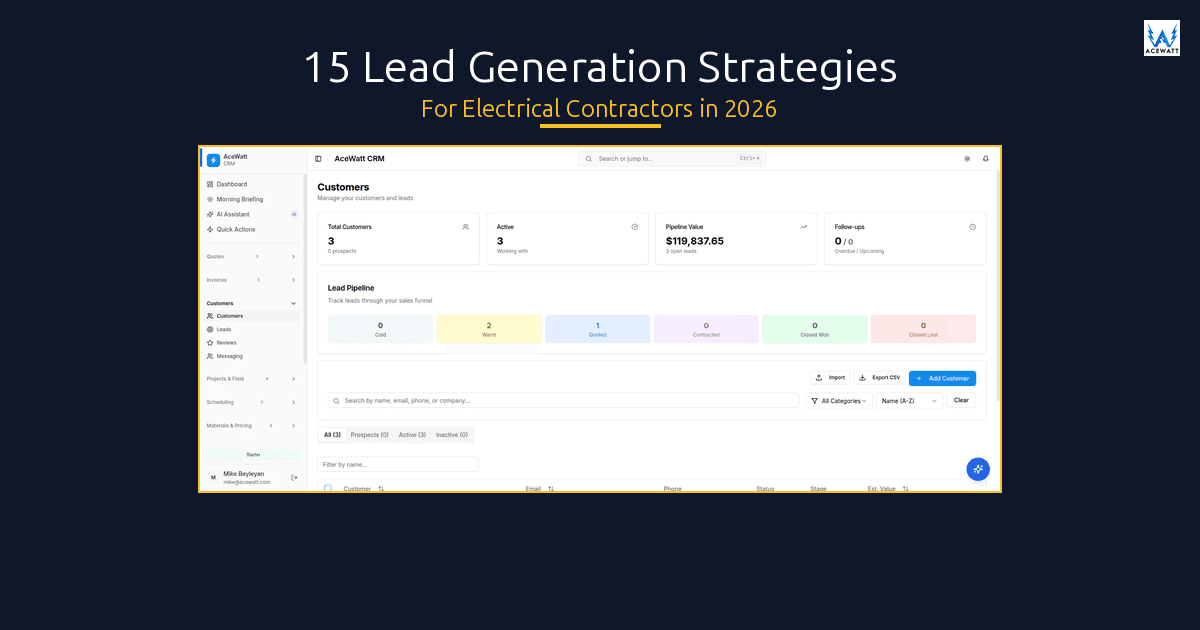
AceWatt is an electrical contractor CRM designed around the real workflow of electrical businesses. It captures leads from all sources, automatically schedules follow-up, and provides pipeline visibility. The system integrates with AI answering services, so calls are captured and added to your CRM without manual entry.
- Centralized lead capture from phone, web, and referrals.
- Automated follow-up sequences with configurable timing.
- Lead source tracking and pipeline conversion metrics.
- Electrical-specific workflows for estimating, scheduling, invoicing, and follow-up.
- AI-assisted lead scoring and next-action suggestions.
By keeping every lead in one place and ensuring consistent follow-up, AceWatt helps electrical contractors turn more leads into booked jobs and more booked jobs into revenue.
Building your lead generation stack
Solo electrician stack
For solo electricians, the goal is simplicity and affordability. You need lead sources that don't require significant ongoing investment and a CRM that handles everything.
Recommended stack:
- Google Business Profile (free)
- Local SEO optimized website
- Referral program
- Facebook or Instagram ads (optional)
- Simple CRM with basic follow-up (AceWatt Basic plan)
- Yard signs and vehicle branding
- Nextdoor for local presence
Focus on doing the basics well: excellent service, consistent branding, and reliable follow-up. If you do one of these things exceptionally well, like being known for 24/7 emergency response, you can generate enough work without a full marketing strategy.
2, 5 person shop stack
Two- to five-person shops have enough volume and complexity to justify multiple channels and more structured systems.
Recommended stack:
- Google Business Profile + local SEO
- Google Local Services Ads (if cost-per-lead is reasonable in your area)
- Google Ads for specific services
- Facebook or Instagram ads
- Nextdoor + community involvement
- AI answering service for after-hours calls
- Full-featured CRM with automation and tracking (AceWatt Professional plan)
- Partnerships with general contractors or builders
- Referral program with incentives
At this stage, you should have a mix of paid and organic sources, automated follow-up, and clear metrics on which channels perform best.
5, 15 person shop stack
Five- to fifteen-person shops can afford more aggressive lead generation and should invest in systems that scale with their team.
Recommended stack:
- Google Local Services Ads + Google Ads
- Facebook or Instagram ads
- Nextdoor + local events and sponsorships
- AI answering service (maybe multiple agents for different time zones)
- Partnerships with commercial builders and developers
- Advanced content marketing and blog SEO
- Full-featured CRM with advanced automation and integrations (AceWatt Enterprise plan)
- Email marketing automation
- Local SEO with multiple location landing pages
- Video content and social media presence
At this scale, lead quality and conversion become as important as lead volume. Your systems need to handle higher volume without breaking, and your team needs clear processes for moving leads through the pipeline.
Measuring lead generation performance
Key metrics: cost per lead, cost per booked job, close rate, response time
To know whether your lead generation is working, you need to track specific metrics:
- Cost per lead: Your total marketing spend divided by the number of new leads captured. This shows how efficiently you're acquiring contacts.
- Cost per booked job: Your total marketing spend divided by the number of jobs booked from those leads. This reflects your conversion efficiency.
- Close rate: The percentage of leads that become booked jobs. This shows how well your quoting and selling process works.
- Response time: How quickly you follow up with a new lead. Faster response is generally correlated with higher conversion.
Track these metrics by channel so you can compare performance. You may find that LSAs have a higher cost per lead but better close rates, while local SEO has lower upfront costs but slower results.
Lead source attribution
Use your CRM to attribute each job to its source. This tells you which channels are actually driving revenue, not just clicks or impressions. Attribution helps you make smarter decisions about budget allocation.
Common attribution methods:
- First touch: The channel that first brought the lead to you.
- Last touch: The channel that generated the final call that booked the job.
- Linear: Equal credit across all channels the lead interacted with.
Choose a method that makes sense for your business and stick with it consistently.
Monthly lead generation review checklist
Once a month, review these items:
- Review metrics by channel: Which sources have the best cost per job and close rates?
- Check response times: Are you following up within your target window?
- Evaluate lead volume: Is your total volume growing, stable, or declining?
- Assess lead quality: Are you getting more serious inquiries, or just price shoppers?
- Review content and ads: Are your creatives fresh, and is your messaging clear?
- Update CRM fields: Ensure new lead types are captured correctly.
- Adjust spending: Shift budget to the best-performing channels.
Regular reviews keep your lead generation strategy aligned with your business goals and help you catch issues before they hurt your revenue.
Frequently Asked Questions
What is the best way to get electrical contractor leads?
There isn't one best way, different contractors have different priorities, markets, and budgets. The most effective approach for most electrical contractors is a mix of Google Business Profile, local SEO, referrals, and either LSAs or Facebook/Instagram ads, supported by a CRM that captures and follows up on every lead. Solo operators can focus on referrals and Google Business Profile. Two- to five-person shops should add Google Ads, Nextdoor, and content marketing. Five- to fifteen-person operations can invest more aggressively in LSAs, partnerships, and advanced automation.
Are Angi and HomeAdvisor worth it for electricians?
Angi and HomeAdvisor can be worth it for electricians, but they should be one part of a broader strategy rather than the foundation. Lead volume and quality vary by market, and competition can be high. Common complaints include high costs per lead and inconsistent lead quality. Evaluate your results by tracking which channels actually generate jobs, not just clicks, and adjust your spending based on actual return on investment.
How much should I spend on lead generation?
There's no fixed percentage, but most electrical contractors allocate 2, 5% of revenue to marketing and lead generation. Solo operators often spend less and rely more on referrals. Growing shops typically spend more as they scale. Focus on channels with a track record of ROI in your specific market, and adjust as you gather data. The goal is to spend on what works, not what feels right.
Does Google Local Services Ads work for electrical contractors?
Google LSAs work well for electrical contractors because they target people actively searching for local services and are backed by Google's verification system. The cost-per-lead is often higher than standard Google Ads, but the quality tends to be better because you're paying for inquiries, not clicks. Effectiveness varies by metro area and competition level. Many contractors find LSAs valuable when they're used as part of a multi-channel strategy.
How do I track where my electrical leads come from?
Use a CRM to tag each lead with its source, LSA, Google Business Profile, referral, Facebook ad, Nextdoor, etc. Track the channel that originally brought the lead to your business. Attribute booked jobs back to their source using first touch or last touch attribution. Review monthly to see which channels generate revenue, not just clicks. This data helps you allocate budget and refine your strategy.
Can AI help with electrical contractor lead generation?
AI helps primarily with lead capture and follow-up, not with finding leads. AI answering services handle after-hours calls, capture job details, and route urgent work appropriately. AI-powered CRMs can assist with lead scoring, summarizing call notes, and suggesting next actions. The biggest benefit is reducing missed calls and ensuring consistent follow-up, which improves conversion rates. For lead generation strategies like SEO, ads, and referrals, human judgment and industry expertise remain essential.
Related reading: CRM for Electrical Contractors That Tracks Leads From Estimate to Service Call.
Related reading: AI Answering Service for Electricians: Never Miss a Lead.