
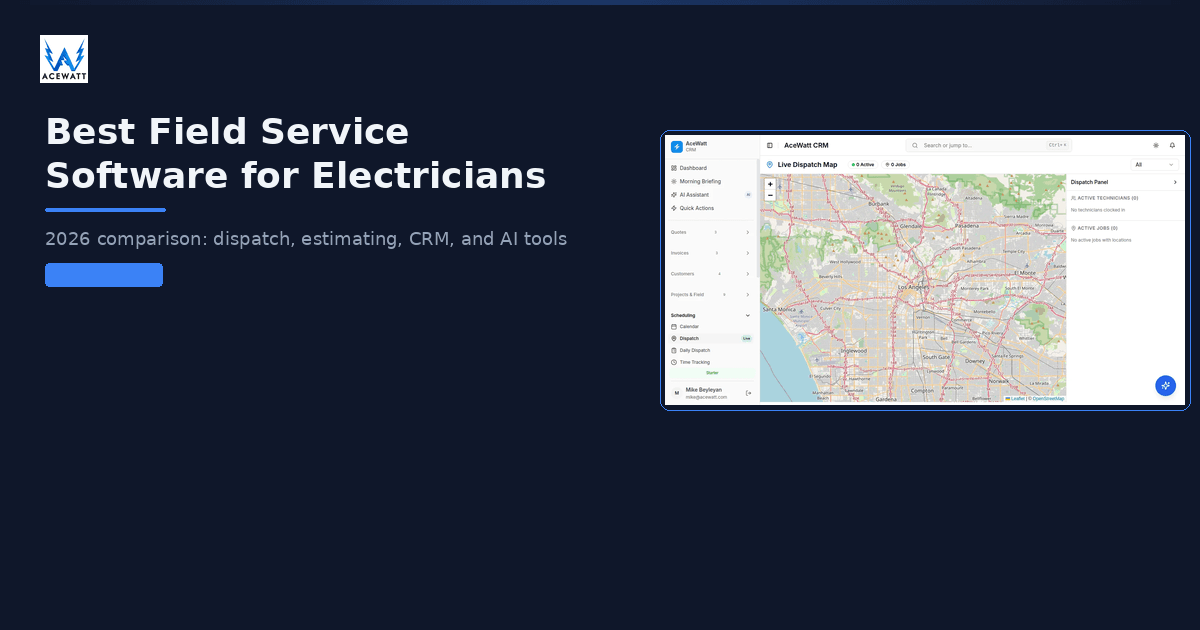
If you run an electrical service business, you've probably felt the pain of juggling scheduling, dispatching, estimates, invoices, and customer follow-up across five different apps, or worse, across paper, spreadsheets, and text messages. Field service software brings all of that into one platform so you can stop managing tools and start managing jobs.
This guide compares the best field service software for electricians in 2026. We evaluated each platform on features, pricing, electrical-trade fit, mobile experience, and AI capabilities, because electrical contractors have different needs than plumbers, HVAC companies, or general handymen.
If you're looking for a broader overview of what field service software does, see our complete guide to field service software for electricians. If you want the wider FSM category before filtering for electrical shops, use the best field service management software comparison as a baseline.
What Is Field Service Software for Electricians?
Field service software is business management software built for companies that send workers to customer locations. For electrical contractors, that means a system that handles the full workflow from first call to final payment.
Field Service Software vs CRM vs Estimating Software
These categories overlap, and the lines are blurring:
- Field service software focuses on scheduling, dispatch, and job management: getting the right person to the right job at the right time. For dispatch-specific features, see electrical dispatch software.
- CRM (Customer Relationship Management) focuses on customer data, follow-up, and pipeline tracking: making sure no lead or proposal falls through the cracks. See our guide to CRM for electricians for more detail.
- Estimating software focuses on generating accurate quotes, turning job-walk data into professional proposals.
The best platforms combine all three. That's where the market is heading in 2026, and it's what electrical contractors actually need. For a focused look at how these capabilities connect, see electrician job management software.
Why Electrical Contractors Need Trade-Specific FSM
Generic field service tools work okay for any trade. But electrical contractors have specific needs:
- Code compliance tracking: NEC requirements, permit status, inspection scheduling
- Material pricing volatility: copper, conduit, and panel prices change frequently
- Safety documentation: arc flash, lockout/tagout, and job-hazard analysis records
- Complex estimating: electrical scope has more variables than most trades
- Good-better-best quoting: electrical customers often need options, not a single price
Core Features Every Electrician FSM Should Have
At minimum, your field service software should handle:
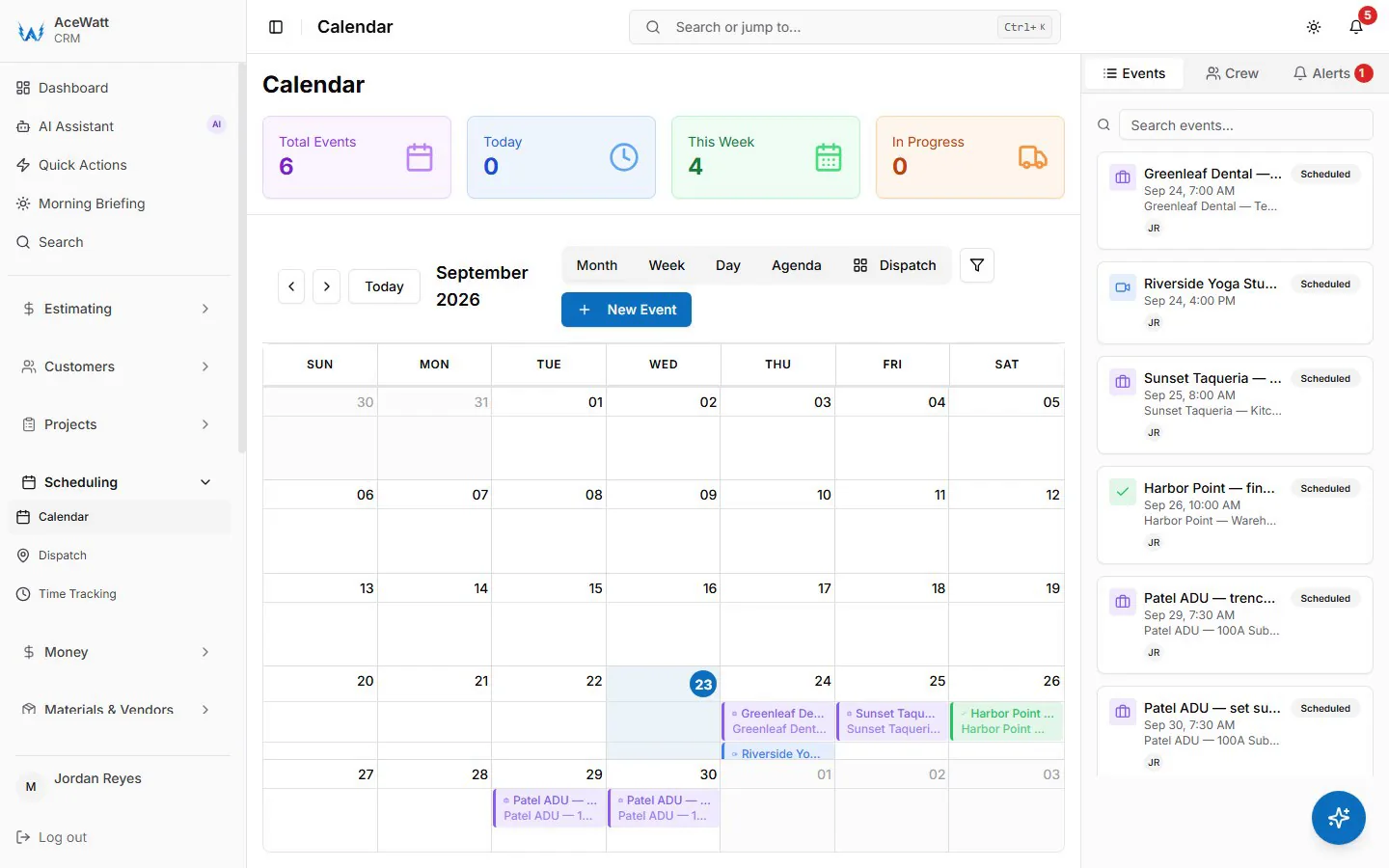
- Scheduling and dispatch: assign jobs, track locations, manage calendars
- CRM and customer history: every customer's jobs, estimates, and communications in one place
- Estimating and quoting: turn scope into professional proposals quickly
- Invoicing: generate and send invoices from approved estimates
- Job documentation: photos, notes, and scope capture from the field
- Follow-up automation: automated reminders on unsent proposals
How We Evaluated Field Service Software for Electricians
We compared each platform across six criteria, weighted by what matters most to electrical contractors:
| Criteria | Weight | What We Evaluated |
|---|---|---|
| Electrical trade fit | 25% | Trade-specific features, scope libraries, material pricing, code/safety support |
| Estimating and quoting | 20% | Speed, accuracy, option cards, good-better-best, AI assistance |
| Scheduling and dispatch | 20% | Calendar management, crew assignment, route optimization, mobile access |
| CRM and follow-up | 15% | Customer history, automated follow-up, pipeline tracking |
| Pricing and value | 10% | Cost vs. features, free trial availability, scalability |
| AI and automation | 10% | AI-assisted features, voice documentation, automated workflows |
Data sources: vendor websites, verified user reviews, public pricing pages, and live product evaluation where available.
Top Field Service Software for Electricians in 2026
AceWatt: Best AI-Powered Field Service CRM for Electricians
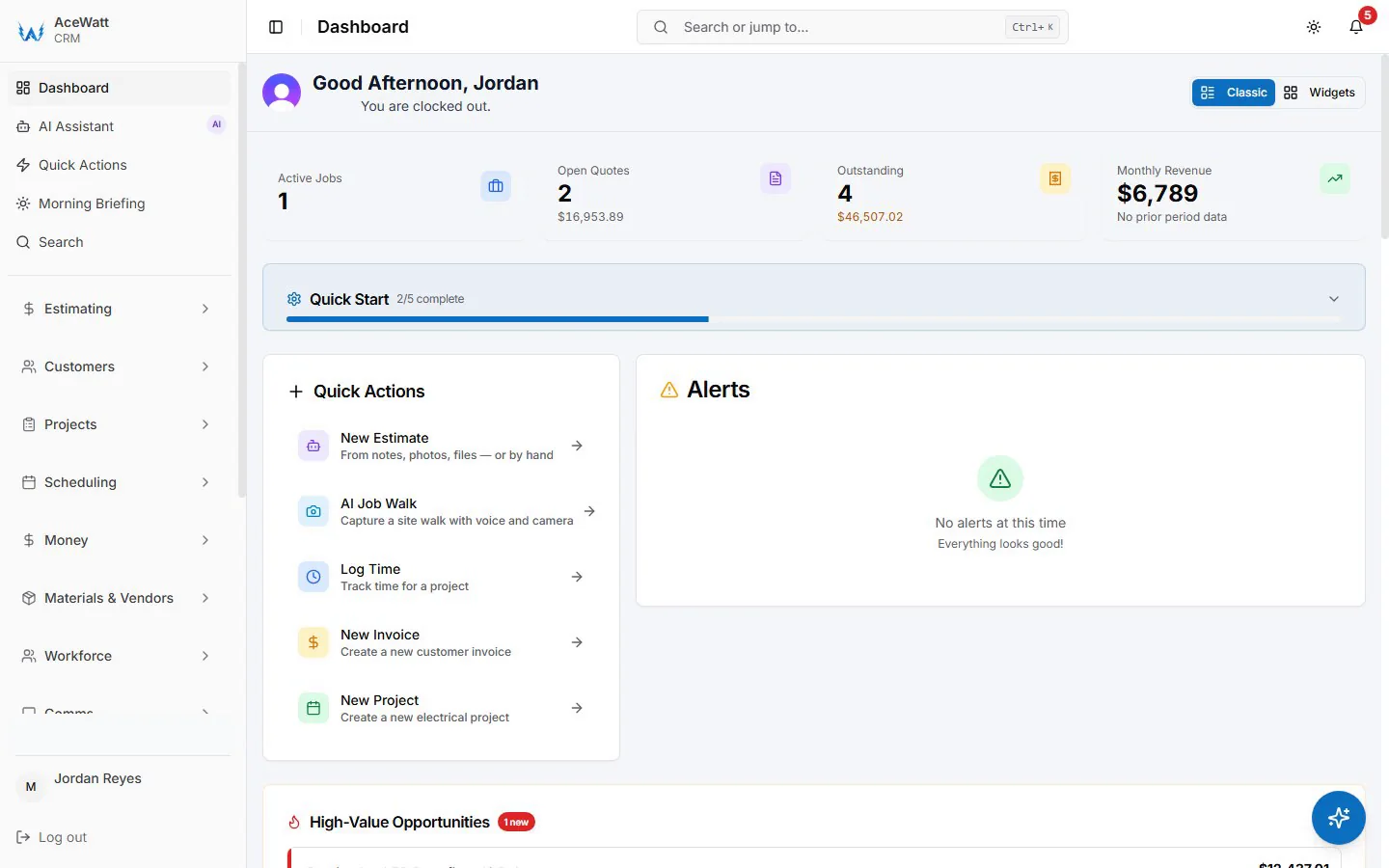
AceWatt is purpose-built for electrical contractors. It combines CRM, estimating, job-walk documentation, and invoicing in one platform with AI features designed for the electrical trade.
Key strengths:
- AI job walk to estimating pipeline: capture scope with voice and photos, then AI helps build your estimate from the documented scope. See AI job walk features.
- Automated follow-up on overdue invoices: automatic email reminders at 1, 7, 14 and 30 days late, so unpaid invoices do not sit in silence.
- Good-better-best quoting: present option cards to customers so they choose based on value, not just the lowest number.
- Voice documentation: hands-free scope capture on every job walk with voice documentation tools.
- Invoice handoff: approved proposals convert to invoices in seconds via invoicing features.
Pricing: Free trial available. Plans start at $49/month (Starter) up to $199/month (Scale). See AceWatt pricing.
Best for: Residential and commercial electrical contractors who want AI-powered quoting and follow-up in one platform. Shops from solo operators to 20+ employees.
ServiceTitan: Best for Large Electrical Operations
ServiceTitan is the 800-pound gorilla of trade service software. It's comprehensive, powerful, and built for companies running 10+ trucks with dedicated office staff.
Key strengths:
- Full dispatch board with real-time GPS tracking and route optimization
- Payroll and HR built in: time tracking, commission structures, performance reporting
- Marketing analytics: track which marketing channels produce profitable jobs
- Accounting integration: deep QuickBooks and Sage connectivity
Trade-offs:
- Custom enterprise pricing, typically $300+/month, often significantly more. Requires a sales demo for any pricing information.
- Complex setup: expect weeks of onboarding and training.
- Overkill for shops under 10 employees.
Best for: Large electrical operations with dedicated office staff, multiple crews, and the budget for enterprise software.
Housecall Pro: Best for Simple Scheduling
Housecall Pro focuses on making scheduling and dispatch easy. It's a popular choice for smaller shops that want a straightforward tool without a steep learning curve.
Key strengths:
- Intuitive scheduling: drag-and-drop calendar, easy rebooking
- Flat-rate pricing board: build a pricebook for common services
- Online booking: customers can book directly from your website
- Payment processing: integrated credit card and ACH payments
Trade-offs:
- Estimating features are basic compared to trade-specific tools.
- CRM depth is limited: customer history exists but follow-up automation is minimal.
- Not electrical-specific. It's built for all home service trades.
Pricing: Starting at approximately $59/month for basic plans, with higher tiers for more features.
Best for: Small residential electrical shops that need simple scheduling and don't require advanced estimating or AI features.
Jobber: Best for All-Trade Field Service
Jobber serves a wide range of field service businesses: landscaping, cleaning, HVAC, plumbing, and electrical. It's well-rounded and well-supported with extensive educational content.
Key strengths:
- Clean, modern interface: easy to learn and use
- Broad feature set: scheduling, invoicing, quotes, client management
- Jobber Academy: extensive training content and business resources
- Multi-trade support: good if you run more than one service line
Trade-offs:
- Not electrical-specific: no trade-specific scope libraries or material pricing
- Estimating is template-based, not AI-assisted
- CRM follow-up is manual: no automated sequences
Pricing: Starting at approximately $69/month (Lite plan). Additional features available at higher tiers. See how Jobber compares to Housecall Pro.
Best for: Multi-trade contractors or electrical shops that want a clean, general-purpose field service tool and don't need electrical-specific features.
FieldEdge: Best for Established Electrical Contractors
FieldEdge has been serving electrical and HVAC contractors for years. It's built for established businesses that are deeply integrated with QuickBooks and want a proven system.
Key strengths:
- Electrical and HVAC focus: built with these trades in mind
- QuickBooks integration: deep, two-way sync with QuickBooks Desktop and Online
- Flat-rate pricing: pre-built pricebook with electrical-specific items
- Established user base: large community of electrical contractors
Trade-offs:
- Interface feels dated compared to newer platforms
- Mobile app limitations: some features require desktop access
- AI features are minimal or absent
Pricing: Custom pricing based on business size and feature requirements.
Best for: Electrical contractors who are deeply invested in QuickBooks and want a proven, trade-specific system.
BuildOps: Best for Commercial Electrical Contractors
BuildOps targets commercial and industrial contractors. If your work is primarily large commercial projects rather than residential service calls, BuildOps is designed for your workflow.
Key strengths:
- Commercial project management: multi-phase projects, change order tracking
- Service agreements: manage recurring commercial maintenance contracts
- Strong content and community: active blog with commercial contractor insights
- Reporting: detailed profitability and job-cost reporting
Trade-offs:
- Overkill for residential service contractors
- Complex implementation for smaller shops
- Pricing requires a custom quote
Pricing: Custom enterprise pricing. Designed for contractors with $1M+ annual revenue.
Best for: Commercial electrical contractors managing multi-phase projects and service agreements.
Tofu and MyQuoteIQ: Emerging Competitors
Tofu focuses on fast invoicing and field service management. It's newer to the market and aims to simplify the billing-first workflow. Best for contractors who lead with invoicing speed.
MyQuoteIQ has built an aggressive SEO and content strategy around AI estimating for electrical contractors. Their comparison content ranks well for "best electrical software" queries. Best for contractors evaluating AI tool options through their content.
Comparison Table: Field Service Software for Electricians 2026
| Feature | AceWatt | ServiceTitan | Housecall Pro | Jobber | FieldEdge | BuildOps |
|---|---|---|---|---|---|---|
| Electrical-specific | Yes | Partial | No | No | Yes | Partial |
| AI estimating | Yes | No | No | No | No | No |
| AI job walk | Yes | No | No | No | No | No |
| Voice documentation | Yes | No | No | No | No | No |
| Auto follow-up | Invoices only | Yes | Limited | No | No | No |
| Scheduling/dispatch | Yes | Yes | Yes | Yes | Yes | Yes |
| Invoicing | Yes | Yes | Yes | Yes | Yes | Yes |
| Good-better-best quoting | Yes | No | No | No | No | No |
| QuickBooks integration | Check site | Yes | Yes | Yes | Yes | Yes |
| Free trial | Yes | Demo only | Yes | Yes | Demo only | Demo only |
| Starting price | $49/mo | ~$300+/mo | ~$59/mo | ~$69/mo | Custom | Custom |
| Best for | ECs wanting AI | Large ops | Simple scheduling | Multi-trade | QB-heavy shops | Commercial |
Pricing reflects publicly available information as of May 2026 and may vary. Check vendor websites for current rates.
How to Choose Field Service Software for Your Electrical Business
By Shop Size
- Solo electrician: You need simple estimating, fast invoicing, and follow-up automation. Start with AceWatt Starter or Housecall Pro.
- 2 to 5 employees: You need scheduling, CRM, and quoting. AceWatt or Jobber.
- 5 to 20 employees: You need dispatch management, crew scheduling, and reporting. AceWatt Scale or ServiceTitan.
- 20+ employees: You need enterprise features, payroll, and deep accounting integration. ServiceTitan or BuildOps.
By Primary Need
- Estimating is your bottleneck → AceWatt (AI-assisted quoting from job-walk data)
- Scheduling is your pain → Housecall Pro (simple drag-and-drop) or AceWatt (scheduling features)
- Unpaid invoices are where you lose money → AceWatt (automatic overdue-invoice email reminders)
- QuickBooks integration is non-negotiable → FieldEdge or ServiceTitan
- Commercial projects are your focus → BuildOps
By Budget
- Under $100/month: AceWatt Starter, Housecall Pro basic
- $100 to $300/month: AceWatt Scale, Jobber higher tiers, Housecall Pro advanced
- $300+/month: ServiceTitan, BuildOps, FieldEdge (custom pricing)
Why Field Service Software Matters for Electrical Contractor Margins
The right software doesn't just organize your business; it directly impacts your profit margin. Here's how:
- Faster quoting means you send estimates while your competitor is still driving back to the office. Speed wins.
- Automated follow-up captures the 15% to 25% of proposals that go cold without a second touch.
- Job costing shows you which job types make money and which ones don't, so you can stop doing the wrong work.
- Dispatch efficiency means more jobs per day per truck.
- Invoice speed means faster payment and better cash flow.
If you want to understand how margins work for electrical contractors (benchmarks, calculations, and improvement strategies), see our guide to electrical contractor profit margins.
Frequently Asked Questions
What is the best field service software for electricians?
The best software depends on your shop size and priorities. For electrical contractors who want AI-powered estimating and follow-up, AceWatt is purpose-built for the trade. For large operations with 10+ trucks, ServiceTitan offers the most comprehensive enterprise features. For simple scheduling on a budget, Housecall Pro is a solid choice. Evaluate based on your specific needs: estimating depth, follow-up automation, QuickBooks integration, and electrical-trade specificity.
How much does field service software cost for electrical contractors?
Pricing ranges from approximately $49/month for AceWatt Starter to $300+/month for enterprise platforms like ServiceTitan. Mid-range options like Jobber and Housecall Pro start around $59 to $69/month. Most platforms offer free trials or demos. Always check the vendor's current pricing page for the most accurate rates.
Is ServiceTitan worth it for small electrical shops?
ServiceTitan is generally overkill for shops under 10 employees. It's designed for larger operations with dedicated office staff, multiple dispatchers, and complex payroll needs. The setup process is extensive, and pricing reflects the enterprise feature set. Small electrical shops typically get better value from platforms built for their scale, like AceWatt or Housecall Pro. Consider ServiceTitan alternatives if you need something more right-sized.
What is the best AI field service software for electricians?
AceWatt currently offers the most AI-integrated field service workflow for electrical contractors, with AI-assisted estimating from job-walk data, voice documentation, and automated follow-up on overdue invoices. Other platforms are beginning to add AI features, but most are in early stages. If AI-powered quoting and scope extraction are priorities, evaluate AceWatt's automated estimating features. For a detailed look at how AI supports every step from job walk to invoice prep, see our guide to AI field service software for electricians. For a broader comparison of mobile tools and reference apps, see best electrician apps.
Can field service software help with electrical estimating?
Yes, and it's one of the highest-value features. Good field service software turns job-walk documentation into estimates, tracks material pricing, applies consistent markup, and generates professional proposals. Some platforms, like AceWatt, use AI to extract scope items from voice notes and photos, making the estimating process significantly faster. For more detail, see our guide to electrical estimating software.
Related Reading
- Overview of every electrical contractor software feature AceWatt ships.
- For teams building their own alternatives library, comparison content hub planning explains the internal-link structure.
- 10 electrical contractor tools compared
- Best Electrician App for Daily Service Work in 2026: 7 Field-Tested Apps for Work Orders, Estimates & Invoicing
- AceWatt vs ServiceTitan comparison — deeper feature-by-feature comparison for electrical contractors.
- More head-to-head comparisons → electrician software comparison hub
- BuildOps alternative page for electrical contractors → BuildOps alternative
- All head-to-head pages → AceWatt alternatives for electricians