

An electrician pricing calculator for 2026 should do more than multiply hours by a labor rate. Electrical contractors need a pricing method that accounts for labor, materials, overhead, permits, travel, job difficulty, profit, and review. If any of those inputs are missing, the number may look clean while the job becomes less profitable than expected.
This guide explains how to use a calculator before building a quote, what inputs matter, how to think about flat-rate versus time-and-materials pricing, and how to turn a calculated price into a reviewed estimate. You can also use AceWatt's free bid calculator as a practical starting point. See the complete tools lineup for more free calculators.
Important boundary: a calculator is an estimating aid, not a final quote, legal advice, tax advice, accounting advice, or a substitute for licensed electrical judgment. Labor, scope, safety, code and compliance considerations, permits, site conditions, and final pricing should be verified by a licensed electrician, qualified reviewer, and appropriate business advisor before you send the customer a bid.
Electrician Pricing Calculator for 2026
A useful calculator helps you build a price from real inputs instead of guessing. It should make your assumptions visible so you can review them before the quote goes out.
Use the Calculator Before Building Your Quote
A useful time to calculate price is before you polish the proposal. Start with the raw job economics: hours, materials, overhead, permits, travel, risk, and profit. Once the math is reviewed, you can turn the number into customer-friendly scope, options, exclusions, and terms.
This sequence helps avoid a common problem: writing a professional-looking quote before you know whether the job is actually priced correctly.
What the Calculator Should Include
At minimum, an electrician pricing calculator should include:
- Labor hours by role or crew.
- Loaded labor cost or billing rate, based on your business inputs.
- Material cost with your chosen markup or handling factor.
- Permit, inspection, and utility coordination costs where applicable.
- Travel, setup, cleanup, and return-visit assumptions.
- Overhead allocation for trucks, insurance, tools, software, rent, and administration.
- Profit target or margin requirement.
- Risk buffer for unknown conditions, difficult access, schedule pressure, or unclear scope.
Those inputs will vary by market, license level, crew structure, job type, supplier pricing, and local requirements. Do not copy a national average into a final quote without checking your own numbers.
Quick Formula Block
A simple pricing formula is:
Job price = labor + marked-up materials + overhead allocation + permits and travel + risk buffer + profit.
That formula is intentionally plain. The value comes from accurate inputs and disciplined review, not from a complicated spreadsheet.
How to Price Electrical Work
Pricing electrical work is a process. The calculator gives structure, but the contractor still needs to inspect the scope and verify assumptions.
Labor Hours
Estimate the hours needed to complete the work safely and correctly. Include setup, protection, demolition where needed, installation, testing, cleanup, documentation, and communication with the customer. For service work, include time for diagnosis and explanation. For project work, include coordination and revision time.
A licensed electrician or qualified reviewer should verify whether the labor hours match the real site conditions. Older buildings, tight access, finished walls, roof work, trenching, occupied commercial spaces, and unknown wiring can all change the labor picture.
Labor Rate by Role and Market
Your labor input should reflect your actual cost structure and selling strategy. A helper, apprentice, journeyman, foreman, estimator, and owner do not all carry the same cost or responsibility. Your market, insurance, payroll burden, training, benefits, and productivity also matter.
Avoid treating hourly rate as a universal number. A calculator should let your shop use its own inputs and update them as costs change.
Materials and Markup
Material pricing changes. Wire, conduit, devices, breakers, panels, controls, fasteners, boxes, fittings, and specialty items should be priced from current supplier information whenever possible. Include waste, purchasing time, delivery, returns, storage, and the risk of price movement between quote and install.
Markup is a business decision, not a guess. It should cover handling and contribute to profit without making the estimate unclear. If material assumptions are uncertain, show exclusions or options clearly in the proposal.
Permits and Inspection Time
Permits are not only the fee paid to a jurisdiction. They can include application time, utility coordination, inspection scheduling, corrections, travel, and customer communication. If the job may require permit work, include it in the calculator and explain it in the scope.
Overhead Allocation
Every electrical business carries overhead: trucks, fuel, insurance, tools, software, phones, licenses, training, estimating time, office support, accounting, marketing, and rent. If overhead is not included in job pricing, it comes out of owner income or profit.
A calculator can allocate overhead by hour, by job type, or by another internal method. The important part is consistency. Review the allocation with an accountant or qualified business advisor when setting your pricing model.
Profit Margin
Profit is not the owner's wage. Profit is what lets the business replace tools, survive slow months, invest in training, and grow responsibly. Your target should be based on your business model, risk tolerance, market, and cash-flow needs.
The calculator should show profit as its own input so you can see whether a job supports the business before you send the quote.
Risk and Complexity Buffer
Some jobs deserve extra review before final pricing: troubleshooting intermittent faults, working in old panels, unknown wiring, difficult access, occupied commercial spaces, emergency timing, customer-supplied materials, or incomplete drawings. A risk buffer helps account for uncertainty, but it should not hide vague scope. Use exclusions and change-order language where needed.
Common Electrical Job Pricing Examples
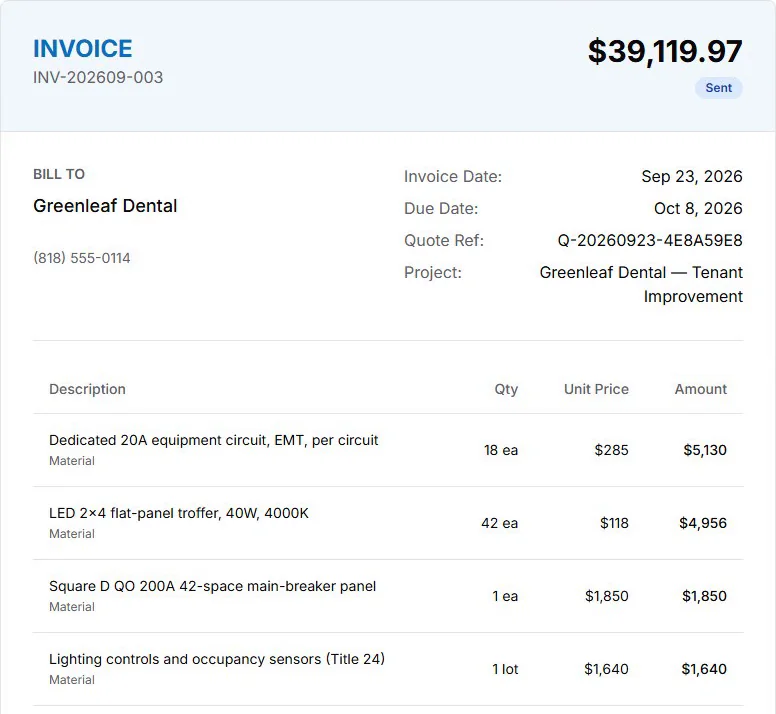
The same calculator can support different job types. The inputs change, but the pricing logic stays consistent.
Outlet or Switch Install
For small service work, labor minimums, travel, materials, wall access, troubleshooting time, and cleanup are often the deciding factors. A calculator helps confirm whether the job covers the real cost of sending a truck.
Panel Upgrade
Panel-related work needs careful review. The calculator may include labor, equipment, breakers, grounding and bonding materials, permit coordination, utility timing, inspection, customer downtime, and site-specific constraints. A licensed electrician or qualified reviewer should verify scope and safety before pricing is finalized.
EV Charger Install
EV charger pricing depends on distance, routing, panel capacity, breaker and conductor requirements, wall conditions, customer equipment, permit needs, and whether options are required. A calculator can organize the inputs, but the site visit drives the final scope.
Generator Install or Service
Generator work may involve equipment coordination, transfer switch considerations, fuel coordination, inspection, startup, maintenance details, and customer education. Do not treat it like a simple device install unless the reviewed scope supports that.
Troubleshooting or Service Call
Troubleshooting often fits time-and-materials or diagnostic fee structures because the final repair may not be known upfront. A calculator can still help set minimums, labor rates, travel charges, and follow-up quote thresholds.
Commercial Maintenance Work
Commercial work may involve off-hours scheduling, access coordination, safety documentation, tenant communication, lift or equipment needs, and repeat visits. The pricing model should account for administrative and coordination time, not only wrench time.
2026 Pricing Variables Electrical Contractors Should Watch
The year on the calculator matters less than the discipline of updating inputs. In 2026, contractors should watch labor availability, material movement, permit timelines, customer expectations, and software workflow.
Labor Market Variance
Your labor assumptions should reflect your crew and market. Hiring, training, benefits, and license requirements can change your true cost per billable hour. Review labor inputs regularly rather than setting them once and forgetting them.
Material Price Movement
Material costs can shift quickly. Use current supplier data where possible and avoid quoting large jobs from stale material lists. If a quote will remain open for a long period, consider terms that explain how material price changes are handled.
Permit and Inspection Delays
Permit timelines and inspection availability can affect labor, schedule, and customer communication. If delays create extra coordination work, include that in your process and scope language.
Travel Time and Repeat Visits
Travel, pickup runs, return visits, and missing material trips erode margin. A calculator should make those assumptions visible. If repeat visits are likely because the scope is unclear, quote accordingly or create a paid diagnostic step.
Change Orders and Unclear Scopes
Unclear scope is a pricing risk. Use the calculator to price known work, then use the estimate to explain exclusions, assumptions, and how change orders will be handled.
Flat Rate vs. Time and Materials
An electrician pricing calculator can support both pricing methods.
When Flat Rate Works
Flat-rate pricing works best when the scope is clear, the shop understands its labor and material history, and the customer values a clear upfront price. Common service tasks, repeatable installs, and well-defined projects can fit this model.
When Time and Materials Is Safer
Time and materials may be safer when the scope is unknown, troubleshooting is open-ended, existing conditions are hidden, or the customer is asking for exploratory work. In those cases, the calculator can help set hourly rates, material handling, minimums, and approval thresholds.
How to Explain Pricing to Customers
Customers do not need to see every internal formula, but they do need clear scope. Explain what is included, what is excluded, what assumptions were made, how changes are handled, and when additional approval is required.
AceWatt's estimate template can help turn the calculation into a more professional customer-facing document.
Electrician Pricing Calculator vs. Estimating Software
A calculator and estimating software overlap, but they are not identical.
Calculator: Fast One-Off Pricing
A calculator is useful when you need a quick price check. It helps you test whether labor, materials, overhead, and profit produce a defensible number. It is especially helpful for small jobs, early scoping, or sanity-checking a quote.
Estimating Software: Repeatable Estimates
Estimating software gives you templates, saved customer records, scope language, revisions, and a repeatable workflow. If you are building many quotes per week, compare tools in the electrical estimating software and electrical contractor estimating software guides.
CRM: Follow-Up, Revisions, and Invoice Handoff
A price is only useful if it turns into a sent quote, accepted work, and a clean invoice. CRM and job-management workflows track customer history, follow-up reminders, revisions, and handoffs to billing. AceWatt's electrician invoice software page explains the invoicing side of that workflow.
How AceWatt Helps Turn Pricing Into Quotes
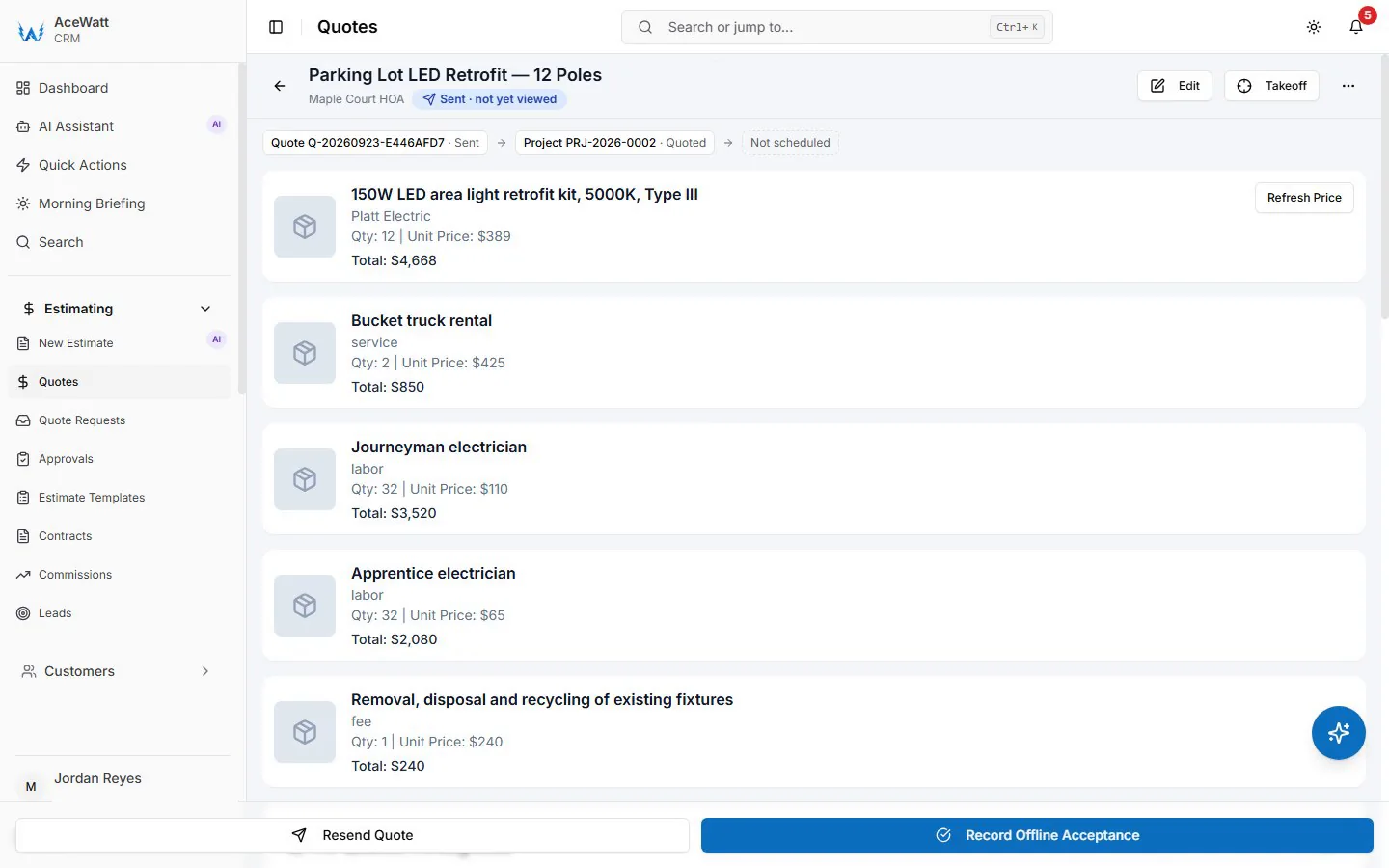
AceWatt supports the workflow around pricing: customer records, job-walk notes, AI-assisted quote drafts, follow-up, and invoice context. The automated estimating feature helps contractors move from notes toward a draft that can be reviewed and edited.
A safe workflow looks like this:
- Capture the customer request and site notes.
- Use the bid calculator to organize labor, material, overhead, risk, and profit inputs.
- Turn the calculation into a clear estimate draft.
- Have a licensed electrician or qualified reviewer check scope, safety, compliance considerations, pricing, and site conditions.
- Send the quote with clear assumptions and exclusions.
- Follow up and move accepted work toward scheduling and invoicing.
AceWatt does not replace professional judgment. It helps organize notes and can reduce repeated typing so the contractor can review and send better-organized quotes.
FAQs About Electrician Pricing Calculators
How much should electricians charge per hour in 2026?
There is no universal hourly rate. Your rate depends on market, labor cost, license level, overhead, insurance, benefits, truck cost, tools, taxes, profit target, and job type. Use your own business inputs and review them with a qualified advisor.
What markup should electrical contractors use on materials?
Material markup varies by shop, supplier, job type, risk, handling time, and competitive market. The important point is to choose a method intentionally, update material costs, and make sure your pricing covers purchasing, waste, returns, and business profit.
How do I price a panel upgrade?
Start with a site review by a licensed electrician or qualified reviewer. Account for labor, equipment, breakers, grounding and bonding materials, utility coordination, permits, inspection, customer downtime, access, and any required follow-up. Use the calculator to organize inputs, then verify the full scope before sending the quote.
Is flat-rate pricing better for electrical contractors?
Flat rate works well for repeatable, well-defined work. Time and materials may be better for diagnostics, unknown conditions, or work where the scope cannot be known upfront. Many contractors use both depending on job type.
What should be included in an electrical estimate?
A strong estimate includes scope, materials, labor assumptions, exclusions, permit notes, timeline assumptions, payment terms, change-order process, and customer approval. The final estimate should be reviewed for safety, compliance considerations, pricing, and site conditions before it is sent.
Ready to test your inputs? Use AceWatt's free bid calculator, then review electrical contractor profit margins for margin context or pricing if you want a connected CRM and quote workflow around your estimates.
To see how the pricing calculator fits the full toolkit, browse the AceWatt features overview.