
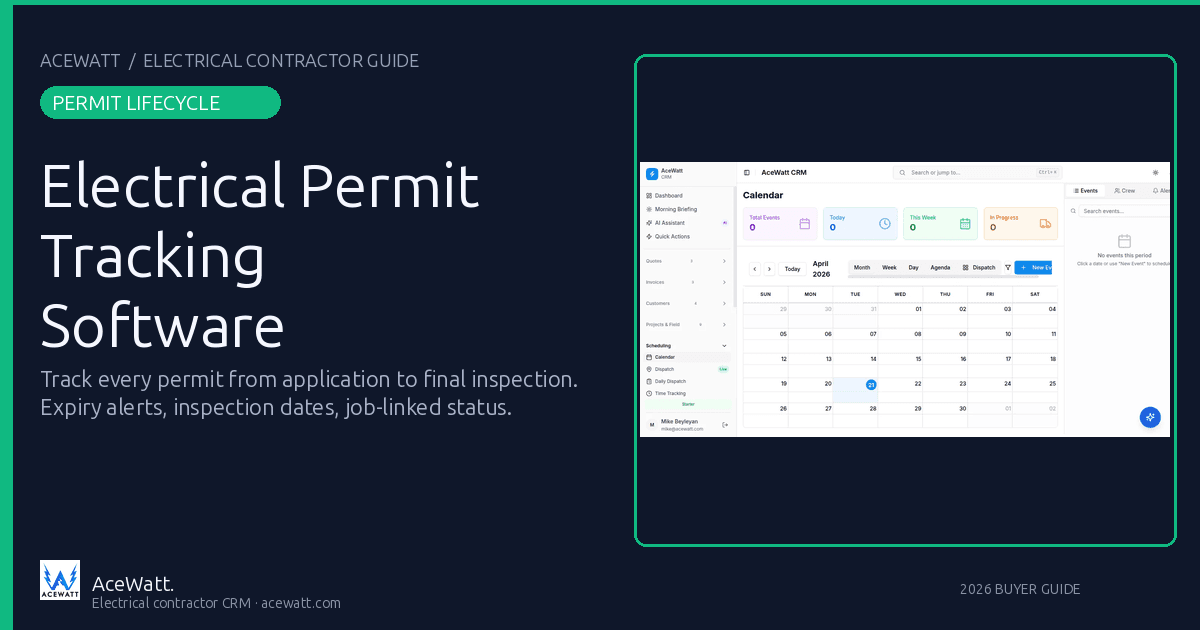
Electrical permits are the quiet tax on a disorganized shop. A missed inspection window, an expired permit nobody saw coming, a final that fails because the rough-in card wasn't on site: each one turns a profitable job into a scheduling scramble and a margin-eating re-inspection fee. Electrical permit tracking software links every permit (rough-in, service, EV charger, solar tie-in) to the job it belongs to, pings you before an inspection lapses or a permit expires, and keeps the whole lifecycle in one place your whole team can see.
Here's the blunt truth up front: AceWatt tracks each permit's number, type, jurisdiction, and status; it does not store expiry dates or send alerts, and you still submit the actual permit application to your AHJ (Authority Having Jurisdiction) through their own portal. Most AHJs don't expose an API for permit filing, and we won't pretend they do. What we do is keep every permit's status in one place your team can see between "issued" and "final inspection," which is exactly where the money leaks out.
Quick answer
What is electrical permit tracking software? It's a field-service system that attaches each electrical permit to the job it belongs to, records its status across the full lifecycle (apply → under review → issued → scheduled inspections → final → closed), and pushes alerts before an inspection lapses or a permit expires. Unlike a generic project-management app or a spreadsheet, it ties the permit to the crew schedule, the cost code, and the inspection checklist so a forgotten rough-in sign-off can't quietly stall a job for two weeks.
The core promise: one permit record travels with the job from pull to final, and every deadline has an alarm. If your current setup is a shared spreadsheet one office manager updates on Fridays, you don't have permit tracking. You have a wish and a prayer. For the document side of getting a permit pulled, pair this with our electrical permit application template.
The real cost of losing track of a permit
Permits don't fail loudly. They fail slowly, then all at once, always on the most expensive day. Here's what an untracked permit actually costs an electrical shop:
- Idle crews. A crew shows up to trim out a panel and the inspector never signed the rough-in. You send two electricians home or to busywork: $500 to $1,500 a day in labor and truck cost burned on a job that can't progress.
- Re-inspection fees. Most AHJs charge $150 to $500 per re-inspection after a fail or no-show. Fail twice on a service upgrade and you've eaten the margin before you bill it.
- Expired permit refile. Let a permit sit too long without an inspection (180 days is common) and the AHJ voids it. Refiling runs $75 to $300 per permit, plus you restart the review queue.
- A failed final becomes a contract dispute. The GC or homeowner withholds payment because the job "isn't closed out," and now you're arguing over retainage instead of running the next job.
None of these show up on a single invoice. They surface at quarter's end when the numbers don't add up. That silent cost is what permit tracking is built to kill. For the broader picture, see how it fits into electrical contractor project management.
The electrical permit lifecycle
Every electrical permit moves through roughly the same stages, regardless of AHJ: apply (submit drawings, load calcs, fees) → under review (plan examiner checks scope and code) → issued (permit number assigned, work authorized, inspection card posted) → scheduled inspections (rough-in, service, sometimes mid-cycle) → final (inspector signs off) → closed (permit on file, CO issued).
The break almost never happens at "apply" or "issued." It happens in the middle, the quiet stretch between the first inspection and the final. A permit gets issued, the crew moves on, the office forgets to call the final, the window lapses, and nobody finds out until the homeowner calls eight weeks later asking why their CO hasn't issued. Good permit tracking software lives in that middle stretch: it's not about pulling the permit, it's about closing it.
Permits every electrical shop tracks
Different scopes pull different permits, and a real tracking system handles all of them on one job without confusion:
- Rough-in: backbone of new construction and remodels; needs inspection before cover.
- Service and panel upgrades: 100A to 200A swaps, panel relocations, sub-panels; almost always permitted.
- EV charger installs: dedicated 40 to 80A circuits, increasingly inspected, especially for commercial fleets.
- Solar / PV tie-ins: interconnection agreements plus electrical permits, often across two AHJs (building + utility).
- Low-voltage: data, fire alarm, security; permitted in many jurisdictions, exempt in others.
- Trenching: underground runs often need a separate excavation permit alongside the electrical one.
- Temporary power: the construction pole permit, with its own inspection and teardown.
- Generator and transfer switch: standby installs and ATS gear, often requiring both electrical and gas/mechanical permits.
A residential service-change shop may only touch the first two; a commercial contractor on a multi-tenant build-out can have all eight on one project. The system holds them all, links each to its job, and never lets one expire while you watch another. See how this layers onto the day-to-day in our electrical contractor software features overview.
What electrical permit tracking software must do
Permit fields tied to the job
Every permit should carry its permit number, AHJ, type, status, issued date, expiry date, and inspector contact, tied to the job it belongs to. In AceWatt you track permits per job: each permit can be linked to a job, and the Permits page shows the job name next to the permit's number, type, jurisdiction, and status. No orphaned spreadsheet rows; see how that fits our electrician job management software overview.
Inspection checkpoints and status
Each permit carries its inspection checkpoints (rough-in, service, final) with a status field (not scheduled, scheduled, passed, failed, re-inspect) and the scheduled date. A failed inspection logs the reason so the re-inspect isn't a surprise.
Expiry alerts that actually fire
This is the feature most shops buy the software for. A permit approaching its expiry window, or an inspection "scheduled" past its lapse date, triggers an alert to the project lead and office, not a buried row you check on Mondays. You set the lead time; the system remembers.
NEC reference tie-in
Each checkpoint can reference the relevant NEC article: rough-in to box-fill, service to grounding and working clearance, EV charger to Article 625. AceWatt does not attach NEC references to permits; it has a separate NEC reference page you can check against each inspection, and it doesn't replace your licensed electrician's judgment or an AHJ's final call. For this year's code picture, our NEC 2026 code changes for electrical contractors guide is the companion read.
Honest scope: what AceWatt tracks, and what stays with your AHJ
We want to be straight with you, because overselling this feature is how contractors end up angry.
What AceWatt does: tracks each permit's number, type, jurisdiction, and status, so your whole team sees one source of truth for where every permit stands. Marking a permit Expired is a status you set yourself; AceWatt does not store expiry dates or send alerts, so deadlines stay on your own calendar.
What AceWatt does not do: it does not auto-file your permit application with the city, it does not integrate directly with Accela, OpenGov, or your local permit portal, and it does not replace your jurisdiction's system of record. The actual application goes through your AHJ's portal or counter. Most AHJs don't expose a permit-filing API, and the few that do each speak a different dialect.
So the workflow is: pull the permit through your AHJ (use our electrical permit application template to prep it), then record it in AceWatt and keep its status current through final. We own the status tracking; the AHJ owns the filing, and your team owns the deadlines. That honest line is what keeps your license safe.
Tying permits to your job schedule
This is the move that separates contractor-grade permit tracking from a standalone checklist app, and we'll credit the framing to Projul, who popularized the idea that a permit is a schedule dependency, not a filing-cabinet entry.
When a permit is a field on the job, the schedule can use it. Trim-out can't start until rough-in passes. The final can't be called until the service inspection is signed off. The CO can't issue until the permit is closed. In AceWatt you can see each permit's status next to the work, so the office knows Job 207 is waiting on a rough-in inspection, not just "running behind"; the gates themselves are yours to enforce.
Contrast that with a spreadsheet, where the permit, the schedule, and the crew's plan live in three files, connected only by the one office manager who, the day they're out sick, isn't connecting anything. For the scheduling side of that handshake, read our electrical contractor scheduling software guide, and for getting the right crew to the right gate, our electrical dispatch software walkthrough.
Multi-jurisdiction tracking: three permits, two AHJs, one crew
The permit-tracking problem multiplies with every jurisdiction. County rules differ from city rules, which differ from state code adoption, and each AHJ has its own inspection cadence, fee schedule, and lapse window. Good permit tracking software doesn't try to normalize all that (it can't, because the AHJs don't agree). It lets you record, per permit, which AHJ owns it and the real deadlines for that permit. The system enforces the dates you entered; you bring the local knowledge.
To make this concrete, picture one crew running three jobs in a week, which is where a spreadsheet collapses:
- Residential panel upgrade (City of Lakewood). A 100A-to-200A service change, permit pulled through Lakewood's portal and recorded in AceWatt with its status. Lakewood voids permits after 180 days without an inspection, so the office puts that date on its own calendar and calls the final before the window moves.
- Commercial EV charger (Jefferson County). A dual-port Level 2 install at an office park. Jefferson County requires a separate trenching permit and the electrical permit: two permits, one job, different inspectors. AceWatt holds both permit records with their own status, so the office sees which one the crew is waiting on.
- Solar PV tie-in (City of Lakewood + state utility). A residential rooftop install where the building permit goes to Lakewood and the interconnection to the state utility commission. Two AHJs, two timelines, one job. The building final can't close until the utility signs interconnection, a dependency the office tracks through each permit's status.
In a spreadsheet that's three tabs and a half-dozen dates with a high chance one expires while the office chases the others. In AceWatt it's three permit records, each with its own status and jurisdiction, all in one place; the lapse dates still go on your calendar, because AceWatt does not track them or send alerts.
2026 comparison: electrical permit tracking software
Pricing below reflects publicly available information as of early 2026 and may change with plan tier, team size, and promotions. "AHJ auto-filing" means the vendor claims to electronically submit the permit application to the jurisdiction's system.
| Tool | Starting Price | Job-Linked Permits | Inspection Checkpoints | Expiry Alerts | AHJ Auto-Filing | Multi-Jurisdiction |
|---|---|---|---|---|---|---|
| AceWatt | From $49/mo | ✓ (on the Permits page) | Status field only | ✗ (no alerts) | ✗ (tracks only) | ✓ |
| Projul | ~$59/mo+ | ✓ | ✓ | ✓ | ✗ | ✓ |
| PermitFlow | Custom (municipality-focused) | Limited | Limited | Limited | ✓ (where APIs exist) | ✓ |
| iWorQ | ~$45/mo+ (gov-facing) | ✗ | ✓ | ✓ | ✓ (gov side) | ✓ |
| UDA ConstructionOnline | From ~$49/mo | ✓ | Limited | Limited | ✗ | ✓ |
| Spreadsheet (DIY) | Free | ✗ | Manual | Manual | ✗ | Manual |
Key takeaways:
- AceWatt is the honest middle: it tracks each permit's number, type, jurisdiction, and status, built for electrical contractors, with no expiry alerts. It does not auto-file permits with the city, and we'd rather say that plainly than oversell it. See plans and pricing.
- Projul does strong job-linked permit and schedule tracking; this post's framing borrows from their approach. It's a solid general-contractor tool, while AceWatt is purpose-built for electrical shops and carries permit data into estimating, job costing, and invoicing.
- PermitFlow and iWorQ sit closer to the jurisdiction side: they help with application submission where a jurisdiction exposes an API, the part AceWatt deliberately doesn't do. Some contractors run PermitFlow for filing and AceWatt for tracking.
- UDA ConstructionOnline handles permits within a broader construction-management suite, but permit-specific depth and expiry alerting are lighter than a dedicated field-service tool.
- A spreadsheet is free until it isn't: no job link, no alerts, no schedule dependency. It works for a one-permit shop and fails at three permits in two jurisdictions.
For how this slots into the rest of a shop's stack, our AI CRM for contractors guide connects the dots.
Migrating from a spreadsheet and pitfalls to avoid
If you're running permits out of a shared sheet, the migration is the scary part. Here's how to do it without losing anything: export every active permit to a CSV (permit number, address, AHJ, type, status, inspection dates, expiry); enter each active permit in AceWatt with its number, type, jurisdiction, and status; put the expiry and inspection dates on your own calendar, since AceWatt does not store them or send alerts; then retire the spreadsheet, because the moment two sources of truth exist, one is wrong. Most shops finish this in an afternoon for a dozen active permits.
Along the way, avoid these common mistakes:
- Believing "permit software" files the permit for you. Read the fine print. If it doesn't list your AHJ as supported, it doesn't, and you'll find out the hard way. AceWatt is explicit: we track status, you watch the deadlines, you file.
- Tracking permits separate from the job. A standalone permit tracker not linked to jobs, schedule, and cost codes is just a nicer spreadsheet. The value is the connection.
- No single owner. Even great software needs one person reviewing the dashboard daily. Caught early, a lapsing permit is a phone call; caught late, it's a refile and a delayed CO.
- Ignoring the multi-AHJ reality and the field crew. Each permit must record its own AHJ and deadlines, and the field team must be able to pull the permit number and inspection card from a phone. If tracking lives only in the office, it dies at the job site. For tying field documentation to the permit record, our electrical contractor daily report workflow is the companion piece.
Frequently Asked Questions
What is electrical permit tracking software?
It's a system that attaches each electrical permit to its job, records status across the full lifecycle (apply → under review → issued → scheduled inspections → final → closed), and alerts you before an inspection lapses or a permit expires. Unlike a spreadsheet, it ties the permit to the crew schedule, cost code, and inspection checklist so deadlines can't quietly slip.
Does AceWatt file permits with the city or AHJ for me?
No, and we're clear about that. AceWatt tracks each permit's number, type, jurisdiction, and status (no expiry alerts); you still submit the actual application to your AHJ through their portal or counter. Most AHJs don't expose an API for permit filing, so we won't claim to "auto-file." Use our electrical permit application template to prep the filing, then track it in AceWatt.
How much does electrical permit tracking software cost?
AceWatt pricing is $49/month (Starter, one user), $99/month (Growth, up to five users), and $199/month (Scale, unlimited users), with a 14-day free trial. Through November 19, 2026, plans include promotional AI credits: 5,000 on Starter, 10,000 on Growth, and 25,000 on Scale. Permit tracking is included on every plan. See pricing for detail.
Can I track permits across multiple jurisdictions and AHJs?
Yes. Each permit records its own jurisdiction and status, so a shop working across counties can see Lakewood's permit and Jefferson County's separate trenching permit in one place. AceWatt does not store or enforce expiry dates; you bring the local AHJ knowledge and keep the deadlines on your calendar.
What types of electrical permits can I track?
All of them: rough-in, service and panel upgrades, EV charger installs, solar/PV tie-ins, low-voltage, trenching, temporary power, and generator/transfer-switch permits. Each gets its own record with its number, type, jurisdiction, and status. A single job can carry multiple permits (e.g., a solar install with a building permit and a utility interconnection).
How is this different from a spreadsheet?
A spreadsheet has no job link, no automated expiry alerts, and no schedule dependency, so a permit can expire while nobody's looking and a trim-out can be scheduled before the rough-in passes. Permit tracking software ties the permit to the job, fires alerts before deadlines lapse, and shows the schedule what's actually blocking progress.
Electrical permit tracking software earns its keep between "issued" and "final inspection," where idle crews, re-inspection fees, and expired-permit refiles quietly eat your margin. AceWatt tracks every permit's number, type, jurisdiction, and status in one place; it does not send expiry alerts. We don't auto-file with your AHJ and we won't pretend to. Start a 14-day free trial of AceWatt. Every plan includes permit tracking.