

_Last updated: May 2026._
Direct answer: An electrical contractor contract template should identify the contractor, customer, project address, scope of work, exclusions, permit responsibility, payment schedule, change-order process, warranty terms, delays, termination rules, and signatures. Use the template below as an operational starting point, not legal advice. State and local rules vary, so have local counsel review it before use.
An electrical contractor contract template is only part of the workflow. A clean contract starts with accurate job-walk notes, a clear estimate, documented exclusions, and a signed approval path. AceWatt helps electrical contractors keep those pieces connected in the CRM so the final invoice matches what the customer approved.
Free electrical contractor contract template
You can copy the structure below into your preferred document editor. It is intentionally plain. It avoids state-specific legal promises and keeps the focus on scope, approvals, and documentation. If you need a printable copy, download the markdown or PDF version:
Legal disclaimer
This electrical contractor contract template is for educational and operational planning only. AceWatt is not a law firm and does not provide legal advice. Electrical contracting rules, consumer-notice requirements, lien rights, deposit rules, cancellation rights, warranty law, licensing language, and disclosure rules vary by state and locality. Have an attorney who understands your jurisdiction review any contract before you use it with customers.
When to use a contract vs an estimate vs a proposal
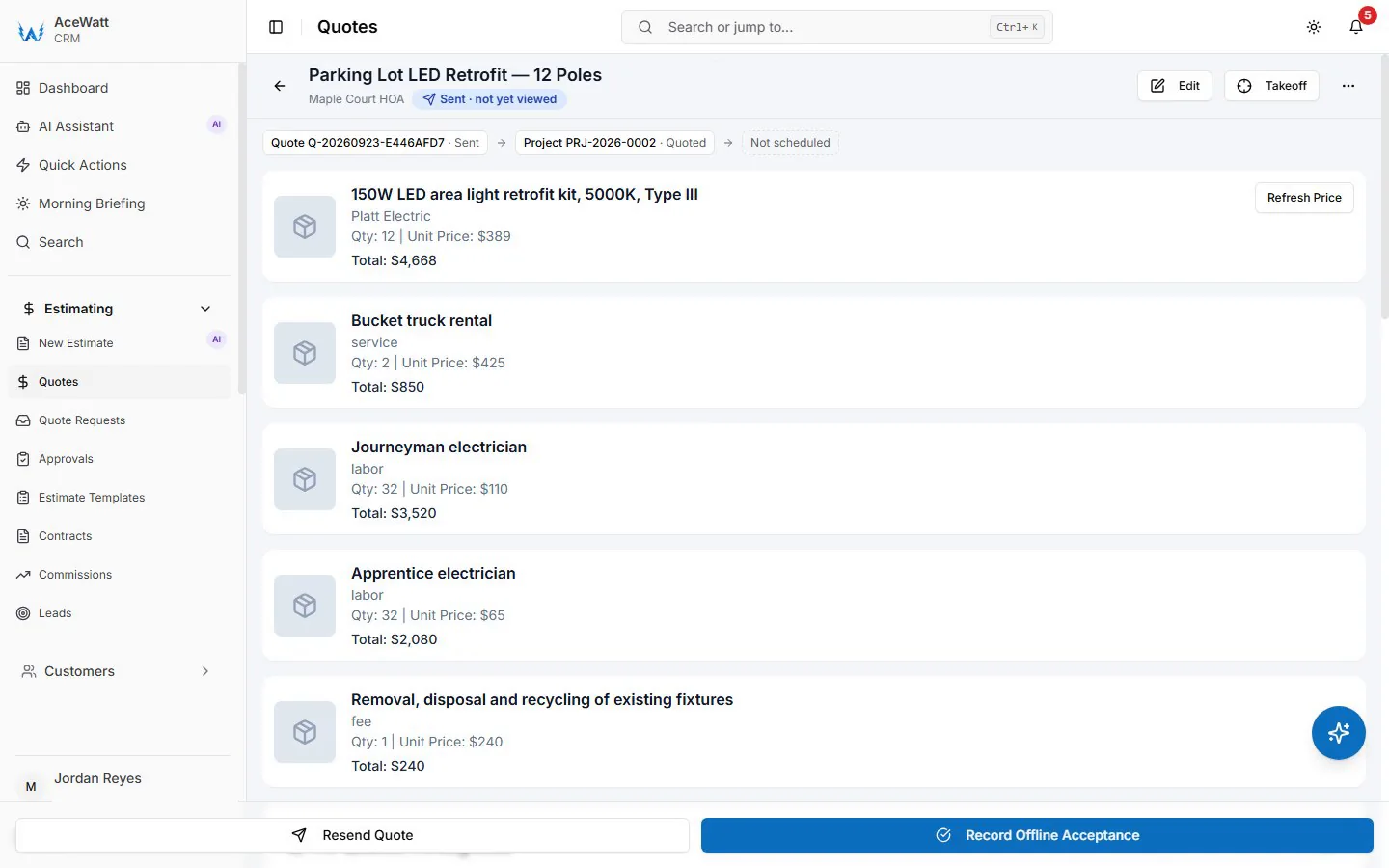
An estimate describes likely scope and price. A proposal is a more polished offer that may include options, timeline, and acceptance terms. A contract is the binding agreement that says what work will be done, what is excluded, how payment works, how changes are approved, and what both parties agree to.
Many small electrical jobs can start from an electrical estimate template. Larger projects, deposits, commercial jobs, panel upgrades, EV charger installations, service upgrades, tenant improvements, and recurring maintenance work usually deserve a stronger written agreement.
Copy/paste electrical contractor contract template structure
Use this as a clause guide. Replace bracketed text with your shop's information and have counsel review the final version.
1. Parties and project information
- Contractor: [Legal business name], [license number if applicable], [address], [phone], [email].
- Customer: [Customer legal name], [billing address], [phone], [email].
- Project site: [Service address and unit/suite].
- Project name: [Panel upgrade, EV charger installation, service repair, lighting retrofit, tenant improvement, or other description].
2. Scope of work
Contractor will provide labor, materials, tools, and coordination reasonably required to complete the following electrical work: [plain-language scope]. The scope should be specific enough that a customer, technician, inspector, and office manager can understand what is included.
Good scope language uses job-specific nouns. Instead of "upgrade electrical," write "replace existing 100A panel with new 200A panel, install labeled breakers, coordinate utility disconnect/reconnect as required, and schedule inspection after installation." The exact language depends on the job and local requirements.
3. Exclusions
Unless expressly listed in the scope, the following are excluded: drywall repair, paint, trenching, concrete cutting, utility company charges, permit fees not listed in the price, engineering, structural work, hazardous-material remediation, hidden condition repair, customer-supplied equipment defects, internet/network configuration, utility delays, and work outside the project area.
Exclusions prevent disputes. They are not a trick. They tell the customer what is not included so the price is fair and the crew is not blamed for work no one quoted.
4. Materials, fixtures, substitutions, and customer-supplied items
List major materials and fixtures. If a customer supplies equipment, state who is responsible for defects, missing parts, compatibility, warranty, and delays. If materials are unavailable, the contract should explain how substitutions are approved.
AceWatt's electrical workflow can keep scope notes, materials context, photos, and quote details tied to the customer record. That helps the office compare what was promised with what the technician needs on site.
5. Permits, inspections, AHJ, and utility coordination
Identify who is responsible for permits, inspection scheduling, inspection fees, utility coordination, and access. The authority having jurisdiction can require changes that are outside the original scope. Your contract should explain how those changes are documented and priced.
Do not promise guaranteed permit approval or inspection outcomes. Contractors can prepare, coordinate, and perform work professionally, but AHJ requirements and utility timelines are outside full contractor control.
6. Payment schedule
Use payment terms that match the job size and local law. Common structures include deposit plus final payment, milestone billing, progress billing for larger jobs, and payment on completion for service calls. State due dates, accepted payment methods, and what happens if payment is late.
Example language: "Customer agrees to pay [deposit amount] upon signing, [progress amount] upon [milestone], and the remaining balance upon substantial completion or final invoice, unless otherwise required by applicable law. Contractor may pause non-emergency work if payment is not received according to this schedule."
7. Change orders
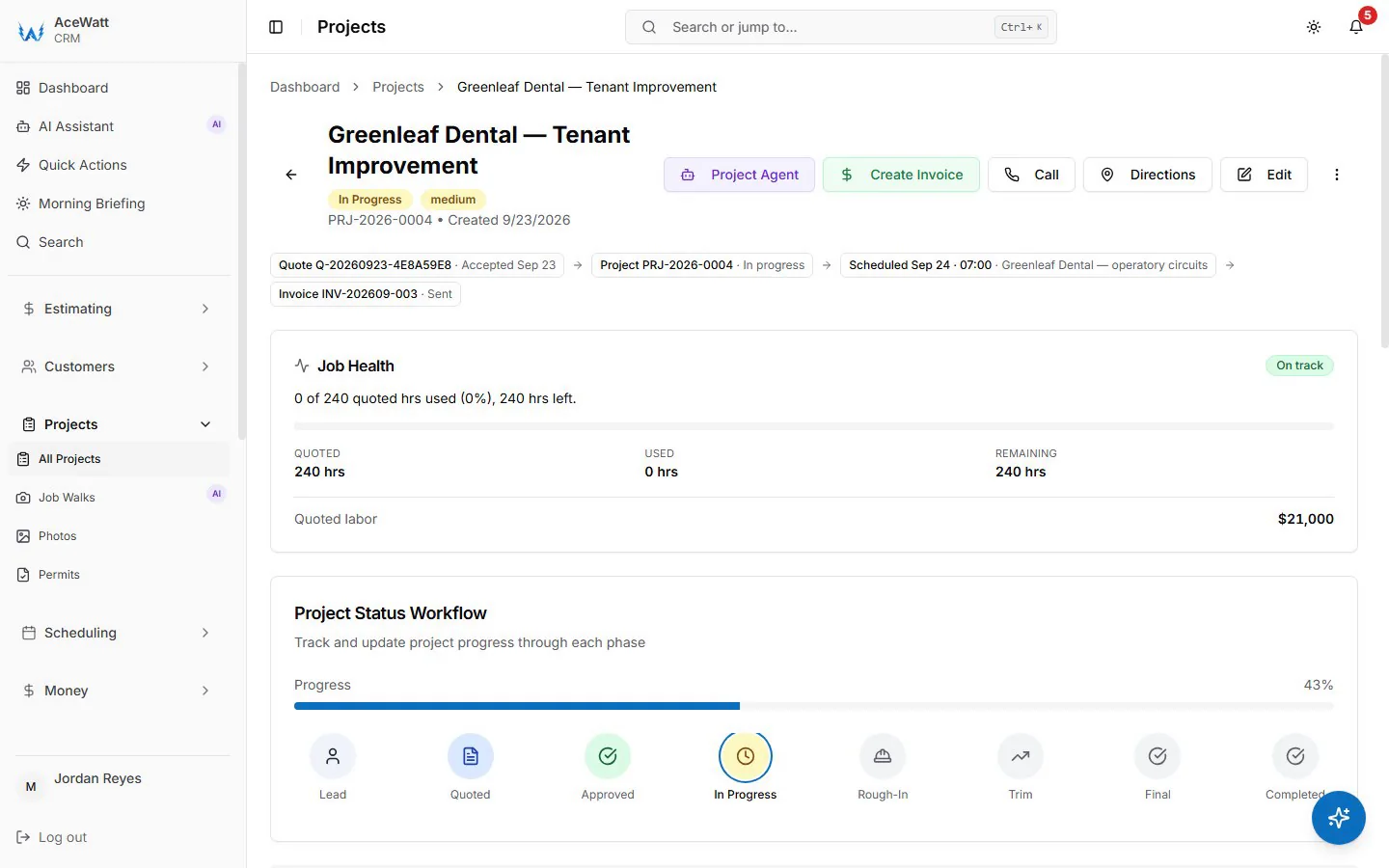
Electrical jobs often uncover surprises: blocked access, hidden damage, undersized equipment, outdated wiring, unavailable materials, inspection changes, or customer-requested upgrades. A contract should require written approval before extra work continues.
Example language: "Changes to scope, materials, schedule, or price must be approved in writing by both parties before the changed work begins, except where immediate action is required to address a safety concern or prevent damage. Approved changes will be added to the contract price."
8. Schedule, access, delays, and unknown conditions
State the expected schedule and the dependencies. Access, weather, utility availability, inspection windows, material availability, customer decisions, and unknown site conditions can change timelines. The goal is transparency, not excuses.
9. Warranty, callbacks, and workmanship
Describe your workmanship warranty, manufacturer warranty boundaries, and callback process. Be clear about what is not covered: customer misuse, third-party work, utility issues, owner-supplied defective materials, normal wear, or conditions outside the contractor's control. Have counsel review warranty language.
10. Signatures and acceptance
The contract should include signatures, printed names, dates, and a clear acceptance statement. If you use electronic approval, confirm that your process is enforceable in your jurisdiction.
Electrical scope examples you can adapt
Panel upgrade scope
"Remove existing panel equipment as required, install new panel equipment listed in the estimate, label circuits, coordinate utility disconnect/reconnect as required, and schedule inspection. Final installation is subject to site conditions, AHJ requirements, utility availability, and contractor review. Drywall, paint, utility fees, and unforeseen repairs are excluded unless listed."
EV charger installation scope
"Install a dedicated branch circuit and customer-approved EV charging equipment at [location], subject to load review, access, routing feasibility, and AHJ requirements. Customer-supplied charger equipment is excluded from contractor warranty unless expressly stated. Final capacity, breaker, conductor, and installation method require qualified review."
Commercial tenant improvement scope
"Install electrical work described in the attached drawing or scope list for [suite/project], including [lighting, receptacles, panel work, controls, or other items]. Work is subject to site access, building rules, inspection scheduling, and approved change orders for tenant or landlord revisions."
Troubleshooting/service call scope
"Perform diagnostic electrical troubleshooting for the described issue. The service call includes investigation and minor corrections only where approved. Additional repairs, replacement parts, concealed damage, code updates, or follow-up work require a separate written approval or estimate."
Contract mistakes that cause disputes
The most common contract problem is vague scope. "Install lights" can mean fixture assembly, rough-in, dimmers, controls, patching, cleanup, lift rental, attic access, permit work, and more. If the scope does not say what is included, the customer may assume it is included.
The second problem is missing exclusions. Customers may expect drywall repair, painting, trench backfill, equipment programming, utility fees, or permit costs even when the electrician never priced those items. Put exclusions in writing.
The third problem is informal change orders. A text that says "while you're here" can turn into a dispute. Use written approval before extra work continues.
The fourth problem is weak documentation. Take photos before and after the work. Keep job walk notes. Store permit and inspection details. Tie them to the customer record. AI job walk documentation and voice documentation help contractors keep that record organized.
How to turn a contract into an estimate, job, and invoice
An electrical contractor contract template should not be a dead PDF in a folder. It should become the operating plan for the job. In AceWatt, the cleaner workflow is:
- Capture job-walk notes and photos.
- Build the scope and exclusions.
- Create the estimate or proposal.
- Confirm customer approval and contract terms.
- Schedule the work.
- Track completion and change orders.
- Convert approved work into an electrical invoice template or invoice record.
- Follow up on payment and future service needs.
That workflow reduces double entry. It also helps your office answer a simple question: what did the customer approve, and what is the crew supposed to do?
FAQ: Electrical Contractor Contract Templates
Do electricians need written contracts?
For many jobs, yes. Written contracts help define scope, exclusions, payment, change orders, permit responsibility, and signatures. Requirements vary by jurisdiction and job type, so verify local rules with counsel.
Is an electrical estimate the same as a contract?
No. An estimate is usually a price and scope proposal. A contract is the accepted agreement with terms. Some estimate documents can become contracts when accepted, but the language must be clear and reviewed for your jurisdiction.
What should be excluded from an electrical contract?
Common exclusions include drywall, paint, trenching, concrete cutting, utility fees, permit fees not included in price, concealed damage, owner-supplied equipment issues, and work outside the listed scope.
Who is responsible for permits and inspections?
The contract should say who applies, who pays, who schedules, and how inspection-driven changes are handled. Do not assume the customer and contractor understand this the same way.
Can I use the same contract for residential and commercial work?
You can start from one structure, but residential and commercial jobs often need different disclosures, payment terms, schedule terms, insurance requirements, and approval paths. Have counsel review both versions.
Can software create electrical proposals and contracts?
Software can help organize scope, estimates, customer details, approvals, and documents. A contractor and counsel should still review legal terms, scope, pricing, code, permits, safety, and final commitments.
Bottom line
A good electrical contractor contract template protects both sides by making the work clear. The best workflow starts before the contract: accurate job walk notes, photos, scope, exclusions, estimate review, and clean customer approval. Use AceWatt to keep that workflow connected, and use local counsel to make the contract legally ready.
For related documents, see the electrical work order template, electrical estimate template, and electrical bidding software guide.
Related Reading
- See all CRM features for electrical contractors in one platform.
- CRM for Electrical Contractors That Actually Tracks Change Orders
- Browse all free downloads → Free electrical contractor templates