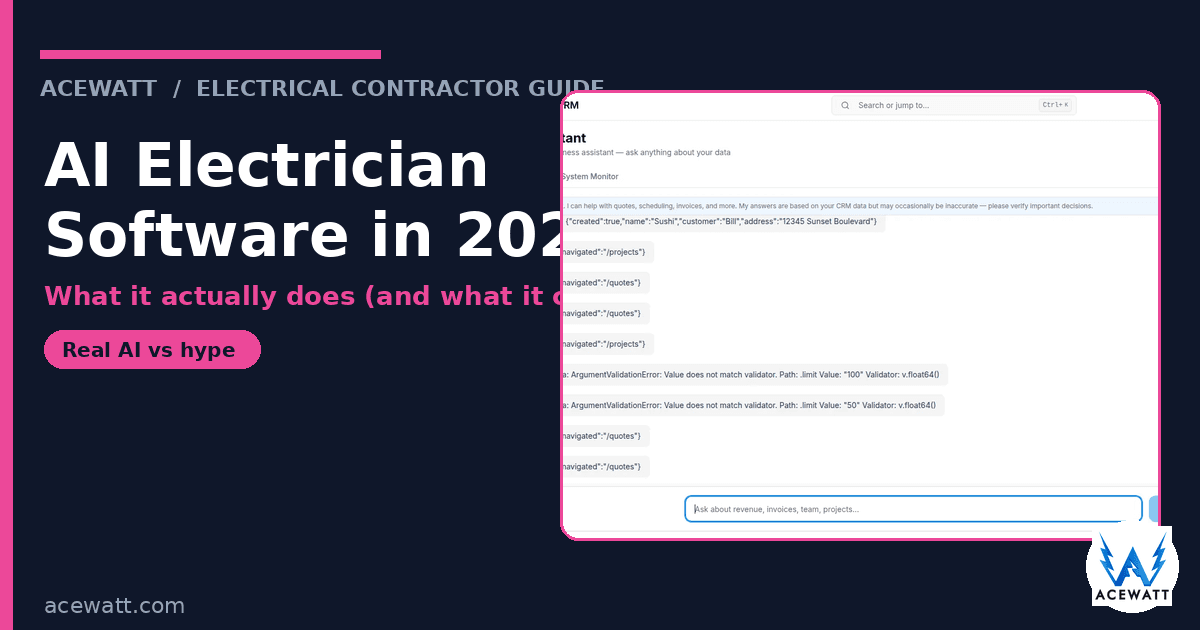
AI electrician software has gone from buzzword to a working set of tools that remove office admin from an electrical business, estimating, follow-up, after-hours calls, dispatch, and reporting. What it has not become is a robot that pulls wire, signs off on a load calc, or replaces your license. The honest 2026 framing: AI in the trades is about removing paperwork and speeding revenue, not replacing the electrician behind the meter.
You already know where the time goes, after-hours leads to voicemail, job-walk notes that take hours to quote, estimates nobody follows up on. AI electrician software collapses those gaps: it drafts the estimate from your job-walk notes, answers the after-hours call, nudges the open quote, and prioritizes tomorrow's dispatch. The electrician still scopes, prices, and signs; the software removes the friction.
This guide covers what AI electrician software does, what it cannot do, how the major tools compare, and how to choose without falling for hype. AceWatt is included because it is built for electrical contractor workflows, treat product comparisons as buyer education, not an independent ranking. Verify live pricing, plan limits, and integrations with each vendor before you buy.
Quick answer: what is AI electrician software?
AI electrician software is field-service and business software for electricians that uses artificial intelligence to automate quoting, follow-up, communication, scheduling, and reporting, not software that performs the electrical work itself.
The distinction matters because "AI" marketing is sometimes careless. A vendor promising an "AI electrician" is overpromising. A vendor promising a tool that drafts your estimate from a scope description, summarizes a job walk, answers after-hours calls, and nudges open quotes is describing something real in 2026.
In practice, the AI sits on top of the CRM and field-service-management (FSM) tools you already use. It reads job notes, scope, photos, the schedule, and call history, then produces drafts, summaries, and recommendations that a human reviews and approves. The electrician still owns the scope, price, permit, and safety call. For how this fits a trade-specific system, see the CRM for electricians page.
What AI can (and can't) do for an electrical business in 2026
It is worth being blunt, because the hype cycle has not finished. Here is what AI in electrical software genuinely does well today, and where it stops.
What AI can do:
- Draft estimates from a scope description or job-walk notes. Describe the job, "200-amp panel upgrade, add surge protection and a generator inlet", and the AI produces a first-draft quote with line items to review, correct, and send.
- Automate follow-up on open estimates. When a quote sits unanswered, AI sends a polite nudge and keeps the estimate visible. Many contractors lose jobs not on price but on missing follow-up.
- Answer after-hours calls via AI voice and an AI receptionist. An 11 p.m. dead-circuit call becomes a logged lead with the issue captured and a callback booked, instead of a voicemail nobody checks.
- Prioritize dispatch by job value and technician fit. AI looks at tomorrow's jobs, revenue, skills required, and techs available, then recommends an order that protects margin and cuts windshield time.
- Summarize job notes and flag invoice anomalies. AI turns raw dictation into a clean summary plus photos, and flags when materials on the invoice don't match what was quoted.
What AI cannot do:
- It cannot pull wire, make up a panel, or do any physical electrical work.
- It cannot do load calculations, conductor sizing, or code-compliance decisions unsupervised. An AI can draft a takeoff or suggest a material list, but a qualified person still verifies it against the NEC and AHJ requirements.
- It cannot replace a license. An AI estimate is a draft, not a sealed document, permitting, inspections, and sign-off still belong to the licensed professional.
The honest summary: AI software for electricians is a force multiplier for office work, not a substitute for the trade. Treat any vendor that says otherwise as a red flag.
The categories of AI electrician software
AI electrician software is not one product, it is a set of capabilities that show up in different combinations depending on the vendor. The main categories in 2026:
- AI estimating and scope-to-quote. Drafts an estimate from a scope description, photos, or job-walk notes, where most service electricians feel the pain first. (See the electrical estimating software guide.)
- AI follow-up and communication. Timed reminders on open estimates, routed back to the right person. The quiet money-maker, most shops lose revenue to un-followed quotes, not underpricing.
- AI voice and AI receptionist. Handles inbound calls outside business hours, captures emergency leads, books callbacks, and triages urgency.
- AI dispatch and scheduling optimization. Prioritizes jobs by value, fit, and route, and flags conflicts before they cost a customer.
- AI reporting and insights. Surfaces pipeline value, quote close rate, overdue invoices, and underperforming service categories.
- AI takeoff for commercial bidders. A separate animal, software that counts symbols on digital blueprints to produce quantity takeoffs for commercial bids. PataBid Quantify and Togal live here.
Most shops need two or three of these, not all six. If you are not sure where you leak time, the full features overview maps the gaps.
AI electrician software: the 2026 landscape
The main tools electrical contractors evaluate when looking at AI software. Treat this as a starting point, pricing and features change often, and several vendors only quote through sales. Always verify pricing on the vendor's site before deciding.
| Tool | Category | Best fit | AI capability focus | Pricing | Primary caveat |
|---|---|---|---|---|---|
| AceWatt | AI-first CRM for electricians | Solo to growing shops wanting estimating, follow-up, voice, and dispatch in one platform | AI quote builder, AI copilot & voice, AI schedule optimizer, AI document scanner, AI job walk | Public pricing page | Newer than incumbents; verify enterprise integrations if needed |
| ServiceTitan | Enterprise field-service platform | Larger service companies with dispatchers and office staff | Atlas AI, Dispatch Pro, Price Insights | Quote-based, verify on vendor's site | Implementation cost and cost per tech can be high; not for solo shops |
| QuoteIQ | AI estimating and follow-up for service trades | Contractors whose main pain is estimating and bidding speed | AI Estimator, Virtual Call Team, Review Multiplier | Verify on vendor's site | Confirm whether it replaces your CRM/scheduling/invoicing or only estimating |
| Fieldproxy | Field-service software with AI scheduling/dispatch positioning | Teams wanting AI-assisted dispatch and operations | AI scheduling and dispatch workflows | Verify on vendor's site | General field-service focus; confirm electrical-specific depth |
| PataBid Quantify | AI electrical estimating and takeoff | Commercial bidders needing quantity takeoffs from blueprints | AI blueprint takeoff and estimating | Verify on vendor's site | Estimating/takeoff only, not the full CRM-voice-dispatch workflow |
| WSCAD ELECTRIX | AI electrical CAD and engineering software | Engineers and design-build firms doing electrical design | AI-assisted electrical CAD, schematics, design | Verify on vendor's site | Engineering/design tool, not a field-service CRM; different buyer |
| Buildforce | AI for electrical contracting (adjacent/payroll angle) | Contractors evaluating workforce, payroll, project-labor angles | AI for workforce and contracting workflows | Verify on vendor's site | Adjacent to FSM; confirm overlap with your CRM |
The pattern to notice: "AI" means different things at each vendor, ServiceTitan's AI is enterprise dispatch and pricebook intelligence, PataBid's counts symbols on drawings, WSCAD's helps design circuits, and AceWatt's drafts estimates, handles after-hours calls, and optimizes dispatch for a service shop. When a vendor says "AI," ask which category they mean. For a deeper CRM side-by-side, see the best CRM for electrical contractors comparison.
How AI changes the electrical job workflow
Follow a job from first contact to review request and you can see exactly where AI removes friction.
- Lead → AI-drafted estimate → faster first quote. A customer calls or fills a web form; AI helps draft an estimate from the scope or job-walk notes. You review, adjust, and send a professional quote the same day.
- Estimate → AI follow-up → higher approval rate. The quote goes out and silence; AI sends a timed nudge and keeps the estimate visible. Contractors routinely lose open quotes not because the price was wrong but because nobody followed up.
- Approval → AI dispatch → right tech, right job. The AI schedule optimizer weighs job value, skills required, tech availability, and location, and recommends an assignment that protects margin and avoids conflicts.
- Completion → AI invoice summary → AI payment nudge. The tech captures notes and photos (AI job walk summarizes them) and the approved estimate becomes an invoice without retyping. If payment stalls, AI sends a reminder. See the electrician invoice software guide.
- Payment → AI review request → more five-star reviews. Once the job is paid, AI prompts a review at the right moment, better local search ranking, more trust, lower cost on the next lead.
AI estimating: scope-to-quote vs blueprint takeoff
This is the most confused area in "AI electrician software." There are two fundamentally different AI estimating tools, and they serve different buyers.
Scope-to-quote AI (service electricians). You type or speak the scope, "install two Tesla wall connectors, 60-amp each, add surge protector", and the AI produces a draft estimate with line items for materials, labor, and markup. You review, correct, and send. This is what AceWatt's AI quote builder and QuoteIQ's AI Estimator do. It fits service calls, panel upgrades, EV charger installs, lighting retrofits, and troubleshooting where speed wins.
Blueprint takeoff AI (commercial bidders). You upload digital drawings and the AI counts symbols, receptacles, switches, conduit runs, fixtures, and produces a quantity takeoff that feeds an estimate. This is what PataBid Quantify and Togal do. It fits commercial new construction, tenant improvements, and design-build bids where the scope lives on drawings.
Why these are different tools. A service electrician rarely has a blueprint; they have a scope description, photos, and a job-walk recording. A commercial bidder rarely types a scope; they count thousands of symbols. Buying blueprint takeoff AI for a service shop is the wrong tool, and buying scope-to-quote AI for a commercial estimator will not count your symbols. AceWatt's quote builder is built for the service-electrician path; if your work is commercial bid volume, evaluate PataBid Quantify or Togal as well.
Honest limits and risks of AI in the trades
AI electrician software is useful, but the risks are real.
AI hallucinations and code/compliance. Large language models can produce confident text that is wrong. In electrical work, "wrong" can mean an undersized conductor, a missing GFCI, or a panel schedule that does not balance. AI estimates, takeoffs, and material lists are drafts. Every AI-generated estimate must be reviewed by a licensed or qualified professional before it is sent, priced, or installed. AI accelerates the first draft; it does not own the compliance decision.
Data privacy and customer information. AI features often send text, photos, and call recordings to external models. Ask each vendor where data is processed, whether it trains shared models, and whether you can delete customer data on exit. Customer addresses, panel photos, and access notes are sensitive.
"AI" that is really basic automation. Some vendors label a simple reminder email or rule as "AI." A timed follow-up works whether or not it is AI, but should not be priced like frontier AI. When a vendor says "AI-powered," ask to see the specific output, the drafted estimate, the transcript summary, the dispatch recommendation. If they can only show a scheduled email, you are paying for marketing.
Human review still owns estimates, safety, and permits. The licensed electrician owns scope accuracy, NEC compliance, AHJ submissions, load calculations, and every safety decision. Software that tries to remove that review, or a vendor that encourages you to skip it, is a liability.
How to choose AI electrician software
There is no single best AI tool for every electrical business, the right choice depends on where your shop leaks time.
1. Start with the bottleneck. Where does your business lose money right now?
- Slow estimates? → AI estimating / scope-to-quote.
- Open quotes never followed up? → AI follow-up.
- After-hours calls to voicemail? → AI voice / receptionist.
- Inefficient dispatch? → AI schedule optimization.
- No visibility into pipeline or overdue invoices? → AI reporting.
Most shops have one or two dominant bottlenecks. Solve those first.
2. Bundled AI inside a CRM/FSM vs bolt-on tools. You can buy AI estimating, AI voice, and AI follow-up from three vendors and stitch them with integrations, that works, but adds cost, data silos, and maintenance. The alternative is a CRM/FSM with AI built in, so estimating, follow-up, voice, dispatch, and reporting share one customer record. For a small shop, the bundled path is usually simpler, the AI CRM for contractors guide covers that angle.
3. Transparency, data ownership, and exit options. Confirm who owns your customer data, whether you can export it, what happens to AI-trained models if you leave, and the cancellation terms. A platform that locks your data in is a long-term risk.
4. Decision framework: use case × integration × price × trust. Score each candidate on whether it solves your bottleneck, integrates with QuickBooks and your payment processor and phone system, has a sustainable total price (including users and AI credits), and earns your trust after a trial. For broader context, see the how to manage an electrical contracting business guide and the electrical contractors page.
How AceWatt uses AI for electricians
AceWatt is built as an AI-first CRM for electricians, the AI is woven into estimating, follow-up, voice, and dispatch, not bolted on. Here is what is real and included today (verify plan details on the pricing page before buying).
AI estimating from job-walk notes and scope. The AI quote builder (Starter+) drafts estimates from a scope description or from AI job-walk notes. You review materials, labor, and markup and send, always a draft until a qualified professional approves it.
AI follow-up that moves estimates to approvals to payments. Open quotes get timed follow-up. Approved jobs move to scheduling. Completed jobs move to invoice, and overdue invoices get payment nudges, all inside the CRM, so nothing depends on the owner remembering to email.
AI voice and AI receptionist for after-hours calls. On the Growth plan and up, AI copilot & voice handles after-hours calls, captures emergency leads, and books callbacks.
AI schedule optimizer and AI document scanner. The AI schedule optimizer (Growth+) prioritizes dispatch by job value and technician fit. The AI document scanner parses permits, panel labels, and scope documents into searchable data.
AI job walk. The AI job walk feature (Growth+) captures voice and photos on site and produces a summarized record that feeds straight into the estimate.
One platform vs stitching five tools. AceWatt bundles estimating, voice, follow-up, a scanner, and a scheduling optimizer around one customer record instead of five separate vendors. Pricing runs Starter $49/month (1 user, AI quote builder, core CRM, basic dispatch), Growth $99/month (up to 5 users, AI copilot & voice, AI schedule optimizer, AI document scanner, AI job walk, QuickBooks sync, commission tracking, customer portal), and Scale $199/month (unlimited users, custom webhooks, route optimization, advanced reports, dedicated contact). A 14-day trial is available; during the current promo (through 2026-11-19) plans include bonus monthly AI credits, Starter 5,000, Growth 10,000, Scale 25,000. Confirm pricing and promo status on the pricing page before subscribing.
AceWatt does not do AI blueprint takeoff (PataBid/Togal), AI electrical CAD/design (WSCAD), autonomous electrical work, or code-compliance decisions without human review. If your bottleneck is commercial bid takeoff or engineering design, those adjacent tools are the place to look.
FAQ
What is the best AI software for electricians?
There is no single best, it depends on your bottleneck. For service electricians wanting AI estimating, follow-up, voice, and dispatch in one CRM, AceWatt is built for that. For enterprise dispatch depth, ServiceTitan. For pure estimating speed, QuoteIQ. For commercial blueprint takeoff, PataBid Quantify. The right answer solves your actual bottleneck and fits your team size.
Can AI write electrical estimates?
Yes, as a first draft. Tools like AceWatt's quote builder and QuoteIQ's AI Estimator produce a draft from a scope description, photos, or job-walk notes. That draft still needs review by a licensed or qualified professional for materials, labor, pricing, code compliance, and safety before it is sent or installed. AI accelerates the first draft; it does not own the final number.
Is AI electrician software worth it for a small shop?
Often, yes, if your bottleneck is slow quotes, missed follow-up, or after-hours calls going to voicemail. A solo electrician on a $49/month plan with an AI quote builder can send same-day estimates instead of next-week estimates. The math is less favorable if you are intentionally staying small and already have more work than you want. Run a trial against a real job and decide.
Does AceWatt use AI?
Yes. AceWatt includes an AI quote builder (Starter+), AI copilot & voice, AI schedule optimizer, AI document scanner, and AI job walk (Growth+). These draft estimates from scope and job-walk notes, handle after-hours calls, prioritize dispatch, scan permits and panel labels, and summarize on-site voice and photo captures. All AI outputs are drafts requiring review by a qualified professional before use.
Will AI replace electricians?
No. AI in 2026 is a force multiplier for the office side, quoting, follow-up, communication, scheduling, reporting. It does not pull wire, do load calculations, make code-compliance decisions, or hold a license. The skilled electrician, the permit, the inspection, and the final safety call remain human responsibilities. Vendors who claim otherwise are selling hype.
Disclaimer
This article is for software evaluation and education only. AceWatt is an AI-first CRM for electricians and is included in comparisons because of that positioning, treat product comparisons as buyer education, not independent rankings. AI-generated estimates, takeoffs, summaries, and material lists are drafts that require review and approval by a licensed or qualified professional before being sent, priced, or installed. All pricing and feature information for AceWatt should be verified on the current pricing page, and all competitor pricing and features should be verified directly on each vendor's site before purchasing. Figures and plan details mentioned here are illustrative and may change; promo terms, AI credit allotments, and feature availability are subject to the vendor's current terms. Licensed electrical judgment remains responsible for scope, code compliance, safety, permits, and final pricing decisions.