_Last updated: June 2026._
Direct answer: An electrical contractor service agreement is the written document that defines the working relationship between an electrical contractor and a customer before work begins, covering scope of work, pricing and payment terms, scheduling, code and permit responsibility, change-order process, warranty, liability, and termination. It is broader than an estimate and more durable than a single job contract, especially for recurring residential service, commercial maintenance accounts, and multi-phase projects. Use the template excerpt below as a starting point, but have a licensed attorney in your jurisdiction review the final version. This post is not legal advice.
Most electrical contractors do not have a "service agreement problem." They have a paperwork problem. The estimate, the work order, the change order, and the final invoice all live in different places and tell different stories. A clean service agreement ties those pieces together and gives both sides a single reference point when scope drifts, payment gets delayed, or the inspector walks the site.
This guide is for electricians who want a workable electrical contractor service agreement template they can adapt for residential, commercial, and maintenance work, plus a way to keep the agreement, the estimate, and the invoice aligned inside the CRM. AceWatt is built for electrical contractors who want paperwork to follow the job.
Quick answer: what is an electrical contractor service agreement?
An electrical contractor service agreement is a written agreement between a licensed electrical contractor and a customer that defines how the two parties will work together on electrical services. It usually covers scope of work, pricing and payment terms, scheduling and site access, permits and inspections, change orders, warranty, liability and insurance, and termination. Unlike a one-off estimate or a single job contract, a service agreement is designed to govern a working relationship that may include multiple visits, multiple scopes, or ongoing maintenance.
In practice, electrical contractors use a service agreement for three situations:
- Recurring or open-ended work (residential service plans, commercial maintenance accounts, property management accounts).
- Larger one-time projects where the scope is detailed enough to need more than an estimate (panel upgrades, service upgrades, EV charger installations, generator installs, tenant improvements, multi-day commercial work).
- Any job where the customer wants a single document that covers "everything we will and will not do, how we get paid, and what happens if something changes."
NECA (National Electrical Contractors Association) and ELECTRI International both emphasize that well-documented scope, change-order, and warranty language is one of the most effective ways electrical contractors reduce disputes on residential and commercial work. A service agreement is the simplest place to put that language in writing.
Why a service agreement is not the same as an estimate or contract
A lot of electrical contractors use "estimate," "proposal," "contract," and "service agreement" interchangeably. They are not the same document, and the difference matters at the job site, at the bank, and in court.
Here is a simple way to think about it:
| Document | Purpose | Typical length | Becomes binding when. |
|---|---|---|---|
| Estimate | Predicts scope and price before work | 1-2 pages | The customer accepts it |
| Proposal | Offers options, terms, and acceptance path | 2-6 pages | The customer signs the acceptance block |
| Contract | Binds both parties to one specific job | 4-10+ pages | Both parties sign and a deposit is taken |
| Service agreement | Governs the working relationship across one or many jobs | 4-12+ pages | Both parties sign, often before any specific work is scoped |
A residential electrical estimate answers, "What will this one job cost?" A service agreement answers, "How will we work together, on this job and the next one, and what are the rules?"
If you want a starting point for the one-off binding document, see our electrical contractor contract template for the project-level version. The service agreement is the umbrella above it.
When a service agreement makes sense (and when it does not)
Use a service agreement when:
- You are doing recurring work (quarterly maintenance, annual testing, residential service plans).
- The scope has more than three or four line items or spans multiple visits.
- The customer is a property manager, facility manager, HOA, or commercial account.
- The job is large enough that change orders are likely.
- Payment terms (deposits, retainers, net 30, materials pass-through) need to be defined up front.
A simple signed estimate is usually enough for small service calls, single-device changeouts, and short diagnostic visits where pricing and scope fit on one page. Over-documenting a $180 service call wastes everyone's time and can slow the close.
Core clauses every electrical service agreement should have
A service agreement does not need to be long. It needs to be complete. Below is the clause checklist we use with electrical contractors who are rewriting their paperwork for 2026. Every clause can be tightened to one paragraph; do not let it bloat.
- Parties and project information. Contractor legal name, license number, customer name, property address, billing address, primary contact, and authorized representative for change orders.
- Scope of work. What you are doing, where, and to what standard. Reference the NEC (National Electrical Code) edition your jurisdiction has adopted, the applicable load calculations, and any manufacturer installation instructions.
- Pricing and payment. How the price is set (lump sum, time and materials, unit price, recurring retainer), when deposits are due, when progress payments trigger, and when the final invoice is issued. Tie this back to your electrical pricing guide and your profit margin targets so the numbers are defensible.
- Schedule and site access. Start date, working hours, expected duration, customer responsibilities (clearing access, providing power, parking), and how delays (weather, materials, inspection queue) are handled.
- Code, permits, and inspections. Who pulls the permit, who schedules inspections, who pays permit fees, and who is responsible if the AHJ (Authority Having Jurisdiction) requires a change. This is where the electrical permit application template plugs in as a sub-checklist.
- Change order process. A change order is a written addendum that documents any scope, price, or schedule change before the extra work is performed. No surprises on the invoice.
- Warranty. What you warrant, for how long, on labor and on materials, and what the customer must do to keep the warranty in effect.
- Liability and insurance. Your general liability and workers' comp coverage, your right to stop work for unsafe conditions, and the customer's responsibility for concealed conditions, asbestos, mold, and other latent hazards.
- Termination. How either party can end the agreement, what happens to open work orders and deposits, and what survives termination (warranty, indemnity, payment obligations).
- Signature block. Dated signatures for both parties, printed names, titles (for commercial), and license number where required.
That list is the spine of the document. Notice provisions, dispute resolution, force majeure, indemnification, and governing law are supporting tissue and should be drafted with counsel.
Where industry-association guidance fits
NECA publishes standard contract documents and position papers widely accepted in the industry. ELECTRI International funds research on electrical contractor productivity, risk, and project management. ExpertCE, a continuing-education provider for electricians, has published guides on documentation practices. Treat these as references, not substitutes for jurisdiction-specific legal review. Multi-state service agreements add a layer of complexity that benefits from counsel familiar with construction law in each state.
Residential vs commercial vs maintenance service agreements
Not every service agreement looks the same. The customer, the risk profile, and the work pattern are different, and the document should reflect that.
| Element | Residential service agreement | Commercial service agreement | Maintenance / recurring service agreement |
|---|---|---|---|
| Primary customer | Homeowner | Business, property manager, GC, facility manager | Same as residential or commercial, but ongoing |
| Typical scope | Single project, panel upgrade, EV charger, generator | TI build-out, multi-phase project, design-build | Quarterly inspections, testing, on-call service |
| Pricing model | Lump sum or T&M with deposit | Often T&M, unit price, or GMP with progress billings | Retainer, recurring visit fee, or pre-bought hours |
| Payment terms | Deposit + balance on completion | Net 15 / Net 30 with retainage possible | Monthly auto-bill, retainer drawdown |
| Insurance floor | Standard GL + workers' comp | Often higher GL limits, OCIP/CCIP clauses | Same as the underlying commercial or residential terms |
| Termination | Usually "at will" by either party with notice | Often tied to project milestones | 30/60/90-day termination notice common |
| Permit responsibility | Contractor pulls, customer pays | Often GC pulls, contractor coordinates | Varies; routine service often permit-exempt |
Use the residential version as the base. Add commercial clauses (retainage, indemnification, OCIP, prevailing wage, notice provisions) when the customer is a business. Add maintenance clauses (response time, after-hours rates, service window, auto-renew) when the relationship is ongoing.
Maintenance-specific clauses to add
For residential service plans or commercial maintenance accounts, fold in:
- Response time commitments. Business hours vs after-hours vs emergency response.
- Exclusions. Tenant-caused damage, code upgrades triggered by unrelated work, and customer-supplied equipment.
- Rate locks and escalation. How and when your hourly rate can change, with at least 30 days' written notice.
- Auto-renewal. Common in commercial accounts; make it opt-out, not opt-in, and disclose it clearly.
- Access and security. Badging, escort requirements, after-hours access, alarm reset procedures.
- Reporting. What you deliver after each visit (test results, photos, recommendations).
These are the details that separate a profitable maintenance account from a money leak.
How AceWatt CRM keeps the agreement, the estimate, and the invoice aligned
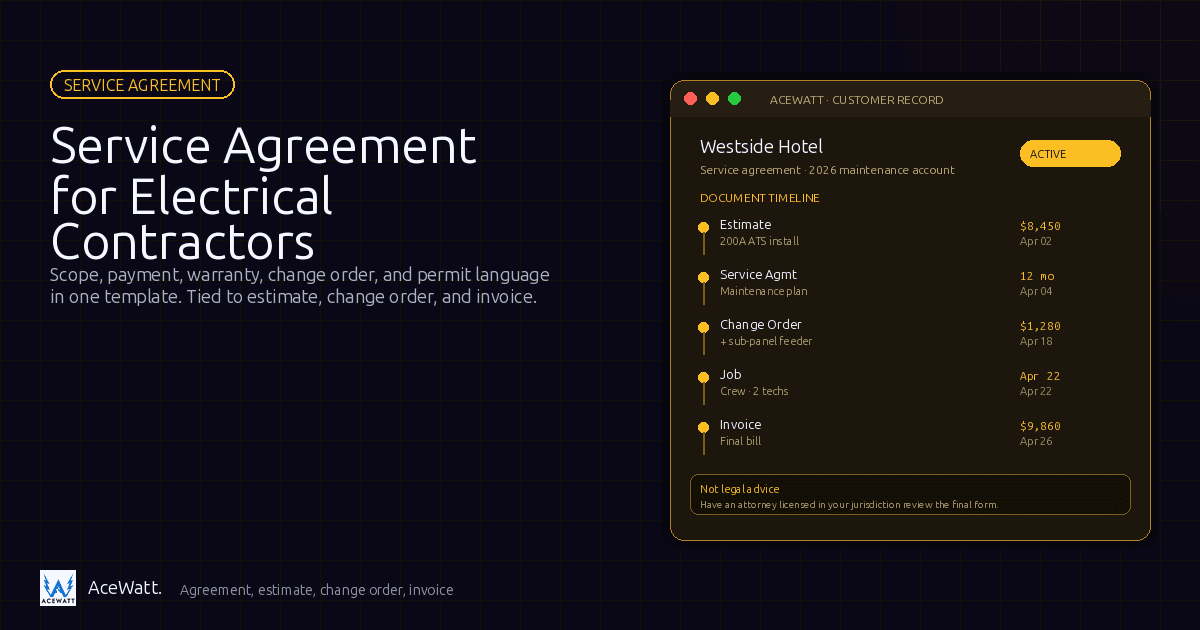
The biggest reason service agreements fail in electrical contracting is not the wording. It is that the agreement, the estimate, the change orders, and the final invoice are not connected. The customer signed a service agreement in January, the estimator wrote a quote in February, the foreman marked up the work in March, and the invoice was generated in April from a different system. When the customer asks, "What did I actually agree to pay?" nobody can answer.
AceWatt is built to keep those pieces on the same record. Here is what that looks like in the electrical contractor CRM:
- The customer record holds the agreement. The signed service agreement, the master scope, the payment terms, the warranty terms, and the termination language all live on the customer record. Anyone who opens the customer file sees the rules of the relationship before they quote, schedule, or bill.
- Quotes pull from the agreement's pricing model. If the agreement says "time and materials at the posted labor rate plus materials markup in the range of 25-45%," the quote reflects that without retyping. See the electrical estimating software and the proposal software working together inside AceWatt.
- Change orders reference the agreement. A change order is generated from the active quote, references the agreement's change-order clause, and is logged against the customer record.
- Job costing reconciles to the invoice. As the job runs, actual labor and materials are captured and compared to the estimate. Read more in electrical job costing software.
- Margin visibility stays in the loop. Your target profit margin is the guardrail. If a change order erodes the margin below your floor, the system flags it before the invoice goes out.
- The customer sees a clean handoff. A homeowner does not care about your CRM architecture. They care that the price they signed is the price they are invoiced. AceWatt's pricing model is designed so the quote, the change order, and the final invoice look like the same document family.
The AI CRM for contractors writeup walks through how AceWatt uses AI to draft agreement language, flag missing clauses, and keep documentation consistent across jobs.
A short example of alignment in practice
A property manager signs a commercial service agreement in Q1 for monthly electrical maintenance across four buildings. In March, an emergency call comes in for a tripped main in Building 2. The technician is dispatched, opens a work order against the same customer record, and the time-and-materials price automatically reflects the agreement's labor rate and materials markup range. The foreman generates a change order in the field for an unexpected breaker replacement. The end-of-month invoice consolidates the scheduled visit, the emergency call, and the breaker change into one document, all referencing the same agreement. One bill, one summary, one audit trail.
Service agreement template (claim-safe excerpt, not legal advice)
Below is a claim-safe template excerpt you can adapt. It is intentionally general so it does not invent state-specific legal promises. This is not legal advice, and it is not a substitute for review by an attorney licensed in your jurisdiction. Use it as a structural starting point and have counsel tailor the language to your state, license class, and customer mix.
` ELECTRICAL CONTRACTOR SERVICE AGREEMENT (This template excerpt is for educational use only and is not legal advice. Have an attorney review before using it with any customer.)
- PARTIES AND PROJECT INFORMATION
Contractor: [Replace with your legal business name, address, license number, and contact information] Customer: [Replace with customer's full legal name, billing address, property address, and primary contact] Date: [Replace with the effective date of the agreement]
- SCOPE OF WORK
The Contractor will perform the electrical work described in one or more written estimates or work orders issued under this agreement. Work will be performed in accordance with the National Electrical Code (NEC) edition adopted by the Authority Having Jurisdiction (AHJ), all applicable local codes, and manufacturer installation instructions. [Replace with your standard of care language.]
- PRICING AND PAYMENT
Pricing for each job is set in the applicable estimate or work order. The Customer agrees to pay:
- A deposit of [Replace with percent or flat amount] before work begins.
- Progress payments at [Replace with milestone language].
- The balance on completion, due within [Replace with terms].
Materials may be billed at cost plus a markup in the range commonly used in the electrical trade. [Replace with your actual markup policy and any specific ranges you publish.] Late payments may be subject to a service charge.
- SCHEDULE AND SITE ACCESS
The Contractor will provide an estimated start date and duration. Start dates are estimates, not guarantees, and may shift due to weather, materials, inspection scheduling, or customer-side delays. The Customer agrees to provide reasonable site access, parking, and power during working hours.
- CODE, PERMITS, AND INSPECTIONS
Permits will be pulled by [Replace with: the Contractor / the Customer / the General Contractor]. Permit fees are [Replace with: included in the estimate / billed at cost / paid by the Customer directly to the AHJ]. The Contractor will schedule required inspections. AHJ-required scope changes will be handled through a written change order.
- CHANGE ORDER PROCESS
Any change in scope, price, or schedule must be documented in a written change order signed by both parties before the extra work is performed. Verbal approvals are not accepted. [Replace with your preferred signature method: in-person, electronic, or both.]
- WARRANTY
The Contractor warrants its labor for [Replace with period] from the date of substantial completion. Manufacturer warranties on materials pass through to the Customer to the extent allowed. Warranty does not cover damage from misuse, unauthorized modification, Acts of God, or work performed by others. [Replace with full warranty terms as advised by counsel.]
- LIABILITY AND INSURANCE
The Contractor maintains general liability and workers' compensation coverage as required by law. Certificates of insurance are available on request. The Contractor is not responsible for concealed conditions, hazardous materials, or code deficiencies in existing wiring discovered during the work. [Replace with indemnification and limitation of liability language as advised by counsel.]
- TERMINATION
Either party may terminate this agreement with [Replace with notice period] written notice. Termination does not relieve the Customer of the obligation to pay for work performed and materials ordered before the termination date. Provisions that by their nature should survive termination, including payment, warranty, and indemnification, will survive termination.
- SIGNATURE BLOCK
Contractor: ____________________________ Date: __________ Name: [Replace with printed name] Title: [Replace with title] License #: [Replace with license number]
Customer: ____________________________ Date: __________ Name: [Replace with printed name] Title: [Replace with title, if applicable] `
That is the spine. It is not a finished document. It is a structural reference.
How to use this template
- Copy the excerpt into a clean document. Strip the comments. Leave the section headers.
- Replace every bracketed placeholder with your shop's information. Do not leave any "[Replace with.]" text in the final version.
- Add clauses your jurisdiction requires. Some states require specific consumer notices, lien notices, or cancellation language. Have counsel tell you which ones.
- Add clauses your customer requires. Commercial customers often send their own terms. Decide which take precedence and put it in writing.
- Have an attorney review the final version in the states where you work, then version and date every revision.
- Store the signed version in the CRM. Tie it to the customer record so every future estimate, change order, and invoice references the same agreement.
What to leave out of a service agreement
Just as important as what goes in is what stays out. A few common missteps:
- Detailed pricing for every possible future job. A service agreement is not a price book. Put pricing models in the agreement and put specific numbers in estimates and change orders.
- State-specific legal language you copied from the internet. If you do not know the source, do not paste the clause. Wrong legal language is worse than missing legal language.
- Long indemnification provisions written for a different industry. The indemnification clause you found in a software contract is not appropriate for an electrical service agreement.
- Verbal commitments baked into the document. "As we discussed" is not enforceable. If it is not in the agreement, it is not in the agreement.
- Promises about the final price before the work is scoped. Lump sum pricing on an unknown scope is a recipe for a margin loss. Estimate the work, then commit to a price.
- Excessive legalese that no one will read. Use plain English headings, short paragraphs, and a clear change-order process.
The goal is a document the customer can read, sign, and reference, not a document you have to defend word by word in a dispute.
Common mistakes electrical contractors make on service agreements
These are the mistakes we see most often, and they are all preventable.
- Skipping the service agreement entirely on a "small" job. Small jobs grow. The "just a quick outlet" call becomes a panel swap with no paperwork tying it together.
- Letting the customer talk past the change-order clause. "Just go ahead, I'll pay" is a verbal change order. The agreement exists to convert that into a signed change order before the work happens.
- Mixing residential and commercial terms. A residential deposit is not the same as a commercial retainage. A residential warranty is not the same as a commercial warranty. Keep them separate.
- Forgetting to update the agreement when the law changes. Code cycles, lien law, and consumer protection rules change. Your service agreement should be reviewed annually.
- Filing the signed agreement somewhere no one can find it. A signed agreement in a desk drawer does not protect you. Store it where the estimator, the foreman, and the office manager can all see it.
- Letting margin drift on a long-running maintenance account. If an account has been running for two years with no rate adjustment, the rate is wrong. Tie the agreement to a periodic rate review.
- Not getting commercial change orders signed by someone with authority. A site supervisor who signs a $40,000 change order without written authority is not enforceable. Spell out who is authorized to approve changes, by name or by title.
- Treating the agreement as a one-time project document. Service agreements are living documents. Update them when scope, pricing, or contact information changes.
FAQ
Is an electrical contractor service agreement the same as a contract? No. A contract binds both parties to a specific job at a specific price. A service agreement governs the working relationship and lets you issue multiple estimates, work orders, and change orders under one set of rules. Many contractors use the service agreement as the umbrella and issue a project-level contract under it for larger jobs.
Do I need a service agreement for residential service calls? For one-off small calls, a signed estimate is usually enough. For any work more involved than a single-device changeout, panel upgrades, EV charger installs, generator installs, service upgrades, multi-room renovations, a service agreement is worth the paperwork. It also makes the warranty, the change-order process, and the payment terms explicit.
How is a service agreement different from a maintenance agreement? A service agreement is the broader umbrella. A maintenance agreement is a specific type of service agreement focused on recurring visits, response time, and rate terms. Most maintenance agreements are service agreements with maintenance-specific clauses added.
What markup and overhead should I include in the agreement? That depends on your cost structure, market, and license class. NECA, ELECTRI International, and ExpertCE continuing-education resources are good starting points for understanding typical ranges, but the actual numbers are yours to set. Do not publish a specific percentage in a service agreement, publish your pricing model and put the numbers in each estimate.
Can I write my own service agreement? Yes, and many electrical contractors do. The right approach is to draft it, then have a construction or business attorney in your jurisdiction review and customize it. Self-drafted agreements are better than no agreement, but reviewed agreements are stronger in a dispute.
Does the agreement need to be notarized? Usually not. Notarization is more common for affidavits, mechanic's lien waivers, and some commercial contracts. Check your state and customer requirements.
What happens if the customer signs the estimate but not the service agreement? Then the estimate is the binding document for that single job. You can still complete the work, but you do not have the framework for change orders, warranty, termination, and ongoing work. This is a common situation with one-off residential customers and is fine for small jobs.
How often should I update the template? At least once a year, and any time your state changes licensing, lien, or consumer-protection rules, or when the AHJ adopts a new NEC cycle. Treat the template as a versioned document with a change log.
Where can I see how AceWatt handles service agreements, estimates, change orders, and invoices together? Review the AceWatt CRM for electricians and the pricing plans, or read about the AI layer that helps draft and review the language.
Reminder: This post is not legal advice. AceWatt is not a law firm. Service agreement language, consumer notices, lien rights, deposit rules, cancellation rights, warranty law, licensing, and disclosure rules vary by state and customer type. Have a licensed attorney in your jurisdiction review the final version of any service agreement before you use it.
Related reading: CRM for Electrical Contractors That Automates Service Agreement Renewals & Recurring Revenue Tracking.