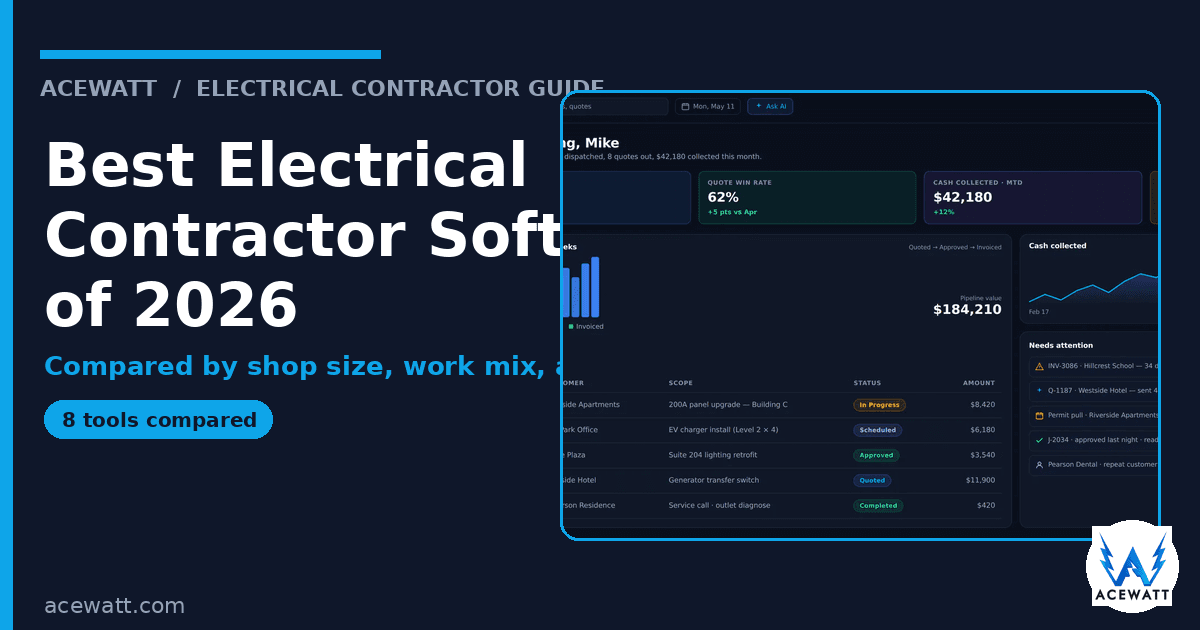
The best electrical contractor software in 2026 is not one product. It is whichever platform matches how your shop actually runs: the jobs you bid, the crew size you manage, the estimating depth you need, and the budget you can justify. A two-truck residential shop and a 40-technician commercial contractor do not buy the same software, and any list that pretends otherwise is selling you something.
This guide compares the eight platforms electricians most often shortlist in 2026 (AceWatt, ServiceTitan, Jobber, Housecall Pro, BuildOps, Simpro, Knowify, and FieldEdge) against a contractor-first framework. We rank by fit, not hype, and keep competitor pricing honest by pointing you to each vendor's site rather than quoting stale third-party numbers. For the short buyer path, start with the CRM for electricians overview and compare plans on the pricing page.
If you handle this on a phone in the field, see our guide to the best mobile app for electrical safety inspections first — it covers the workflow end to end.
Quick answer: the best electrical contractor software in 2026
If you are skimming, here is the honest short version. There is no single winner. The best electrical contractor software depends on shop size, work mix, budget, and how mature your team is with AI-assisted workflows. The same "best electrical contractor software" pick for a solo residential shop is the wrong answer for a 40-tech commercial contractor, which is why this guide ranks the field by fit, not by hype.
- Best AI-first all-in-one for small to mid-size electrical contractors: AceWatt CRM: leads, estimates, scheduling, job walks, invoicing, and follow-up with AI quote building, voice copilot, schedule optimization, document scanning, and AI job walk.
- Best for large/enterprise electrical service businesses: ServiceTitan: deep dispatch, pricebook, reporting, and marketing for companies with dedicated office staff.
- Best for small residential and light-commercial shops: Jobber: simple scheduling, quoting, invoicing, and payments with low onboarding friction.
- Best for solo or very small residential service: Housecall Pro: polished dispatch, customer communication, and payments for one-to-three-tech teams.
- Best for commercial contractors with multi-property service agreements: BuildOps: commercial service work, equipment tracking, and contract management.
- Best for mixed service plus commercial project work: Simpro: project management and service desk for contractors running both.
- Best trade-contractor platform with QuickBooks depth: Knowify: job costing, contract billing, and QuickBooks sync.
- Best for service-agreement and equipment-history shops: FieldEdge: recurring service, agreement tracking, and equipment history.
A note on framing: "best" here means best fit for a defined scenario, not objectively superior. Map your shop to one of those scenarios, then trial the two or three platforms that match.
How we evaluated
We judged every platform against the work an electrical contractor actually does, not a generic field-service checklist. Six evidence classes plus three contextual factors usually decide whether software gets adopted or becomes shelfware.
Evidence classes: (1) Scheduling and dispatch: can it assign technicians, avoid double-booking, handle recurring service, and keep customers informed? (2) Estimating and quoting: does it understand electrical scope (panels, EV chargers, lighting retrofits, service changes, troubleshooting) or force generic line items? (3) Invoicing and payments: can a completed job become an invoice without retyping, and can customers pay online? (4) CRM depth: does it track leads, customer and location history, equipment, warranty notes, and repeat work? (5) Job costing: can you see which jobs, services, and crews are profitable? (6) Reporting: pipeline value, close rate, average job size, overdue invoices, and productivity, visible without a custom build.
Contextual factors: electrical-specific depth versus horizontal FSM (a platform built for every trade can work, but usually lacks native understanding of panels, loads, circuits, and permit notes); AI features (in 2026, AI estimating, voice follow-up, dispatch, and job documentation are real and differentiated); and pricing transparency plus mobile quality (published plans let you budget before a sales call, and a weak mobile app kills field adoption faster than any missing feature).
For a CRM-specific methodology lens, see our companion best CRM for electrical contractors guide.
The best electrical contractor software of 2026 (ranked by fit)
The order below is not a podium. It is a sequence from small, AI-first, and trade-specific (AceWatt) outward to large, enterprise, and commercial-specialized (ServiceTitan, BuildOps). Read the "best for" line first; if it does not describe your shop, skip ahead. If you are weighing AceWatt against the closest AI-positioned rival, see our dedicated AceWatt vs FieldCamp comparison.
1. AceWatt CRM: best AI-first all-in-one for electrical contractors
Best for: Solo electricians and small-to-mid-size electrical contractors who want one trade-specific system for leads, estimates, scheduling, job documentation, invoicing, and follow-up, with AI woven through the daily workflow.
Key features: Core CRM (jobs, quotes, invoices, scheduling), AI quote builder, AI copilot and voice, AI schedule optimizer, AI document scanner, AI job walk (voice + photos), QuickBooks-ready exports (Growth and above), commission tracking, customer portal, route optimization, advanced reports, custom webhooks (Scale).
AI: This is AceWatt's center of gravity. The AI quote builder turns scope notes into structured estimates. AI copilot and voice let the office draft follow-ups, summaries, and customer messages without retyping. The AI schedule optimizer reorders the day around job value and travel. The AI document scanner pulls details from photos of panels and nameplates. The AI job walk feature combines voice notes and photos into a job record you can quote from. For the broader AI workflow context, see our AI CRM for contractors breakdown.
Electrical fit: High. AceWatt is built around electrical contractor workflows (panel work, EV charger installs, lighting retrofits, service calls, troubleshooting) rather than generic home-service categories.
Price range (verify on pricing): Starter at $49/month for one user; Growth at $99/month for up to five users; Scale at $199/month for unlimited users. Every plan includes a 14-day trial. Promo AI credits per month run 5,000 (Starter), 10,000 (Growth), and 25,000 (Scale) through 2026-11-19; standard credits are 1,900 / 4,000 / 10,000 respectively. Top-up packs are $5 for +25 requests, $15 for +100, and $40 for +300.
Notable limitation: AceWatt is newer than the enterprise incumbents and does not attempt to be an enterprise operations suite. It also does not do CAD, design, or blueprint takeoff; pair a dedicated takeoff tool if your shop needs that. Verify current plan details, integrations, and onboarding on the AceWatt for electrical contractors page before committing.
2. ServiceTitan: best for large/enterprise electrical service businesses
Best for: Larger electrical or multi-trade service companies with dedicated dispatchers, office managers, marketing staff, and complex reporting needs.
Key features: Enterprise dispatch board, pricebook management, reporting and analytics, marketing workflows, call tracking, customer communications, membership and agreement tools, payroll integrations, multi-branch operations.
AI: ServiceTitan has been investing in AI-assisted dispatch, customer communication, and analytics, but depth and availability vary by plan and rollout. Confirm AI capability on a live demo, not an assumption.
Electrical fit: Medium to high. ServiceTitan supports electrical contractors as a major vertical, but it is not electrical-only; some electrical setup is configured during onboarding rather than shipped out of the box.
Price range (verify on vendor's site): Sold through a quote-and-demo process with implementation fees and contract terms. Do not rely on third-party price estimates; request a current quote covering per-technician cost, onboarding, payment processing, and contract length.
Notable limitation: Complexity and total cost. A two-person shop will rarely get full value from an enterprise platform, and implementation can take weeks. Without office staff to run the system, the tool can create more admin than it removes.
3. Jobber: best for small residential and light-commercial shops
Best for: Solo operators and very small service businesses that want simple scheduling, quoting, invoicing, and payments without a heavy implementation.
Key features: Scheduling and calendar, quoting, invoicing, online payments, client hub, basic CRM, request booking, reporting.
AI: Jobber has added AI-assisted features such as AI-informed text for customer messages, but deep AI estimating or AI job walk capture is not its focus. Confirm current AI capabilities on a trial.
Electrical fit: Low to medium. Jobber is a broad home-service platform. It works for general electrical service, but it is not electrical-first, so detailed estimating and electrical scope templates may need workarounds.
Price range (verify on vendor's site): Jobber publishes plan tiers, but feature limits and user counts vary by plan. Confirm the tier that includes the automations, users, and payment features you need.
Notable limitation: Estimating depth. If your work involves detailed material assemblies, multi-phase quotes, or commercial bid packages, Jobber may push that work back into a spreadsheet.
4. Housecall Pro: best for solo and small residential service
Best for: One-to-three-technician service teams that prioritize polished dispatch, customer communication, and payments.
Key features: Dispatch and scheduling, customer notifications, online booking, invoicing and payments, photo and document sharing, reputation and review requests, basic reporting.
AI: Housecall Pro has introduced AI-assisted features for customer messaging and some workflow automation, but it is not positioned as an AI-first estimating or dispatch platform.
Electrical fit: Low to medium. Like Jobber, Housecall Pro is a multi-trade field-service tool: excellent at the service-operations layer, lighter on electrical-specific estimating.
Price range (verify on vendor's site): Housecall Pro publishes entry-level plans with higher tiers sold through a sales flow. Confirm plan limits, user costs, dispatch features, and whether estimating will need a separate tool.
Notable limitation: Estimating and electrical scope handling. For complex quotes, plan to pair Housecall Pro with a dedicated estimating process. For invoice-specific depth, see our electrician invoice software guide.
5. BuildOps: best for commercial contractors
Best for: Commercial electrical and mechanical contractors running multi-property service agreements, recurring maintenance contracts, and complex account hierarchies.
Key features: Commercial service management, preventive maintenance and agreement tracking, multi-site asset and equipment tracking, work order management, dispatch, invoicing, reporting designed for commercial relationships.
AI: BuildOps has been expanding into AI-assisted workflows for commercial operations, but availability and scope should be confirmed on a demo.
Electrical fit: High for commercial electrical work specifically. BuildOps is built around commercial property and equipment relationships, exactly what a commercial electrical contractor manages.
Price range (verify on vendor's site): BuildOps is typically sold through a quote process aimed at mid-market and commercial contractors. Confirm implementation, per-user cost, contract terms, and commercial feature availability directly.
Notable limitation: Not a fit for small residential shops. BuildOps is purpose-built for commercial complexity, and that depth is overkill (and over-budget) for a solo residential electrician.
6. Simpro: best for mixed service and commercial project work
Best for: Electrical contractors who run both recurring service work and commercial project work, and need project management, asset management, and a service desk in one platform.
Key features: Project management, service and maintenance agreements, asset management, quoting and estimating, scheduling and dispatch, invoicing, purchasing and inventory, reporting.
AI: Simpro has been integrating AI-assisted features for estimating and field workflows, but depth and availability vary. Confirm what is live versus roadmap during evaluation.
Electrical fit: High. Simpro has a strong electrical and trades heritage and handles the mixed service-plus-project reality of many mid-market contractors.
Price range (verify on vendor's site): Simpro is typically sold through a quote process. Confirm modules, users, implementation, and contract length before buying.
Notable limitation: Module complexity. Simpro's breadth is a strength for mixed-work contractors but can feel heavy for shops that only do simple residential service. Decide which modules you actually need before signing.
7. Knowify: best trade-contractor platform with QuickBooks depth
Best for: Trade contractors, including electricians, who want strong job costing, contract billing, service agreements, and clean QuickBooks sync without a full enterprise suite.
Key features: Job costing, contract and project management, service agreements, quoting and estimating, scheduling, invoicing, deep QuickBooks Online integration.
AI: Knowify's AI positioning is lighter than AI-first platforms. Its center of gravity is accounting and job-costing integration rather than AI estimating.
Electrical fit: Medium. Knowify supports trade contractors broadly, so electrical contractors get strong job costing and accounting but may need to confirm electrical-specific estimating templates.
Price range (verify on vendor's site): Knowify generally publishes plan tiers, but confirm current pricing, QuickBooks integration scope, and feature limits on the plan you need.
Notable limitation: Estimating and field workflow depth may trail purpose-built electrical platforms. If your bottleneck is fast electrical quoting rather than job costing, weigh Knowify against an electrical-first tool. For the costing angle, see our electrical job costing software guide.
8. FieldEdge: best for service-agreement and equipment-history shops
Best for: Service-heavy electrical and multi-trade contractors whose revenue depends on recurring service agreements, equipment history, and membership-driven dispatch.
Key features: Service agreement tracking, equipment history, dispatch and scheduling, customer management, invoicing and payments, reporting, reputation tools.
AI: FieldEdge has been adding AI-assisted dispatch and customer communication features, but availability varies. Confirm on a demo.
Electrical fit: Medium to high. FieldEdge supports electrical contractors as a vertical, with particular strength where recurring service and equipment tracking drive revenue.
Price range (verify on vendor's site): FieldEdge is typically sold through a quote process. Confirm implementation, per-user cost, agreement features, and contract terms directly.
Notable limitation: Less ideal for project-heavy or bid-heavy commercial work. If your shop is project-led rather than service-led, weigh FieldEdge against BuildOps or Simpro.
Best by shop size and work mix
Software choice should follow your business, not the other way around. Use this map to narrow the shortlist before trials.
Solo and 1 to 3 tech residential shops
For solo electricians and tiny teams doing service calls, small installs, panel changes, and light retrofits, simplicity and speed matter more than enterprise features. Strong fits: AceWatt (electrical-first all-in-one with AI quoting), Jobber (simplest setup), or Housecall Pro (dispatch and payments priority). Avoid enterprise platforms that charge for dispatchers and reporting you will never use.
4 to 15 tech mixed residential and commercial shops
Growing shops running mixed work need real crew scheduling, repeatable estimating, invoicing that scales, and reporting the owner can trust. AceWatt Growth or Scale fits here, as do Housecall Pro and Jobber at higher tiers, and FieldEdge if service agreements drive revenue. The decision usually comes down to estimating depth (electrical-first versus generic) and how much AI workflow you want built in.
15+ tech commercial contractors
Established commercial contractors need multi-property agreements, equipment history, project work, and team-level reporting. BuildOps is strongest for pure commercial service; Simpro for mixed service and project work; ServiceTitan for large multi-trade or enterprise operations. AceWatt Scale can still serve electrical-first contractors who want AI depth without an enterprise implementation; verify whether your commercial workflows need module-specific depth.
Estimator-heavy commercial bid shops
For contractors whose life is commercial bidding (plan takeoff, detailed material assemblies, multi-phase quotes, change orders), the estimating tool is the spine of the business, and a dedicated estimating platform often complements a CRM rather than replacing it. Pair a deep estimating tool with AceWatt, Simpro, or Knowify for CRM, scheduling, and invoicing. Do not force a residential service app to do commercial bid work. Our electrical estimating software guide covers the estimating layer in more depth.
What "all-in-one" actually means (and what it doesn't)
"All-in-one" is the most overused phrase in contractor software marketing, so let's be precise.
A true single platform runs the full electrical workflow in one database: lead, customer and location, estimate, approval, schedule, dispatch, job documentation, invoice, payment, follow-up, and reporting. When data lives in one place, a finished job becomes an invoice with one click, a repeat customer's history is one click away, and profitability reporting does not require a spreadsheet export.
A best-of-breed stack stitches together a sales CRM, estimating tool, scheduling app, invoicing system, and accounting tool. This can work if one layer is irreplaceable (say, a commercial estimator who refuses to leave their dedicated takeoff software). But every integration is a seam where data gets lost, re-typed, or contradicted.
The practical question is not "is it all-in-one?" but "how many seams will my team tolerate?" For most small and mid-size electrical shops, fewer seams means faster quotes, invoices, and follow-up, which is the case for a true single platform like AceWatt.
There are three places where a dedicated tool usually complements an all-in-one platform rather than competing with it:
- Takeoff and CAD. Blueprint takeoff and electrical design are specialized. No mainstream contractor CRM does this well, and AceWatt explicitly does not do CAD, design, or blueprint takeoff; pair a dedicated tool if you need it.
- Accounting depth. Even an all-in-one platform usually syncs to QuickBooks or Xero rather than replacing a full accounting system.
- Specialized compliance and permitting. Some jurisdictions need dedicated permitting software; treat it as a complement, not a replacement.
The make-or-break integration for most electrical contractors is QuickBooks or Xero sync. If your CRM cannot push invoices and payments cleanly into accounting, you will spend evenings doing data entry. AceWatt Growth and above include QuickBooks-ready, line-level exports your bookkeeper brings into QuickBooks once, not a native two-way sync, and we say that plainly; Knowify's strength is QuickBooks depth; for every other platform, confirm integration scope on a demo before buying.
AI in electrical contractor software (2026 state of play)
AI in trades software moved from novelty to daily use between 2024 and 2026. The platforms that took it seriously are now visibly ahead. Here is the honest state of play, by use case.
AI estimating and scope-to-quote. The highest-value AI use case for electrical contractors. Instead of typing line items from a scope note, the AI reads your job walk notes, photos, and scope description, then drafts a structured estimate with materials, labor, and markup you can edit. AceWatt's AI quote builder and AI job walk features are built for this. The benefit is speed: quotes that used to take an hour can go out the same day, and slow quotes lose jobs.
AI follow-up, voice, and receptionist. AI voice and copilot features draft follow-ups, summarize calls, answer routine questions, and request reviews after a completed job. AceWatt's AI copilot and voice feature sits in this layer, recovering estimates that would otherwise go cold and keeping the office responsive without hiring a receptionist.
AI dispatch and job-value optimization. AI schedule optimizers reorder the day around job value, travel time, technician skill, and urgency. AceWatt includes an AI schedule optimizer on Growth and above. Enterprise platforms offer dispatch optimization too; verify whether it is AI-driven or rules-based.
AI job documentation. AI document scanners pull details from photos of panels, nameplates, and existing work; AI job walk combines voice and photos into a structured job record. This is where AI removes the friction that causes field notes to get lost in text threads.
Honest limits of AI in trades today. AI cannot replace licensed electrical judgment. It does not perform load calculations to code, sign off on permits, make safety decisions on a job site, or set final pricing without review. AI drafts the estimate; a qualified person still reviews scope, code compliance, safety, and price. AI drafts the follow-up; a human still owns the relationship. Any vendor that promises AI replaces a licensed electrician is overpromising, and you should treat that as a red flag. For a broader view, see our AI CRM for contractors analysis.
How to choose without getting locked in
Software lock-in is the hidden cost most buyers ignore until they try to switch. Four principles keep you in control.
Trial versus demo-only. A 14-day trial (like AceWatt's) lets you run real jobs through the system before paying. A demo-only vendor forces you to commit on a curated walkthrough. Demos are useful but are not a substitute for hands-on testing; if a vendor will not give you a trial, demand a longer evaluation period or a money-back clause.
Per-seat versus flat-rate pricing. Per-seat scales linearly with headcount. Flat-rate (like AceWatt Scale at $199/month for unlimited users) caps cost as you grow. For a solo shop, per-seat is fine; for a growing shop, run the math on what the platform costs at 5, 10, and 20 users.
Data portability. Before you sign, ask how you export your customers, jobs, estimates, and invoices if you leave. A vendor that makes export painful is banking on lock-in.
The decision framework. The right platform is a function of shop size (solo, small 4 to 15, or large 15+), work mix (residential service, mixed, commercial service, or commercial bid), budget (including users, implementation, and payment processing), and AI maturity (how ready your team is to adopt AI-assisted estimating, follow-up, and dispatch). Score each platform against all four. The fit, not the demo polish, decides what to trial first.
Common mistakes when choosing electrical contractor software
Buying enterprise software for a two-person shop. The most expensive mistake. Enterprise platforms are powerful, but their implementation, training, and admin overhead will drown a small team. If you do not have a dispatcher and an office manager, you probably do not need an enterprise dispatch board.
Choosing a horizontal FSM tool without electrical depth. A multi-trade field-service app can work for simple residential work, but it will fight you on electrical scope. If your quotes involve panels, loads, circuits, and material assemblies, an electrical-first tool saves hours every week.
Ignoring the field-to-books workflow. Many shops buy a CRM that is great in the field but does not sync to accounting; the result is double entry, slow month-end close, and profitability numbers nobody trusts. Confirm QuickBooks or Xero sync before buying.
Overpaying for unused features. Enterprise reporting is worthless if nobody opens the reports. Buy for the workflows you actually run. A flat-rate plan like AceWatt Scale exists precisely to prevent per-seat feature inflation as you grow.
Skipping the trial. The demo is a sales exercise; the trial is the truth. If you cannot test the platform on one real service call, one real estimate, and one real follow-up during the trial, you are not really evaluating it.
Trusting AI to replace judgment. AI drafts the estimate; a qualified person still reviews it. AI drafts the follow-up; a human still owns the relationship. Platforms that blur this line set you up for scope, code, and pricing mistakes.
FAQ
What is the best electrical contractor software in 2026?
There is no single best; it depends on shop size, work mix, budget, and AI maturity. For small to mid-size electrical contractors who want an AI-first all-in-one, AceWatt is the strongest fit. For large enterprise service operations, ServiceTitan. For small residential shops, Jobber or Housecall Pro. For commercial contractors, BuildOps. For mixed service and project work, Simpro. For QuickBooks depth, Knowify. For service-agreement shops, FieldEdge.
Is ServiceTitan worth it for a small shop?
Usually, no. ServiceTitan's value comes from depth that requires dedicated office staff, dispatchers, and marketing operations. For a two-to-five-person shop without that staff, the implementation cost and complexity usually outweigh the benefit. A small shop is almost always better served by a lighter, electrical-first platform. Confirm current pricing and implementation scope on ServiceTitan's site before deciding.
What is the cheapest electrical contractor software?
The cheapest option is the platform that covers the most of your workflow at the lowest total cost, not always the lowest sticker price. AceWatt Starter at $49/month for one user is one of the most affordable electrical-first options in 2026, covering core CRM, AI quote building, jobs, quotes, invoices, scheduling, and basic dispatch. Jobber and Housecall Pro also publish entry-level plans (verify on their sites). The real cost question is total workflow cost: a cheap tool that forces you to buy three other tools is not cheap.
Does AceWatt replace ServiceTitan?
For most small to mid-size electrical contractors, yes: AceWatt can replace the core workflow ServiceTitan covers (CRM, estimating, scheduling, invoicing, follow-up, reporting) at a fraction of the cost and implementation effort. For large enterprise operations needing multi-branch dispatch, deep marketing automation, call tracking, and dedicated operations staff, ServiceTitan remains the stronger fit. AceWatt does not try to be an enterprise operations suite; it aims to be the best AI-first all-in-one for electrical contractors up to the mid-market.
What software do most electricians use?
Most small and mid-size electricians use a stitched-together mix: a basic CRM or spreadsheet for leads, a separate tool for estimating, a calendar app for scheduling, an invoicing tool, and QuickBooks or Xero for accounting. That patchwork is what all-in-one electrical contractor software aims to replace. Among purpose-built platforms, Jobber and Housecall Pro are common for small residential shops; ServiceTitan dominates large enterprise; AceWatt is becoming the default for AI-first small and mid-size contractors in 2026. Verify adoption claims on each vendor's site.
Disclaimer
This article is for software evaluation and comparison only. All product names, features, and pricing references are illustrative and were accurate to the best of our knowledge at the time of writing, but software features and prices change frequently. Verify current features, pricing, integrations, contract terms, and plan limits directly with each vendor before purchasing. AceWatt pricing cited here reflects the verified plans on the AceWatt pricing page; competitor pricing is intentionally not specified and must be confirmed on each vendor's site. AI-assisted workflows can support estimating, documentation, scheduling, and follow-up, but licensed electrical judgment remains necessary for scope, code compliance, safety, load calculations, permit decisions, and final pricing. Nothing here should be read as a claim that AI replaces a licensed electrician or that any platform will produce a deterministic return on investment. Examples and scenarios are illustrative and require professional review before being applied to a real contracting business.