
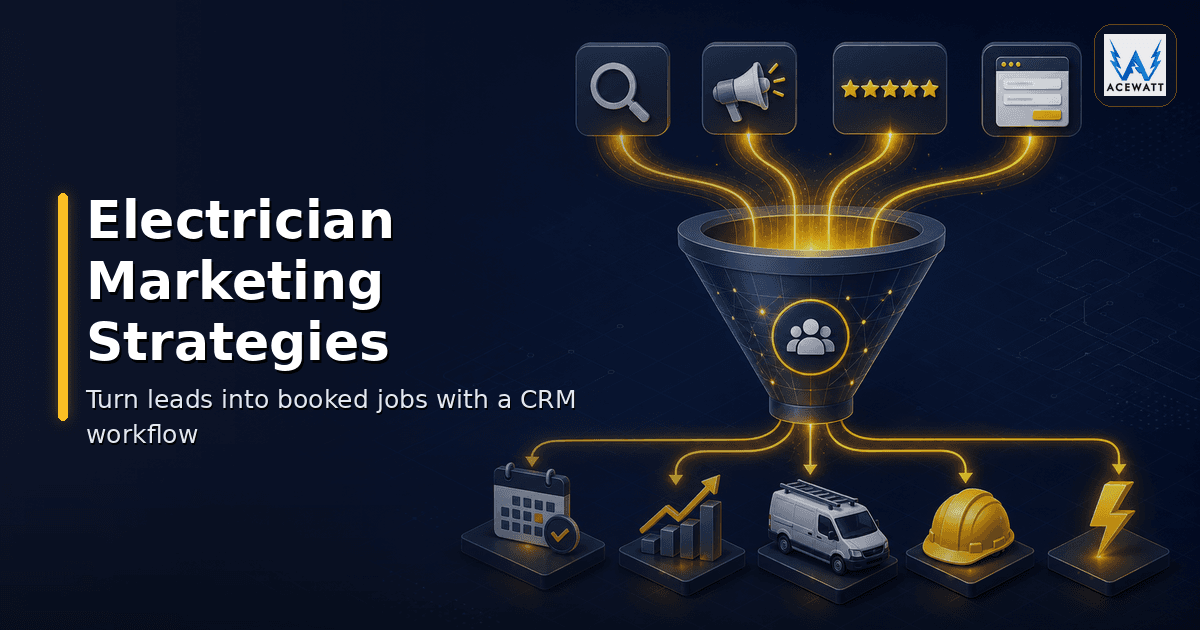
Electrician Marketing Strategies That Win Jobs in 2026
Electrician marketing strategies fail when the shop pays for demand but has no operating system to catch it. A homeowner clicks your Google ad, calls during a panel change, leaves a voicemail, and hires the next company that answers. A property manager fills out a form, but nobody follows up until tomorrow. A happy customer pays the invoice, yet no one sends the review request. Ranking on Google and running ads help, but missed calls, slow follow-up, scattered job notes, and weak review habits quietly leak revenue. The practical answer is not “do every channel.” It is to build a marketing workflow where every lead source connects to a CRM: capture context, respond fast, schedule the job, send the estimate, invoice cleanly, and ask for the review while the work is fresh.
Key takeaways: electrician marketing strategies
> Definition: Electrician marketing strategies are the repeatable ways an electrical business gets found, earns trust, captures leads, follows up, books jobs, and turns completed work into more demand.
- Treat marketing as an operating plan, not a pile of tactics. A clear electrician marketing plan tells you who you want to serve, which jobs you want more of, and what happens after someone contacts you.
- Local SEO, Google Business Profile, Google Ads for electricians, referrals, reviews, and social proof all work better when the lead lands in one CRM workflow.
- PPC for electricians is risky when calls are missed, forms are slow to answer, or job sources are not tracked to revenue.
- Reviews compound because they influence searchers, ads, referrals, and close rates. Electrician review requests should be triggered by job completion or payment, not memory.
- AceWatt does not run your ads or build your website. AceWatt is the AI-first CRM that helps electrical contractors capture lead context, respond faster, follow up, schedule, estimate, invoice, and see which channels become booked work.
What makes electrician marketing different?
Electricians sell trust before they sell labor. Most customers do not understand load calculations, troubleshooting steps, service upgrades, or local permit requirements. They are choosing a company to work on systems that affect their home, tenant space, downtime, and budget. That makes electrical contractor marketing different from a generic coupon campaign.
The buying window is also short. A customer with flickering lights, a tripping breaker, a failed inspection item, or an EV charger deadline may contact three shops in ten minutes. The company that responds first with organized questions often wins the appointment. That is why electrician marketing strategies must include response speed, job-context capture, and follow-up rules, not just traffic.
Finally, the lead has to become a real electrical record. “Need quote” is not enough. Your team needs service type, property type, urgency, photos, panel details when available, preferred schedule, and the customer’s communication history. A CRM built for electrical contractors, like AceWatt for electrical contractors, keeps that context with the customer and job instead of spreading it across voicemail, text threads, sticky notes, and inboxes.
Build a clear electrician marketing plan before spending on ads
A practical electrician marketing plan starts with four decisions.
1. Pick the jobs you want more of. Do you want panel upgrades, EV charger installs, service calls, lighting projects, commercial maintenance, generator work, or tenant improvements? Each job type needs different keywords, landing pages, photos, estimate workflows, and follow-up timing.
2. Define the service area. Local campaigns get weak when they cover every city within driving distance. Build around the neighborhoods, suburbs, or commercial corridors where your crews can arrive on time and complete profitable work.
3. Set lead-handling rules. Decide who answers calls, what happens after missed calls, how fast forms are answered, when estimates get followed up, and when a customer receives a review request. If these rules are not written down, they depend on memory.
4. Track revenue by source. Clicks and impressions are not the scoreboard. Booked jobs, approved estimates, paid invoices, and repeat customers are. Use source fields and pipeline reporting so your electrician marketing strategies are judged by revenue, not noise.
A simple plan can fit on one page: target services, service area, channel mix, monthly budget, response-time standard, review-request trigger, referral offer, and CRM owner. Once that plan exists, every new lead should move through the same capture-to-revenue workflow. For the broader software stack behind this process, see AceWatt’s guide to electrical contractor marketing software.
Local SEO: win "electrician near me" searches
Local SEO is the foundation for many electrician marketing strategies because it meets customers at the moment they are searching. Your goal is not just to “rank.” Your goal is to make a nearby customer confident enough to call, request a quote, or book a visit.
Start with Google Business Profile. Google’s own guidance on improving local ranking emphasizes relevance, distance, and prominence. For an electrical shop, that means complete business information, accurate service areas, clear categories, recent photos, updated hours, and a steady pattern of legitimate reviews.
Then build service pages that match real jobs. A generic “electrical services” page is weaker than pages for panel upgrades, EV charger installation, troubleshooting, generator interlocks, lighting, commercial service, and emergency electrical repair. Each page should explain the problem, your process, service-area fit, and how to request help.
Local SEO also needs clean lead capture. If your website form asks too little, the office has to chase details. If it asks too much, customers quit. A balanced form asks for name, phone, address or ZIP, service type, urgency, photos if helpful, and preferred contact method. From there, the CRM should create a lead record automatically so the office can respond without retyping.
A good local SEO system includes:
- Google Business Profile categories, services, photos, and business hours kept current.
- Service pages for high-value jobs, each with clear calls to action.
- Local proof: project photos, review snippets, city or neighborhood references where appropriate.
- Fast mobile pages with click-to-call and quote-request buttons.
- CRM capture so every SEO lead becomes a trackable opportunity.
For a deeper search-focused workflow, use AceWatt’s guide to electrician lead generation SEO.
Google Ads and PPC for electricians (without burning budget)
Google Ads for electricians can produce high-intent calls quickly, especially for emergency service, panel upgrades, EV chargers, and commercial troubleshooting. The problem is that paid traffic exposes every weakness in your follow-up process. If a click costs money and the call goes unanswered, the campaign is paying to test your leak.
Before increasing spend, tighten the basics:
- Send traffic to job-specific pages. A panel-upgrade ad should not land on a general homepage. Match the ad, page, and call to action.
- Use call tracking and form tracking. Google explains that phone call conversion tracking can show which campaigns and keywords drive calls. Pair that data with CRM source tracking so you know which calls became jobs.
- Separate emergency and planned work. Emergency keywords behave differently from “EV charger quote” or “panel upgrade cost.” Different intent needs different ads, pages, budgets, and response expectations.
- Write negative keywords. Avoid paying for DIY, jobs, salaries, free advice, appliance repair if you do not offer it, or cities outside your service area.
- Follow up every estimate. Many shops lose PPC for electricians after the first appointment because the quote sits untouched.
PPC for electricians should be measured from click to booked job to paid invoice. A campaign with expensive clicks may still be profitable if it books high-ticket projects. A campaign with cheap clicks may waste money if it produces wrong-fit calls. AceWatt’s features help connect the handoff: lead context, customer records, scheduling, estimates, follow-up, and revenue reporting live in the same system.
Reviews: the marketing asset that compounds
Reviews influence almost every channel. They help local searchers choose, make ads feel safer, support referral conversations, and give your website proof that real customers trusted your crew. BrightLocal’s Local Consumer Review Survey shows that star ratings and review recency continue to matter for local buying decisions, which lines up with what electricians see in the field: fresh, specific reviews make the phone ring with more confidence.
The workflow matters more than the script. Electrician review requests should be automatic enough to happen every week, but personal enough to feel like they came from a real shop. Ask shortly after the job is complete, the invoice is paid, or the customer has confirmed the work was handled. Mention the job type when appropriate, keep the message short, and send the direct review link.
Avoid review gating. Do not ask only happy customers or filter people before giving them a public review option. Ask all customers, respond professionally, and use unhappy feedback as an internal service recovery signal.
A useful review workflow looks like this:
- Job marked complete or invoice paid.
- CRM triggers a review-request task or message.
- Customer receives a short request with the review link.
- Team monitors new reviews and responds.
- Positive review snippets are reused on estimates, service pages, and referral emails.
AceWatt’s electrician reputation management software guide explains how to turn the ask into a repeatable system instead of another thing the office has to remember.
Referral programs that actually work for electrical shops
An electrician referral program works best when it is simple, local, and easy to track. Most customers are willing to recommend a good electrician, but they will not remember a complicated promotion two months later.
Start with a plain offer. For residential work, that could be a thank-you card, a modest credit, or a seasonal inspection discount for qualified referrals. For commercial property managers, general contractors, and real estate contacts, the better reward may be priority communication, cleaner documentation, faster estimates, or a structured partner relationship instead of a consumer-style coupon.
Make the ask at the right moment. The best time is after the customer has paid, left a positive review, or complimented the technician. The message can be direct: “If you know a neighbor who needs electrical work, we would be grateful for the introduction.” Include a referral link or a simple “reply with their name and number” path.
Track referrals in the CRM. If a referred lead becomes a job, the original customer should be tagged so your office can thank them. Without tracking, referral programs become vague goodwill instead of a measurable channel.
A strong electrician referral program includes:
- One clear offer.
- A short ask sent after a successful job.
- Referral source tracking on the new lead.
- A thank-you workflow when the referral books.
- Monthly reporting on referred leads, booked jobs, and revenue.
This is one reason electrician marketing strategies need CRM discipline. Referral goodwill is valuable, but it leaks when nobody records who referred whom.
Email and SMS follow-up: where most electricians lose money
Most electrical shops do not lose money because they failed to generate any leads. They lose money because good leads get quiet after the first touch. The customer needs to check with a spouse. A facility manager waits on approval. A homeowner asks for an estimate and then gets busy. If your team does not follow up, a competitor will.
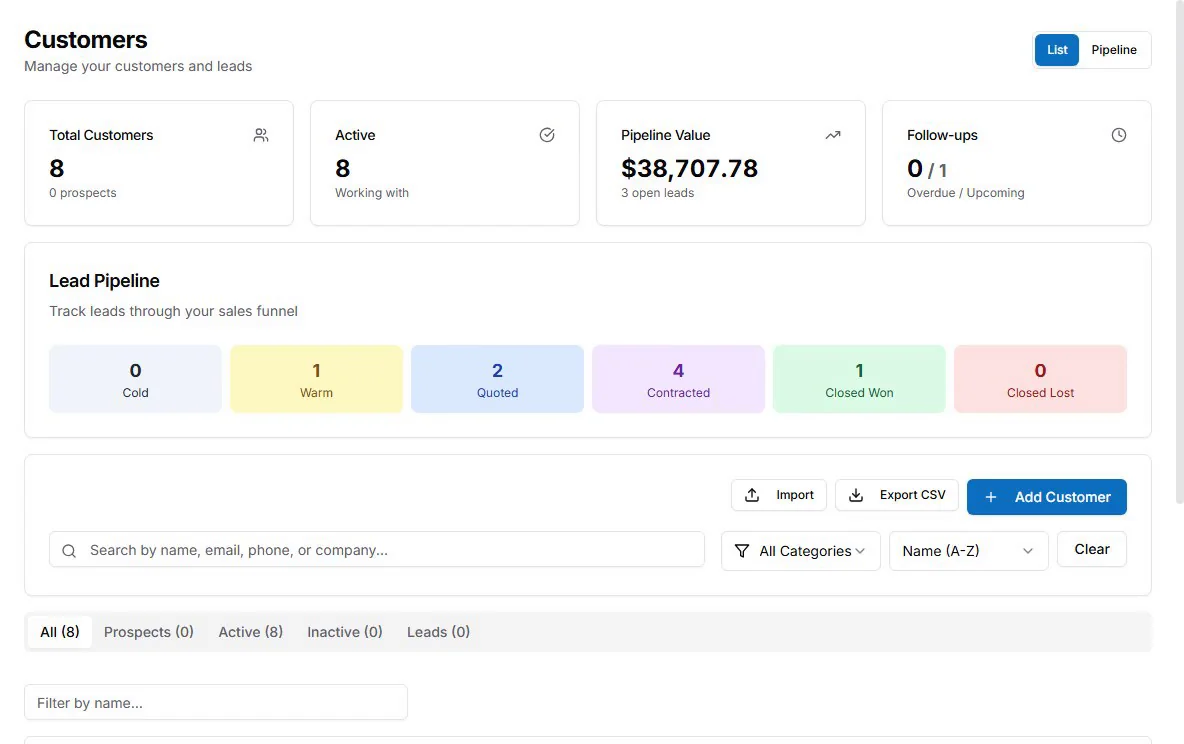
Email and SMS should support the job stage:
- New lead: Confirm the request, ask for missing details, and offer a scheduling link or call window.
- After job walk: Send the estimate, explain the next step, and invite questions.
- Estimate not approved: Follow up at 24 hours, three days, and seven days with helpful context, not pressure.
- Job scheduled: Send reminders and preparation notes.
- Invoice sent: Provide the payment link and contact information for questions.
- Job complete: Send the review request and referral ask.
In AceWatt, follow-up messages are written by your team, with customer, job, and estimate context on one record; the automatic sends are email reminders on overdue invoices (1, 7, 14 and 30 days late) and a short satisfaction survey after a job is marked complete. For estimates created from a site visit, AI Job Walk helps organize job details so the follow-up is based on actual scope. A qualified person should still review pricing, safety, code-sensitive scope, and final terms before sending customer-facing commitments.
For owners who want to see where leads stall, AceWatt’s electrician sales pipeline software guide shows how to track the path from inquiry to booked job to invoice.
Social media for electricians (low-effort, high-trust)
Social media does not need to become a full-time content job. For most electrical contractors, social works best as proof, not entertainment. Customers want to know whether your crew is professional, organized, and experienced with the kind of work they need.
Post the work you already do:
- Before-and-after photos of clean panels, labeled circuits, lighting upgrades, EV chargers, and commercial service work.
- Short explanations of common problems: tripping breakers, outdated panels, flickering lights, overloaded circuits, failed inspection items.
- Technician introductions and behind-the-scenes shots of organized trucks, tidy job sites, and safety-conscious process.
- Review screenshots or quotes, with permission and no private customer details.
- Seasonal reminders: generator readiness, outdoor lighting, storm preparation, holiday load planning.
The operating rule is simple: one job can create three pieces of content, a project photo, a short lesson, and a review or referral ask. Social posts should point back to a clear quote request or call path, then the CRM should capture the lead. For a LinkedIn-specific content workflow, use this feature-demo approach to LinkedIn authority building. AceWatt does not auto-post to social media, but it helps make sure a social lead is not lost after someone messages, calls, or fills out a form.
How AceWatt connects every marketing channel to revenue
AceWatt’s role in electrician marketing strategies is conversion operations. Ads, SEO, websites, referral partners, and social posts create attention outside the CRM. AceWatt helps electrical shops turn that attention into booked work.
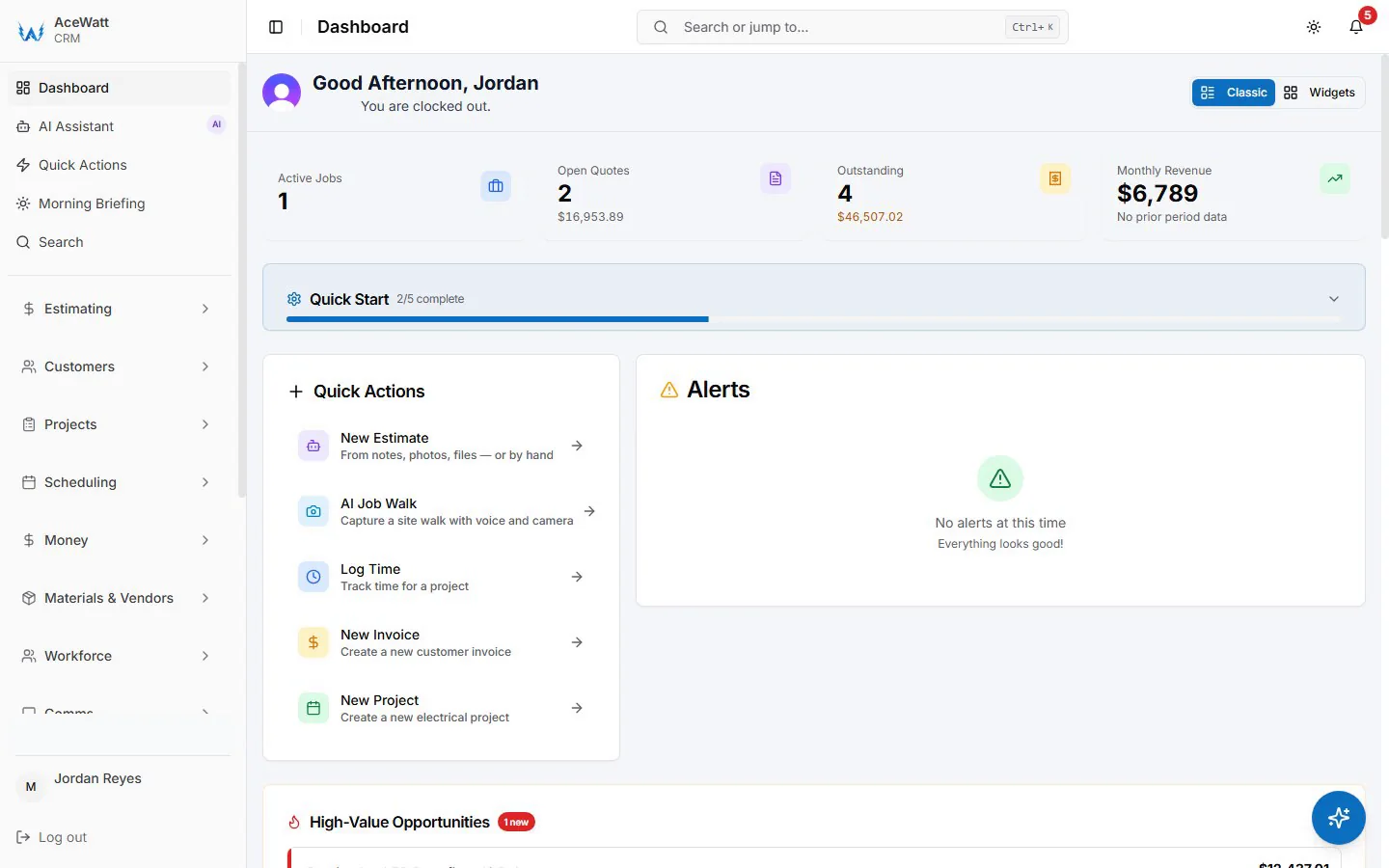
Here is the channel-to-revenue workflow:
- Lead capture. A call, form, referral, or social inquiry becomes a customer or lead record with job context.
- Fast response. Voice AI and communications tools help the shop respond when the office is busy or the techs are in the field.
- Scheduling. The lead moves into a job or appointment instead of sitting in a voicemail box.
- Estimating. AI estimating and job-walk notes help organize scope, materials, and next steps for human review.
- Invoicing and payment. AceWatt supports invoicing with payment links, so the job can move from completed work to paid invoice without extra admin drag.
- Review and referral loop. After completion or payment, the review-request workflow and referral tracking help the finished job feed future demand.
- Pipeline reporting. Financial pipeline reporting shows which sources create booked jobs and revenue, not just leads.
AceWatt includes customer and job records, scheduling, a communications hub, AI estimating, an AI Assistant for business questions, an automatic satisfaction survey after each completed job, a customer portal, and invoicing. Plans are Starter at $49 per month, Growth at $99 per month, and Scale at $199 per month, with a 14-day free trial.
Turn electrical leads into booked jobs with AceWatt CRM.
Electrician marketing checklist for 2026
Use this checklist to turn the article into an operating plan:
- Choose three target job types you want more of.
- Define your profitable service area by city, ZIP, or neighborhood.
- Update Google Business Profile services, hours, photos, and contact details.
- Build or improve service pages for your highest-value jobs.
- Add clear call, form, and quote-request paths on mobile pages.
- Connect every form, call, referral, and ad lead to a CRM record.
- Set a response-time target for new leads, such as under five minutes during business hours.
- Track lead source, job type, estimate status, booked job, invoice, and revenue.
- Separate Google Ads campaigns by intent: emergency, planned project, commercial, and service-area segments.
- Add negative keywords monthly.
- Send estimate follow-ups at 24 hours, three days, and seven days.
- Trigger electrician review requests after job completion or payment.
- Create a simple electrician referral program and track referred leads.
- Turn completed jobs into social proof: photos, lessons, and review snippets.
- Review monthly reports and shift budget toward channels that create profitable booked work.
The point is not to do more marketing work forever. The point is to make electrician marketing strategies repeatable enough that a busy week does not break the system.
Frequently Asked Questions
What are the best electrician marketing strategies in 2026?
The best electrician marketing strategies combine local SEO, Google Business Profile, reviews, Google Ads, referrals, social proof, and automated follow-up. The important part is the workflow behind them: every lead should be captured, tagged by source, followed up, scheduled, estimated, invoiced, and reviewed in a CRM.
How much should an electrician spend on marketing?
There is no universal number. A small shop might start with a focused local SEO plan, review requests, and a modest Google Ads test. A growth-focused electrical contractor may spend more on PPC, service pages, and referral partnerships. Track booked jobs and paid invoices by source before increasing budget.
Are Google Ads worth it for electricians?
Google Ads for electricians can be worth it when the campaign targets high-intent searches, uses call tracking, sends traffic to relevant pages, and connects every lead to fast follow-up. Ads get expensive when calls are missed, wrong-fit keywords are not filtered, or estimates are not followed up.
How do I ask customers for electrician reviews?
Send electrician review requests shortly after job completion or payment. Keep the message short, thank the customer, mention the service when natural, and include the direct review link. Ask all customers rather than filtering only happy ones, and respond professionally to both positive and negative reviews.
What should an electrician referral program include?
A good electrician referral program includes one clear offer, a simple way to refer, CRM tracking for the referral source, and a thank-you workflow when the referred customer books. Keep it easy for homeowners, property managers, real estate contacts, and general contractors to make the introduction.
How does AceWatt help with electrical contractor marketing?
AceWatt helps after the click, call, form, or referral. It captures lead context, organizes customer and job records, speeds up response, supports scheduling and estimating, emails reminders on overdue invoices, emails the customer a short satisfaction survey after a job is marked complete, tracks referrals, invoices with payment links, and reports pipeline revenue. It does not replace your ads, SEO, or website; it helps convert that traffic into booked jobs.
Ready to stop losing leads between the ad click and the invoice? Start a 14-day free trial and turn electrical leads into booked jobs with AceWatt CRM.