
Electrical Contractor Payroll & Labor Cost Management: Track Time, Calculate True Labor Cost, Feed Clean Data to Payroll (2026)
BLUF: Accurate electrical contractor payroll starts before payroll day: every electrician hour has to be captured, tied to the right job, and reviewed before it reaches your payroll provider. Your true electrical labor cost is not the wage on the paycheck; it is the fully loaded labor rate per productive hour after taxes, workers' comp, benefits, PTO, vehicles, tools, and non-billable time. AceWatt helps you track electrician labor costs from schedule to job record, then export clean time data to the payroll system you already use.
The Real Cost of Getting Labor Tracking Wrong in Electrical Contracting
Electrical contractors usually notice payroll problems when a check is wrong. The bigger problem is that the same bad time data also distorts job costing, workers' comp audits, overtime calculations, and future estimates. If a tech writes "40 hours" without job codes, the paycheck may still go out, but the business has lost the record that explains where the hours went.
Overtime is the obvious risk. Under the federal Fair Labor Standards Act, non-exempt employees generally receive overtime at one-and-a-half times the regular rate for hours over 40 in a workweek. Some states add stricter rules, such as daily overtime thresholds. If your office reconstructs clock-in times from texts and memory, payroll is being built on weak evidence.
Workers' compensation audits are another pain point. Auditors want payroll by class code, state, and type of work. Electrical contracting often falls under code 5190 in many NCCI-based states, but workers' comp classification is state-specific and carrier-specific. When hours are not tied to jobs and work types, the audit becomes a spreadsheet scavenger hunt instead of a clean export from time records.
Buddy punching and rounded time add another leak. A five-minute favor at clock-in, a lunch that never gets deducted, or a helper left on the wrong job code may look small for one employee. Across five to twenty employees, the variance can become meaningful before anyone notices.
The most expensive leak is unallocated labor. If an eight-hour day includes two hours of material pickup, one hour of warranty callback, and five hours on a billable panel upgrade, your job-cost report needs to see all of it. Otherwise the panel job looks more profitable than it was, the callback looks free, and the next bid repeats the same mistake.
How Electrical Contractor Payroll Is Different
Electrical contractor payroll is not the same as payroll for a storefront or office. Electricians move between job sites, service calls, emergency work, shop time, training, and inspections. The payroll record has to answer more than "how many hours did this employee work?" It also has to answer "which job did those hours hit, what classification applied, and what labor cost should the estimate carry next time?"
Multi-site days make the problem visible. A journeyman might spend two hours troubleshooting a restaurant circuit, three hours roughing in a remodel, and three hours helping an apprentice finish a service upgrade. One paycheck line can pay the employee, but three job-cost lines are needed to understand the work.
Prevailing wage adds another layer. On government-funded or public works projects, wage determinations may set minimum rates and fringe requirements by trade and classification. Davis-Bacon rules apply to many federal construction contracts, while states and local agencies can have their own prevailing-wage programs. AceWatt can help keep the field time tied to the right job; wage determinations, certified payroll reports, and fringe calculations should be reviewed with your payroll provider, CPA, or compliance specialist.
Union and non-union shops also track labor differently. A union shop may need classifications, foreman premiums, benefit fund remittances, and apprenticeship steps. A non-union shop may still have helper, apprentice, journeyman, master, service manager, and owner time. Wage data is just the starting point; the payroll record must reflect how each hour was actually worked.
License tiers matter for estimating as much as payroll. If your estimate assumes apprentice-heavy labor but the job required a master electrician for most of the day, your electrical labor cost changed. That is why labor tracking should live next to scheduling and job records, not in a disconnected paper folder.
Time Tracking -> Job Costing -> Payroll: The Missing Link
Spreadsheets feel manageable with two employees. At five employees, they start to break. At ten employees, someone in the office is usually spending payroll day decoding handwriting, matching jobs to invoices, chasing missing lunch breaks, and asking field techs what they did last Thursday.
The common broken workflow looks like this: time is captured on paper or texts, payroll is entered into Gusto, QuickBooks Payroll, ADP, Paychex, or another provider, and job costing lives in a third sheet. Each system has a slightly different version of the week. The paycheck may be correct while the job record is late, or payroll may be re-keyed with a typo. Garbage in, garbage out.
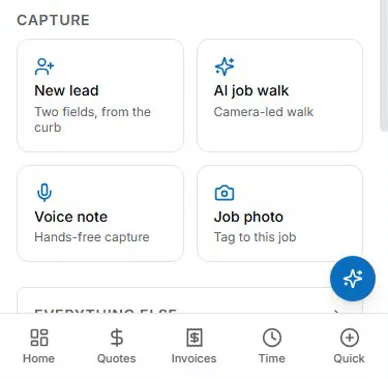
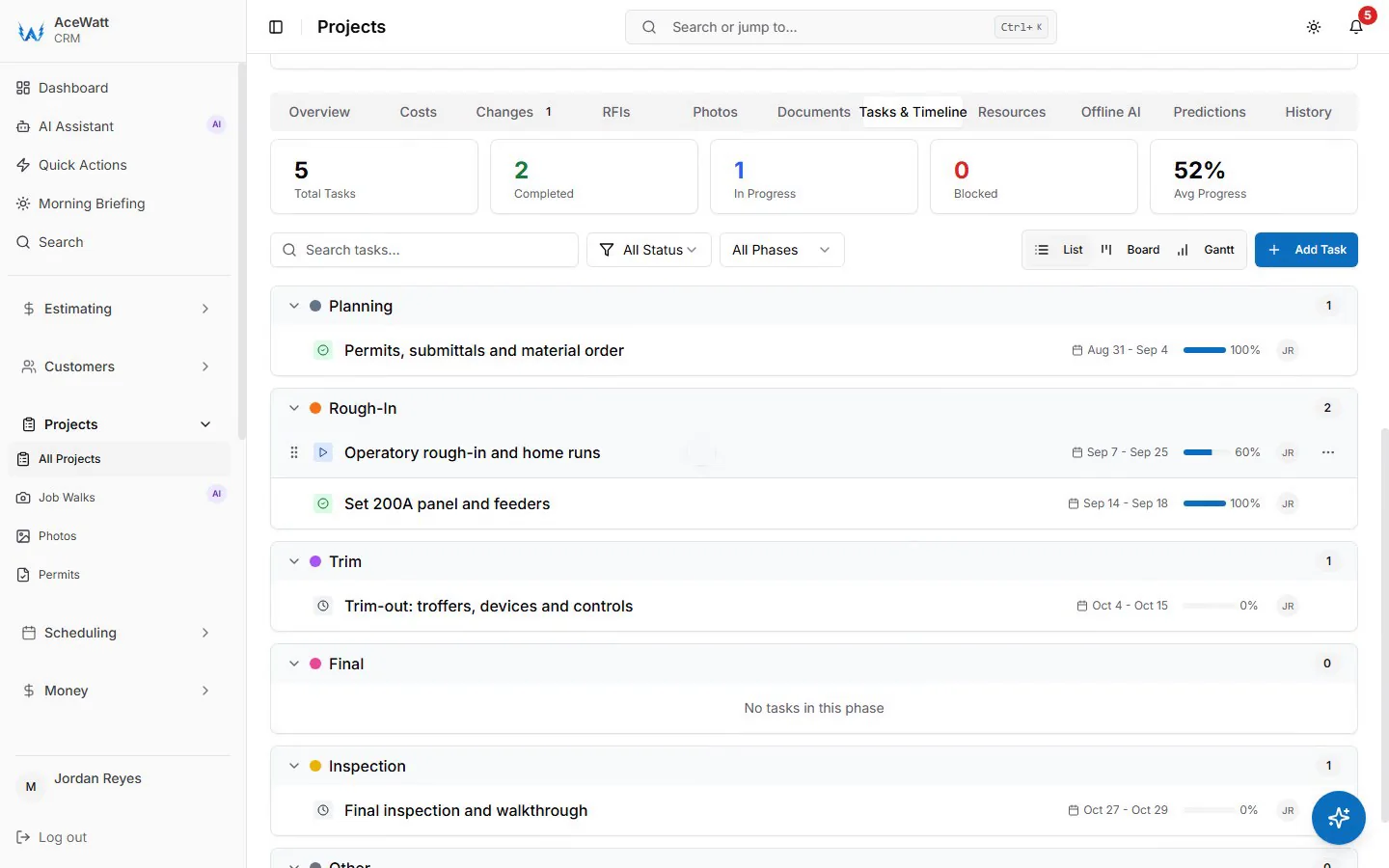
The better workflow is one connected pipeline: schedule the job, assign the tech, capture time against the job, review exceptions, then export approved time to payroll. AceWatt supports that middle layer for electrical contractors. With scheduling and job assignment, the office knows where the electrician is supposed to be. With AI job walks, the site record can capture notes, scope, photos, and what happened during the visit.
AceWatt does not process payroll directly. It is designed to feed clean, job-coded time data to your existing payroll provider. That distinction matters. Your payroll provider handles paychecks, tax filing, deductions, direct deposit, and payroll tax compliance. AceWatt helps make the input accurate: who worked, when they worked, which job they worked on, and what labor category the office should review before export.
This is also where job costing becomes the ROI lever. Clean time data lets you compare estimated labor against actual labor. If your bid allowed 16 journeyman hours and the job consumed 22, you can see the variance before you repeat it. Pair that review with a bid calculator and your estimating process gets sharper over time. Every calculator is collected on the free tools page.
How to Calculate Electrical Labor Costs Accurately
A wage is not a labor cost. A wage is what the electrician earns per hour. A fully loaded labor rate is what the business spends for a productive field hour after employment costs and overhead are included.
Use this simple electrical labor cost formula:
Fully loaded labor rate per productive hour = (wages + payroll taxes + workers' comp + benefits + paid time off + training + vehicle/tool/software overhead allocation) ÷ productive field hours
If a journeyman earns $36 per hour, the true cost is higher after payroll taxes, workers' comp, benefits, PTO, drive time, uniforms, vehicles, tools, phones, and software. If 2,080 paid hours produce 1,450 productive job hours, each productive hour must carry the rest.
This is where many electrical businesses underprice labor. They estimate using wage plus a small markup, then wonder why profit disappears after a busy month. In small shops, wage-only math can be 15-25% below fully loaded labor math once non-billable time and burden are included. Use your payroll reports, insurance invoices, benefits costs, and bookkeeping records.
A practical setup is to calculate three rates:
| Labor category | What to include | How to use it |
|---|---|---|
| Apprentice/helper | Lower wage, supervision time, training, PPE, payroll burden | Use for tasks that can be safely assigned under required supervision. |
| Journeyman/service tech | Wage, burden, truck, tools, phone, callbacks, training | Use for most service calls, remodels, troubleshooting, and production work. |
| Master/foreman | Higher wage, supervision, planning, inspection coordination | Use when the job needs licensed oversight, layout, quality control, or crew leadership. |
For a deeper worksheet, use the electrical labor cost calculator. For pricing strategy, connect the rate to service-call minimums, change orders, and gross margin targets in our guide on how to price electrical work.
The job-costing rule is simple: track every paid hour to a job, internal category, or overhead bucket. "Miscellaneous" should be rare. Warranty work, callbacks, training, shop cleanup, estimating, meetings, material pickup, and drive time all need a home. If they are not visible, they inflate electrical labor cost and hide from bids.
Electrical Contractor Payroll & Labor Software Comparison
The right payroll stack depends on job mix. A residential service contractor may need mobile time tracking and QuickBooks Payroll export. A commercial contractor with public works jobs may need prevailing-wage support from a construction payroll specialist. AceWatt fits the operational layer: scheduling work, capturing time, organizing job records, and exporting clean data.
| Software | Time Tracking | Job Costing | Payroll Export | Prevailing Wage | Best For | Price |
|---|---|---|---|---|---|---|
| AceWatt | Job-assigned time tracking connected to dispatch and job records | Yes, tied to estimates, job walks, and invoices | QuickBooks-format payroll-hours CSV for your payroll provider or bookkeeper | Time can be job-coded; use payroll/compliance tools for wage determinations and certified reports | 2-20 employee electrical shops that want scheduling, AI job walks, job costing, and clean payroll inputs | See pricing |
| ClockShark | Strong mobile time clock, GPS, and crew time | Job and task tracking | Integrates/exports to common payroll and accounting tools | Limited; depends on setup and payroll partner | Contractors focused on time capture and crew accountability | Published plans plus add-ons |
| ServiceTitan | Field time within a large FSM suite | Strong for larger service operations | Payroll/accounting integrations | Available through configuration and partner workflows; verify requirements | Larger shops that need enterprise dispatch, call center, and reporting | Custom/quoted |
| Housecall Pro | Basic field time and timesheets | Service-job reporting | Payroll integrations vary by plan | Limited for complex public works | Residential service businesses that need simple operations software | Published tiers plus add-ons |
| Manual spreadsheet | Manual entries, texts, or paper cards | Manual job-cost columns | Re-key into payroll | Manual and high-risk | Owner-operators or very small shops with simple jobs | Low software cost, high admin time |
If you are specifically comparing payroll providers, read our separate guide to electrical contractor payroll software. This article is about the upstream labor-cost pipeline: how to track electrician labor costs accurately before payroll runs.
Setting Up Labor Tracking for Your Electrical Business
You do not need a giant implementation project to clean up construction payroll for electricians. You need a clear weekly process and a system the field will use.
1. Choose a payroll provider
Decide who will process paychecks, taxes, direct deposit, deductions, and year-end forms. Many small contractors use Gusto, QuickBooks Payroll, ADP, Paychex, or a construction payroll specialist. If you perform prevailing-wage, union, or multi-state work, confirm those needs before choosing.
2. Set up AceWatt time tracking and export rules
Create employees, roles, job types, and labor categories. Tie scheduled work to the job record so the tech is not choosing from a blank list. Decide how approved time will be exported, and define who reviews exceptions.
3. Configure overtime and prevailing-wage review rules
Your payroll provider should handle wage math, taxes, and overtime calculations. Your field system should make exceptions visible: missing clock-outs, unusually long shifts, public works time, or a tech working across two states. If prevailing wage applies, keep wage determinations and certified reporting in the payroll/compliance tool.
4. Run the initial cycle with accurate data
For the initial payroll cycle, compare old timesheets against AceWatt records. Look for missing lunches, incorrect job codes, travel time questions, and helper hours assigned to the wrong project. Do not wait until payday morning; review time daily or the day after work is performed.
5. Reconcile job costing vs. actuals monthly
At month end, compare estimated labor hours to actual labor hours by job type. Review service calls, panel upgrades, EV chargers, remodels, generators, and commercial work separately. The patterns show where estimating is strong and where your labor rate needs attention. This monthly review helps improve electrical contractor profit margins without guessing.
Payroll Compliance Checklist for Electrical Contractors
This checklist is not legal, tax, or accounting advice. Use it to prepare better questions for your payroll provider, CPA, insurance agent, and state labor agency.
- FLSA overtime: Non-exempt employees generally receive time-and-a-half for hours over 40 in a workweek under federal rules. State rules can be stricter.
- State-specific overtime: California and some other jurisdictions have daily overtime, double-time, meal/rest break, or reporting-time rules. Configure payroll with your state requirements, not a generic default.
- Prevailing wage: Public works and federally funded construction projects may require wage determinations by trade and classification. Track the job, classification, and hours clearly.
- Davis-Bacon and certified payroll: Federal projects often require weekly certified payroll reporting. AceWatt can support time tracking and dispatch records; pair it with a payroll or certified-reporting tool for the actual report.
- Workers' comp classification: Electrical work is commonly associated with class code 5190 in many states, but codes vary by state, carrier, and work performed. Keep auditable time records by work type.
- Employee classification: Review W-2 vs. 1099 status carefully. Misclassification can create tax, wage, insurance, and benefit exposure.
- Apprentice supervision and ratios: If your state, apprenticeship program, union agreement, or project contract sets supervision requirements, make sure scheduling and payroll records reflect the actual crew.
- Record retention: Keep timecards, payroll records, job assignments, change orders, and supporting notes in a consistent system so you can answer questions months later.
FAQ: Electrical Labor Cost & Payroll
What is electrical labor cost?
Electrical labor cost is the full cost of employing and deploying electricians, not just their hourly wage. It includes wages, payroll taxes, workers' comp, benefits, paid time off, training, vehicle and tool allocation, software, supervision, and non-billable time. For job costing, calculate it per productive field hour.
How do I track electrician labor costs?
The most reliable way to track electrician labor costs is to connect scheduling, mobile time tracking, job records, and payroll export. Every clock-in should be tied to a job, labor category, and employee. Review exceptions daily, then export approved hours to payroll instead of re-keying paper timesheets.
Does AceWatt run payroll for electrical contractors?
No. AceWatt does not process payroll, file payroll taxes, or issue paychecks. AceWatt helps electrical contractors capture job-coded time, organize labor data, and export payroll hours as a QuickBooks-format CSV for your payroll provider or bookkeeper.
What is a fully loaded labor rate for an electrician?
A fully loaded labor rate is the true hourly cost of an electrician after wage, payroll burden, benefits, insurance, workers' comp, PTO, vehicles, tools, overhead allocation, and productive-hour use are included. It is the number you should use for job costing and estimating, with review from your accountant or bookkeeper.
Can AceWatt help with prevailing wage or certified payroll?
AceWatt can help capture job-coded time, dispatch records, site notes, and labor context for prevailing-wage jobs. It does not generate certified payroll reports or make wage-determination decisions. Use a dedicated payroll/compliance provider and have your CPA or compliance advisor review public-works requirements.
See How AceWatt Feeds Clean Time Data Into Payroll
Payroll accuracy starts in the field. When the schedule, job walk, time record, estimate, invoice, and job-cost review are connected, your office spends less time chasing timesheets.
AceWatt helps electrical contractors schedule work, document the job, track electrician labor costs, and export clean time data to the payroll provider they trust. Start with accurate time on each job, then let payroll do its job.
See how AceWatt's scheduling and time tracking feeds clean data into your payroll, Free Trial
Related Reading
- Browse the full AceWatt feature set: AI job walk, estimating, invoicing, scheduling.
- Electrician salary by state (2026)
- Electrician time tracking app comparison
- Best Accounting Software for Electrical Contractors Doing Prevailing Wage
- ServiceTitan vs. AceWatt: an honest 2026 comparison for electrical contractors
- How to Bid Electrical Work: 2026 Guide + Best Bidding Software — the bidding workflow that sits upstream of labor cost tracking.