
If you're an electrical contractor shopping for business management software, you've probably come across Jobber and Housecall Pro. They're two of the most well-known field service platforms on the market, and for good reason, they both offer solid tools for managing customers, scheduling jobs, and getting paid.
But here's the question most comparison articles won't ask: Are they actually built for electricians?
Jobber and Housecall Pro are general field service platforms. They serve plumbers, landscapers, HVAC technicians, cleaners, painters, and dozens of other trades. That breadth is a strength in some ways, but it's also a limitation. When software tries to serve everyone, it can't fully optimize for anyone.
AceWatt takes a different approach. It's built specifically for electrical contractors. Every feature, every workflow, and every tool is designed around how electricians actually work.
In this comparison, we'll break down how all three platforms stack up across the areas that matter most to electrical contractors: estimating, scheduling, documentation, invoicing, and overall value.
Platform Overview
Jobber
Founded in 2011, Jobber is one of the original field service management platforms. It serves a wide range of home service businesses with tools for scheduling, invoicing, customer management, and basic reporting.
Strengths: Mature platform, wide integration ecosystem, strong scheduling tools. Weaknesses: Generic across all trades, limited estimating sophistication, no industry-specific AI features.
Housecall Pro
Launched in 2013, Housecall Pro focuses on home service businesses with an emphasis on dispatch, invoicing, and payment collection. It's known for its mobile app and real-time dispatch features.
Strengths: Good mobile experience, strong payment processing, built-in marketing features. Weaknesses: Generic across trades, limited customization, estimating is template-based rather than intelligent.
AceWatt
Built specifically for electrical contractors, AceWatt combines CRM, estimating, scheduling, invoicing, and documentation in one platform. Its standout feature is AI, voice AI for hands-free documentation, AI-powered estimating, and automatic overdue-invoice reminders.
Strengths: Electrical-specific design, AI estimating and voice tools, competitive pricing, built for electrician workflows. Weaknesses: Newer platform, smaller integration ecosystem (growing rapidly).
Feature-by-Feature Comparison
Estimating and Quoting
This is where the differences become most obvious.
Jobber uses template-based estimating. You create quote templates and customize them for each job. It works, but it's manual. You select line items, enter quantities, and adjust pricing for every estimate. Plan-to-quote time: 10-20 minutes.
Housecall Pro also uses template-based estimating with a focus on flat-rate pricing. It works well for businesses that price every job the same way, but electrical work varies significantly from job to job. Custom estimates require manual adjustment. Plan-to-quote time: 10-15 minutes.
AceWatt offers AI-powered estimating. Describe the job in natural language, by typing or speaking, and the AI drafts an itemized estimate for your review in under 60 seconds. It understands electrical terminology, scopes of work, and your pricing structure. You review, adjust if needed, and send. Plan-to-quote time: under 1 minute.
Winner for electricians: AceWatt. AI estimating is a generational leap beyond templates, and the speed advantage directly translates to more won jobs.
Scheduling and Dispatch
All three platforms offer drag-and-drop scheduling, calendar views, and dispatch capabilities. They're all competent here.
Jobber has a mature scheduling system with route optimization and team management. It's been refined over a decade and handles complex scheduling well.
Housecall Pro offers real-time dispatch with GPS tracking and "on my way" notifications to customers. The mobile experience is strong.
AceWatt provides drag-and-drop scheduling with team views, automatic customer notifications, and mobile access. It matches the core scheduling capabilities of the other two platforms.
Winner for electricians: Tie. All three handle scheduling effectively. Choose based on your other needs.
Job Site Documentation
This category matters more for electricians than for most other trades. Electrical work requires documentation, safety checklists, inspection records, job walk reports, code compliance notes.
Jobber offers basic job notes and photo attachment. You can add notes to a job and attach photos, but there's no structured documentation system or checklist functionality.
Housecall Pro includes job notes and photo capture. It's similar to Jobber, functional but not designed for the documentation rigor that electrical work demands.
AceWatt includes purpose-built documentation tools: custom safety checklists, photo documentation with geotagging, voice-to-text notes, and structured job walk reports. Documentation attaches directly to the job and customer record. The voice AI feature lets you dictate observations hands-free while working.
Winner for electricians: AceWatt. Documentation is critical for electrical contractors, and AceWatt is the strongest fit in this comparison for documentation-heavy workflows.
Invoicing and Payments
All three platforms offer invoicing and integrated payment processing. This is table stakes for field service software.
Jobber offers invoicing, online payments, and recurring billing. Payment processing rates are competitive.
Housecall Pro has strong invoicing with same-day funding options and built-in payment processing. The checkout experience for customers is smooth.
AceWatt includes invoicing, online payments, and the ability to convert approved estimates directly into invoices. Payment processing is integrated and customers can pay by credit card, or by ACH when your Stripe account has it enabled.
Winner for electricians: Tie. All three handle invoicing and payments well.
Customer Management (CRM)
Jobber has a solid CRM with client records, communication history, and basic segmentation. It's good for general field service but not optimized for any specific trade.
Housecall Pro offers client management with communication tools and basic marketing features like postcard campaigns and email blasts.
AceWatt provides an electrical-specific CRM with customer records, job history, communication tracking, and automatic email reminders on overdue invoices.
Winner for electricians: AceWatt, for the electrical-specific CRM.
AI and Automation
This is where the platforms diverge significantly.
Jobber has limited AI features. Some basic automation for reminders and follow-ups, but no AI-powered estimating, no voice AI, and no intelligent automation.
Housecall Pro offers basic automation for follow-ups and scheduling, but no AI-driven features for estimating or documentation.
AceWatt is built on AI. AI estimating drafts quotes for your review from natural language descriptions. Voice AI enables hands-free documentation and note-taking. Automated follow-up emails reminders on overdue invoices at 1, 7, 14 and 30 days late. AI analyzes your business data to surface insights and recommendations.
Winner for electricians: AceWatt, by a wide margin. AI is the company's core differentiator.
Pricing
Pricing matters, especially for smaller electrical businesses watching their overhead.
Jobber pricing starts around $69/month for the basic plan and goes up from there. Advanced features require higher-tier plans.
Housecall Pro pricing starts around $79/month for basic features. Additional users and advanced features increase the cost.
AceWatt pricing starts at $49/month for the Starter plan (suitable for solo electricians), $99/month for Growth (for small teams), and $199/month for Scale (for growing businesses). All plans include AI features. A 14-day free trial is available. Confirm current pricing and trial terms on the AceWatt pricing page.
Winner for electricians: AceWatt. Lower starting price with AI features included across all plans.
Summary Comparison
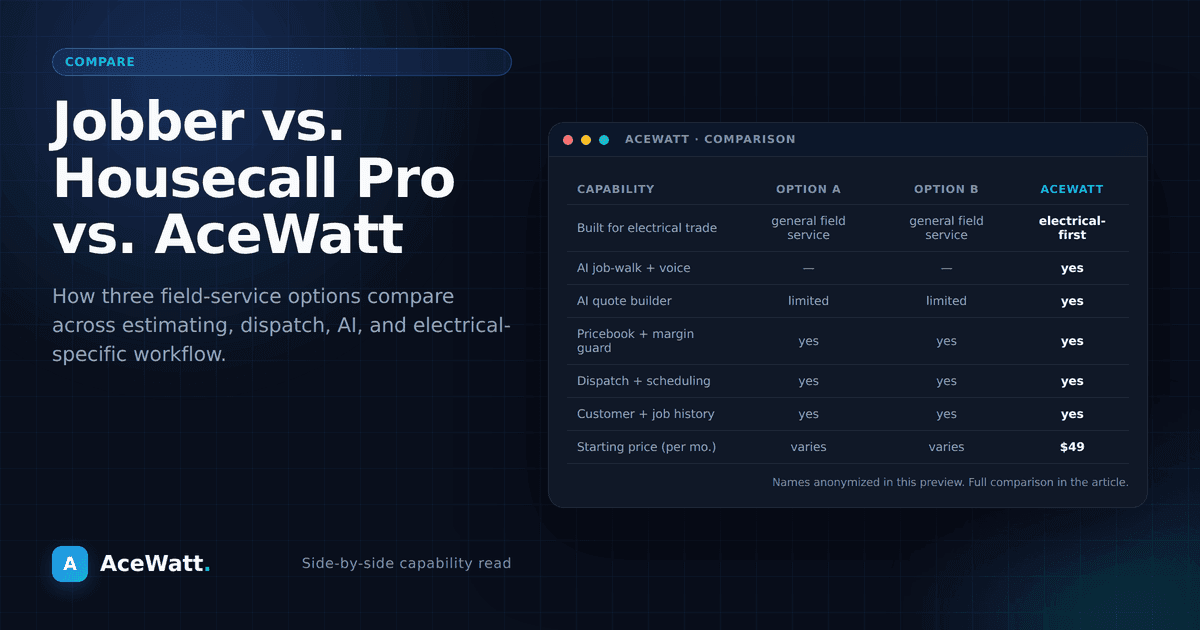
| Feature | Jobber | Housecall Pro | AceWatt |
|---|---|---|---|
| Trade-specific design | General | General | Electrical only |
| Estimating | Templates | Templates | AI-powered |
| Scheduling | Strong | Strong | Strong |
| Documentation | Basic | Basic | Advanced (voice, checklists) |
| Invoicing | Good | Good | Good |
| AI features | Limited | Limited | Core feature |
| Starting price | ~$69/mo | ~$79/mo | From $49/mo |
| Free trial | Yes | Yes | 14 days |
| Best for | General trades | General trades | Electricians |
How to Run a Fair 14-Day Trial Before You Decide
Comparison pages are useful, but your workflow is what matters most. Before committing to any platform, run a short controlled trial with real jobs.
Use the same test set for each platform
Pick 5-10 recent jobs that represent your normal mix (service calls, panel upgrades, troubleshooting, and small commercial work). Recreate those jobs in each system and compare:
- Time to build and send an estimate
- Time to schedule and dispatch work
- Ease of documenting site details and change orders
- Time to send invoices and collect payment
Score what matters to your shop
Use a simple scorecard (1-5) for your must-haves:
- Estimating speed and quality
- Mobile usability in the field
- Electrical workflow fit
- Reporting clarity
- Total monthly cost at your current team size
Get team feedback before purchasing
Have one office user and one field user test each product. If either side dislikes the workflow, adoption usually breaks down.
A fair trial removes guesswork and makes the decision far less stressful.
Who Should Choose What?
Choose Jobber if:
You're a general contractor or multi-trade business that needs a mature, stable platform with a wide range of integrations. Jobber is a solid, reliable choice, it's just not optimized for electrical work specifically.
Choose Housecall Pro if:
You prioritize a strong mobile experience and same-day payment processing, and you're okay with a platform that serves all trades equally. Housecall Pro works well for businesses that rely heavily on flat-rate pricing.
Choose AceWatt if:
You're an electrical contractor who wants software built for your specific trade. You want AI-powered estimating, voice documentation, electrical-specific workflows, and a platform that understands the difference between a service call and a service upgrade. And you want it at a competitive price.
The Bottom Line
Jobber and Housecall Pro are good platforms for general field service businesses. But "good for everyone" is not the same as "great for electricians."
Electrical contracting has unique requirements, code compliance documentation, safety checklists, complex estimating, technical terminology, and regulatory requirements that other trades don't face. A platform built specifically for those requirements will often be a better operational fit than a general-purpose tool.
In this comparison, AceWatt is positioned specifically around electrical-contractor workflows. And it shows, in the AI estimating, in the voice documentation, in the electrical-specific templates, and in the pricing that reflects what electricians actually need.
See the full head-to-head comparison and start an AceWatt trial after confirming the current terms on the pricing page.
Want to see what else AceWatt can do? Explore AI-powered estimating for electricians or learn how AceWatt helps you manage your entire electrical business from one app.
For current plan options, compare tiers on the AceWatt pricing page.
Related Reading
- Jobber vs AceWatt for Electrical Contractors (2026)
- Housecall Pro vs AceWatt for Electrical Contractors (2026) — direct head-to-head on electrical estimating, accounting sync, and switching steps.
- ServiceTitan alternatives for electrical contractors
- AceWatt vs Jobber comparison — side-by-side feature, pricing, and fit breakdown for electrical shops.
- More head-to-head comparisons → electrician software comparison hub