

Electrician business owner salary is not a number you can look up the same way you look up an employee wage. An owner can be busy, booked out, and still underpaid if labor is underpriced, materials are stale, callbacks are hidden, and invoices sit unpaid. The better question is not only “how much do electrical business owners make?” It is: how much profit can the business reliably create after direct costs, overhead, taxes, debt, hiring plans, and retained cash?
Direct answer: there is no single reliable average electrician business owner salary. The U.S. Bureau of Labor Statistics tracks wages for employee electricians, not owner distributions. Owner compensation varies widely because it can include a W-2 salary, draws, distributions, and money intentionally left in the company. A healthy electrician business owner salary comes from profit discipline: accurate pricing, strong labor use, clean material markup, fast estimates, consistent follow-up, low callback leakage, and timely collections.
This article is for general informational purposes and is not tax, legal, or financial advice. Compensation structure, taxes, and payroll rules vary, consult a qualified CPA or financial advisor.
If you handle this on a phone in the field, see our guide to the best systems playbook for running a profitable electrical business first; it covers the workflow end to end.
Key Takeaways
- The best public baseline is employee electrician pay. The U.S. Bureau of Labor Statistics electrician wage data shows employee wages by percentile, but those figures are not the same as electrician owner pay.
- The electrician business owner salary range varies widely because owners choose different mixes of salary, draws, distributions, and reinvestment.
- Treat electrician business owner salary as a repeatable operating outcome, not a one-time draw from a good month.
- Owner pay is mainly a profit-control problem. Gross revenue matters, but revenue that is lost to callbacks, unbilled materials, unpaid invoices, and weak follow-up does not become take-home income.
- Industry profit discussions from sources such as NECA and EC&M consistently point contractors back to estimating accuracy, productivity, job documentation, and margin tracking.
- Use the scenarios below as EXAMPLES only. They are not salary benchmarks, guarantees, or promises. Your electrician business owner salary depends on your job mix, market, pricing, tax structure, and risk tolerance.
Average Electrician Business Owner Salary in 2026
If you are searching for an average electrician business owner salary, start by separating two ideas: employee wages and owner compensation.
BLS wage data is the employee baseline. The BLS OEWS profile for Electricians, SOC 47-2111, reports hourly and annual wages for people employed as electricians. For 2026 planning, many contractors use the most recent published BLS OEWS data as a market reference for what a skilled electrician might earn as an employee. For example, BLS data commonly includes the median, 10th percentile, 25th percentile, 75th percentile, and 90th percentile employee wage ranges. Those numbers help you understand labor-market pressure and what your own field time is worth.
But an electrical contractor owner is not just selling labor. The owner is also pricing work, carrying insurance, funding vehicles and tools, managing permit risk, training helpers, financing materials, collecting invoices, handling sales follow-up, and absorbing bad jobs. That is why the electrician business owner salary conversation must move beyond “what does an electrician earn?” and into “what profit pool does the company create?”
Owner compensation can show up in several ways:
- Salary or guaranteed pay: regular compensation paid to the owner for work performed, often used when the owner is on payroll.
- Owner draw: money taken from the business by a sole proprietor or partner, usually not the same as payroll wages.
- Distribution: profit paid to owners depending on entity structure and tax rules.
- Retained earnings: profit left inside the company for trucks, tools, tax reserves, debt reduction, hiring, and working capital.
This is why two contractors with the same revenue can have very different take-home income. One shop may pay a modest salary and retain cash for growth. Another may draw aggressively but starve the business of working capital. A third may show high revenue but low electrician business owner salary because labor is underutilized, material costs are missed, and receivables are slow.
For a real electrician business owner salary plan, the owner should know which dollars came from labor, which came from markup, which came from close-rate discipline, and which should stay in the company.
So, how much do electrical business owners make? They make what remains after the business consistently converts sold work into collected, job-level profit. The employee wage range from BLS is a useful floor for valuing the owner’s field labor. The owner premium comes only when the company produces profit beyond a fair wage for the owner’s time.
What Determines How Much an Electrical Business Owner Can Pay Themselves
The electrician business owner salary is shaped by the levers below. None of them works alone. A higher close rate does not help if the jobs are underpriced. More revenue does not help if a new helper creates rework. Faster invoicing does not help if the estimate missed material markup.
| Lever | How it affects take-home |
|---|---|
| Revenue volume | More sold work creates a larger potential profit pool, but only if pricing and production quality hold. |
| Gross margin | The percentage left after direct labor and materials funds overhead, owner pay, and profit. Review electrical contractor profit margins before increasing draws. |
| Labor use | Paid hours must become billable or productive job hours. Drive time, supply runs, warranty work, and idle time reduce electrician business owner salary if they are not priced in. |
| Close rate | A weak close rate means estimating time turns into unpaid admin. Faster, clearer proposals and follow-up can help more good-fit quotes become jobs. |
| Material markup | Stale material costs and skipped markup move profit from the owner to the supplier. Update pricing before quoting, especially on copper-heavy work. |
| Callback rate | Rework consumes labor, fuel, schedule capacity, and customer goodwill. Track callbacks by job type and cause. |
| Overhead | Insurance, vehicles, rent, software, licenses, office help, marketing, and phones must be covered before owner distributions are safe. |
| AR and collections speed | A profitable invoice that is not collected cannot fund payroll, taxes, or owner pay. Slow receivables create cash stress even when the P&L looks fine. |
| Headcount | Hiring can increase capacity, but a new employee also adds supervision, training, insurance, rework risk, and admin. Hire only when the margin math supports it. |
A sustainable electrician business owner salary is usually the result of boring operational consistency: estimating from current costs, recording job notes, scheduling crews clearly, following up on quotes, invoicing cleanly, and reviewing job-level profit every month.
Owner Pay Scenarios: Solo, Small Crew, Growing Shop
The formula is simple:
Revenue × net margin = pre-owner profit pool
Define net margin consistently. If owner field wages are already counted as labor cost, the pool is true profit. If not, it must cover both owner labor and owner return. The following scenarios are EXAMPLES only, not benchmarks or salary promises.
| Scenario | Typical revenue | Example net margin | Pre-owner profit pool | Note |
|---|---|---|---|---|
| EXAMPLE: Solo owner-operator | EXAMPLE: $220,000 | EXAMPLE: 12% | EXAMPLE: $220,000 × 12% = $26,400 | If the owner has not paid themselves for field labor, this pool is not enough by itself; it must be compared against the value of the owner’s time. |
| EXAMPLE: Small crew, 2, 5 people | EXAMPLE: $750,000 | EXAMPLE: 10% | EXAMPLE: $750,000 × 10% = $75,000 | Owner pay improves when crews are productive, callbacks are low, and estimates include overhead, supervision, and materials. |
| EXAMPLE: Growing shop, 6, 20 people | EXAMPLE: $1,600,000 | EXAMPLE: 8% | EXAMPLE: $1,600,000 × 8% = $128,000 | Revenue is higher, but office load, scheduling complexity, management time, and working-capital needs also rise. |
These examples show why the phrase electrician business owner salary can be misleading. In a solo shop, the owner may be a technician, estimator, dispatcher, and collector. In a growing shop, the owner may spend less time on tools and more time managing people, quality, pricing, and cash. The same pre-owner pool can feel strong or weak depending on how much unpaid owner labor the business used to create it.
How to Calculate What You Should Pay Yourself
A practical electrician business owner salary target starts with personal need, then backs into business math. Do not begin with “what is left in the bank today?” Bank balance is timing. Owner pay should be tied to recurring gross profit, overhead, taxes, and cash reserves.
Use this worksheet:
- Set a target personal income. Decide what the owner needs to live, save, and justify the business risk. Compare the field-labor portion of that target with BLS employee wage ranges for electricians in your area.
- Separate owner labor from owner return. If you work on tools, price your labor like any other skilled tech. Profit beyond that is the return for owning and managing the company.
- Calculate required gross profit. Add direct labor, materials, permits, subcontractors, and target gross margin. Use a pricing model, not gut feel. See how to price electrical work and the electrical labor rate calculator.
- Subtract overhead. Include insurance, trucks, fuel, phones, rent, licenses, marketing, admin time, software, training, bad debt, warranty allowance, and management time.
- Reserve cash before distributions. Hold back money for taxes, debt service, hiring, tools, slow receivables, seasonal dips, and material deposits. Your CPA can help set a reserve policy.
- Use job-level review. After each job type, compare estimated labor, material, and margin against actual results. Feed the lesson into the next bid with a bid calculator. All calculators live under free contractor tools.
A simple planning formula looks like this:
Required revenue = (desired owner pay + overhead + retained cash + tax reserve + debt payments + hiring reserve) ÷ target net margin
The formula will not make the electrician business owner salary appear automatically. It shows whether the current pricing and volume can support the target. If the required revenue is unrealistic for your crew size, the answer may be price changes, better job mix, tighter scope, faster quoting, or staying lean longer.
Revisit electrician business owner salary quarterly, not just at year-end, so pricing decisions stay connected to current labor cost, material cost, backlog, and cash position.
Common Mistakes That Reduce Electrician Owner Income
Many owners do not have a revenue problem. They have leakage. The electrician business owner salary shrinks when small leaks repeat across dozens of jobs.
Underpricing labor
Using employee wage as the billable rate ignores payroll burden, drive time, supervision, vehicle cost, tools, training, and unproductive hours. A fully loaded labor rate should cover the real cost of productive field time.
Letting material costs go stale
Electrical material pricing can move quickly. If the estimate uses old panel, wire, conduit, breaker, or device costs, the owner absorbs the difference. Refresh material pricing before sending quotes, especially on larger jobs.
Not tracking callbacks
Callbacks feel like customer service, but they are also profit events. Track the job type, tech, root cause, lost hours, materials, and whether the work was warranty, scope gap, customer-caused, or billable. A hidden callback rate is a hidden tax on electrician business owner salary.
Slow estimates
When an owner walks a job on Monday but sends the quote on Friday, the customer may have already chosen someone else. Slow estimating turns demand into wasted sales time. Faster estimates can help close work while the customer still cares.
Weak follow-up
Many customers do not say no; they simply go quiet. If no one follows up on open quotes, the owner loses work already paid for with site visits and estimating time. Follow-up reminders can help turn more quoted work into scheduled revenue.
Missing invoice handoffs
A finished job is not finished financially until the invoice is accurate and sent. Missing notes, change-order details, photos, or material adders create delays and write-offs. Clean invoice handoff protects cash and reduces arguments.
No job-level profit review
If you only review monthly revenue, you cannot see which jobs are carrying the company and which are draining it. Review service calls, panel upgrades, EV chargers, remodels, and commercial projects separately. The fastest way to improve electrician business owner salary is often to stop repeating low-margin work.
How Software Helps Protect Owner Pay
Software does not guarantee a higher electrician business owner salary. It can help protect the margin you already earned by reducing admin friction, missed follow-up, and job-record gaps.
The right software habit is simple: make the electrician business owner salary visible in the workflow by protecting the estimate, the schedule, the job record, the invoice handoff, and the margin review.
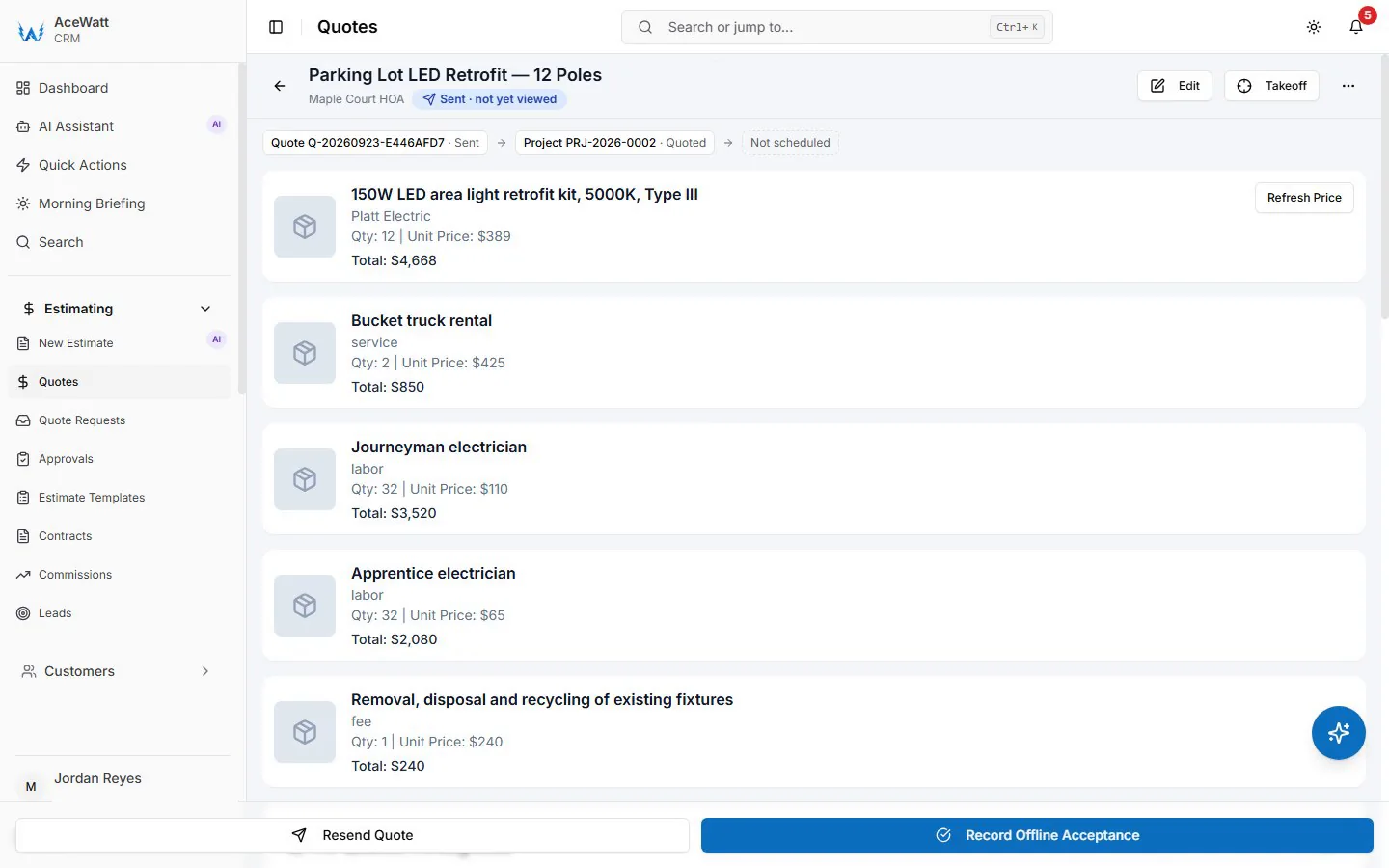
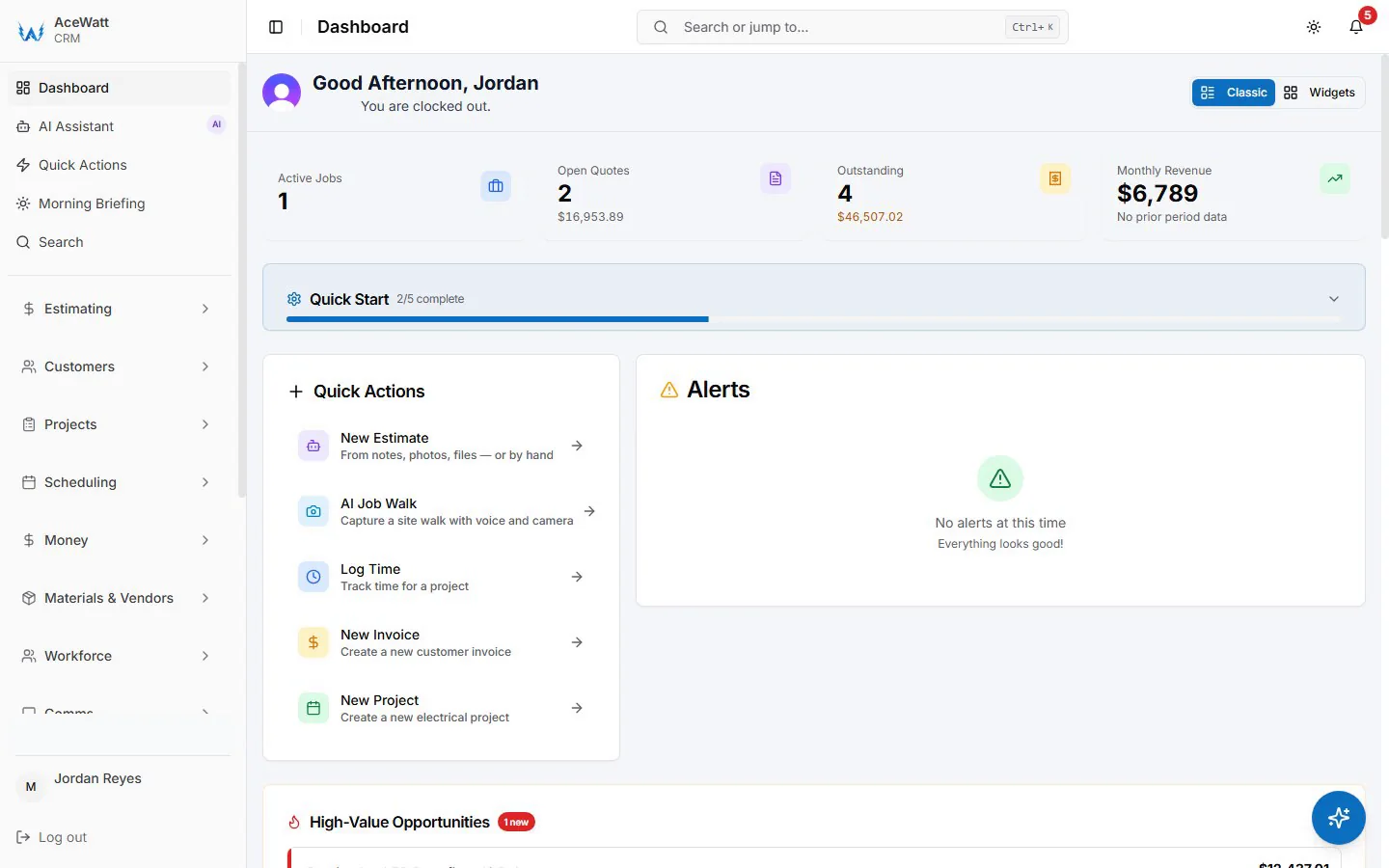
AceWatt is built for electricians who need cleaner estimating, job documentation, scheduling visibility, and margin review. With automated estimating, a contractor can build quotes faster and keep pricing more consistent. Faster quotes may improve close rate because customers receive a clear proposal while the need is fresh.
AceWatt’s AI job walk and voice documentation can help capture better job notes from the field: scope, customer requests, site conditions, panel details, photos, and change-order context. Better notes support cleaner invoice handoff and reduce the chance that billable details disappear between the truck and the office.
Quote visibility supports sales discipline. Instead of relying on memory, owners can see which quotes are open, which prospects need a nudge, and which jobs are ready to schedule. Scheduling and job status visibility can help reduce confusion over who is going where, what is ready, and what is stuck.
Reports and margin visibility help owners compare estimate assumptions against job outcomes. If panel upgrades are consistently beating target margin but remodels are not, your pricing and job mix can change. That is the operational path to a stronger electrician business owner salary: quote faster, document better, schedule clearly, invoice cleanly, and review margin consistently.
If you are comparing systems, start with CRM for electricians, then review AceWatt pricing against the admin hours and quote leakage you want to reduce.
When to Raise Prices, Hire, or Stay Lean
A higher electrician business owner salary usually comes from one of three decisions: raise prices, add capacity, or stay lean and improve mix.
Raise prices when your close rate is strong, the schedule is full, callbacks are controlled, and job-level reports show margins below target. Price increases are especially important when material costs rise, drive time expands, or you add a higher-skill tech whose cost must be recovered.
Hire when demand is consistent, the backlog is real, and the next employee can be productive without dragging the owner into constant supervision. Before hiring, model fully loaded labor cost, expected billable hours, vehicle/tool needs, insurance, training time, and admin load. A new tech should improve the owner’s profit pool after onboarding, not just increase payroll stress.
Stay lean when leads are inconsistent, estimates are slow, job notes are messy, or the owner cannot yet see job-level margin. Adding headcount to a leaky process makes the leak bigger. In that phase, the better move may be tightening pricing, improving follow-up, reducing callbacks, and using software to remove admin drag.
The decision rule is simple: do not chase revenue for its own sake. Chase collected gross profit that survives overhead. That is the money that funds a sustainable electrician business owner salary. Review electrician business owner salary after pricing changes, major hires, and large jobs so owner pay stays tied to real margin.
Frequently Asked Questions
What is a typical electrician business owner salary?
There is no single typical electrician business owner salary that applies across markets. Use BLS employee electrician wage data as a baseline for the value of field labor, then calculate owner compensation from business profit. Owner pay varies widely by revenue, net margin, overhead, tax structure, retained cash, and how much unpaid owner labor is still inside the business.
How much should an electrical business owner pay themselves?
Start with a target personal income, then test whether the business can support it after direct costs, overhead, taxes, debt, hiring needs, and retained cash. The safer question is not “how much can I pull this month?” but “what recurring owner pay can the business support without starving working capital?” Ask a CPA to help choose the right structure.
Should owner pay be treated as labor cost or profit?
If the owner works in the field, the labor portion should be priced like any skilled electrician’s productive time. Profit is what remains after labor, materials, overhead, and reserves. Separating owner labor from owner return makes the electrician business owner salary easier to evaluate.
Can a solo electrician owner make more than an employee electrician?
Yes, it is possible, but not guaranteed. A solo owner can out-earn an employee when pricing, use, close rate, callbacks, and collections are disciplined. A solo owner can also earn less than an employee if they underprice work, absorb admin time, and take on business risk without enough margin.
What profit margin should I watch before increasing owner pay?
Watch gross margin by job type and net margin after overhead. Gross margin tells you whether labor and materials are priced correctly. Net margin tells you whether the business can fund owner pay, retained cash, and growth. Review both before increasing draws or distributions.
Want a clearer path from estimates to take-home pay? Use AceWatt to quote faster, capture better job notes, follow up on open proposals, and review job margin more consistently. Estimate your potential ROI with your own numbers or start your AceWatt trial to see where admin leakage may be reducing owner pay.
Related Reading
- See all CRM features for electrical contractors in one platform.
- Adding your first employee changes your take-home math. See the hiring playbook for electrical contractors.
- Electrician salaries by state (2026 data)
- Which State Pays Electricians the Most? 2026 Salary & Hourly Rates by State: where licensed electrician wages are highest, and what that means for your market.