
Artificial intelligence isn't coming for your job. But it might be coming for the parts of your job you hate, the paperwork, the estimating, the scheduling, the follow-up calls. And that's good news.
AI for electricians is already here in practical, usable tools that handle administrative tasks so you can spend more time on billable work and less time at a desk. This guide explores how AI is being used in the electrical trade today and what it means for contractors who want to work smarter.
What Does AI Actually Mean for Electricians?
Let's clear up some confusion. When we say "AI for electricians," we're not talking about robots pulling wire or AI designing electrical systems. We're talking about software that uses artificial intelligence to automate business tasks that eat up your time.
Specifically, AI in the electrical trade handles:
- Estimating, Analyzing job data to generate accurate estimates faster
- Voice documentation, Transcribing and organizing your spoken notes from job sites
- Scheduling optimization, Finding the most efficient assignment of jobs to crews
- Customer communication, Automating follow-ups, reminders, and routine messages
- Document processing, Converting photos, notes, and voice memos into structured job data
None of this replaces your expertise as an electrician. It replaces the hours you spend on tasks that don't require an electrician's expertise.
How AI is Being Used in Electrical Contracting Today
AI-Powered Estimating
Writing estimates is one of the most time-consuming tasks for electrical contractors. AI estimating tools change the process in several ways:
Auto-populating materials. Instead of manually looking up every item, AI can analyze your job description and suggest the materials you'll need based on similar past jobs. You describe a 200-amp panel upgrade, and the AI suggests the panel, breakers, wire, connectors, and other materials typically required.
Labor calculation. AI can estimate labor hours based on the scope of work, your historical data, and regional averages. It factors in job complexity, access challenges, and crew size.
Consistent pricing. AI applies your standard labor rates, material markups, and overhead percentages automatically, ensuring every estimate is priced consistently and profitably.
Faster turnaround. What used to take 30-60 minutes of desk work can be reduced to 5-10 minutes of reviewing an AI-generated estimate and making adjustments.
For a deeper dive, check out our AI for electrical contractors guide.
Voice AI for Job Documentation
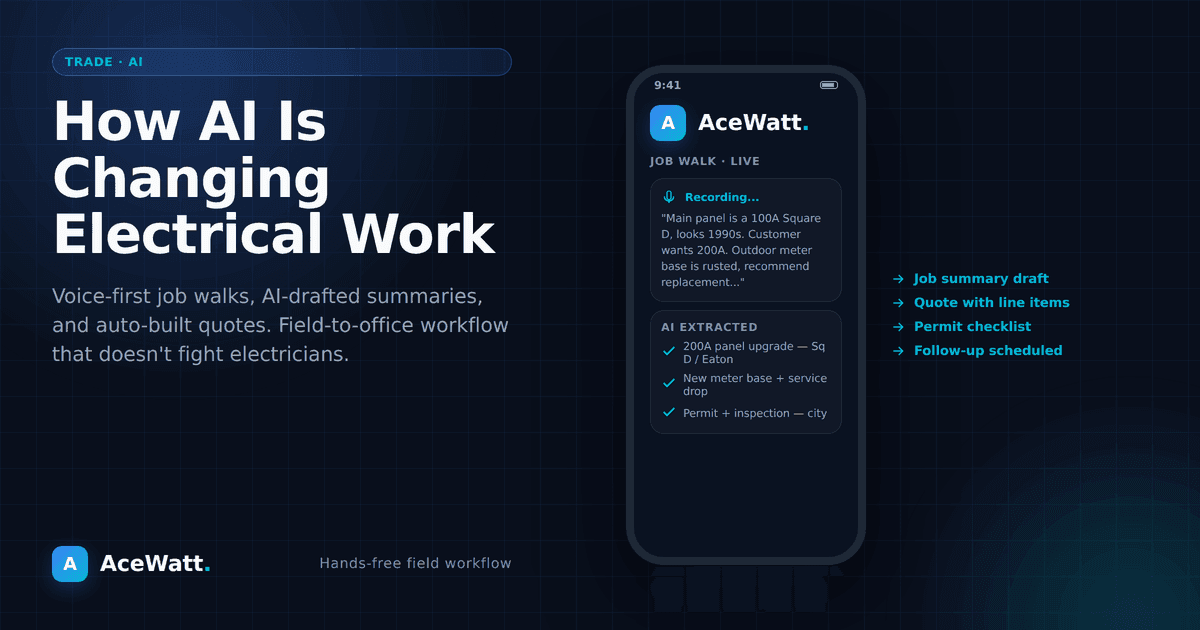
Electricians work with their hands. Typing notes on a phone while wearing gloves in a crawlspace isn't practical. Voice AI solves this.
Here's how it works:
- You press record and describe what you see on the job site: "Walked the Miller job. Existing 100-amp panel, Federal Pacific, needs full replacement. Client wants EV charger in garage, about 40 feet from panel. Crawlspace access, no attic. Existing wiring is 12/2 Romex throughout, copper, in good condition."
- AI transcribes your words and extracts the key data points:
- Panel: 100-amp Federal Pacific (needs replacement)
- New circuit needed: EV charger
- Wire run: ~40 feet
- Access: crawlspace
- Existing wire: 12/2 Romex, copper, good condition
- This structured data feeds into your job record, estimate, or work order automatically.
Voice AI that understands electrical terminology, panel types, wire gauges, conduit sizes, is far more useful than a generic voice-to-text tool. It captures the specifics that matter in your trade.
AI for Job Walk Documentation
Job walks generate a lot of unstructured data, photos, measurements, observations, client requests. AI processes this data into something usable:
- Photo analysis, AI can identify electrical components in photos and categorize them
- Voice note transcription, Converting spoken observations into text organized by topic
- Summary generation, Creating a concise job summary from all your inputs
- Scope extraction, Identifying the work items that need to be included in the estimate
Learn more about AI-powered job walk documentation and how it simplifies the estimating process. You can also try a dedicated voice job walk app that turns spoken walkthrough notes into structured job records.
AI-Powered Scheduling
Assigning the right electrician to the right job at the right time sounds simple until you're managing a crew of five with 15 jobs across a three-county area.
AI scheduling tools analyze:
- Location, Minimize drive time between jobs
- Skills required, Match electricians to jobs that fit their expertise
- Priority and urgency, Handle emergency calls without disrupting the schedule
- Job duration, Prevent overbooking or underutilizing your crew
- Client preferences, Honor specific time requests when possible
The result is a schedule that maximizes billable hours and minimizes windshield time. AI handles the optimization; you approve the schedule.
AI for Customer Communication
Following up with leads, confirming appointments, sending reminders, and chasing overdue invoices are all necessary tasks that eat up hours every week. AI automates these communications:
- Estimate follow-ups, Automatically email or text leads who haven't responded to an estimate within 48 hours
- Appointment confirmations, Send reminders 24 hours before scheduled jobs
- Invoice reminders, Follow up on overdue payments with escalating urgency
- Post-job follow-up, Check in with clients after job completion and request reviews
These aren't generic spam messages. Good AI tools use templates you customize with your brand voice and trigger them based on specific conditions in your workflow.
What AI Can't Do for Electricians
Being honest about AI's limitations is important. Here's what AI cannot do in the electrical trade:
Replace your expertise. AI can't interpret the National Electrical Code, diagnose a complex wiring issue, or determine the right solution for an unusual situation. That requires a licensed electrician's knowledge and judgment.
Ensure code compliance. AI can flag potential code issues, but code interpretation and compliance verification must be done by a qualified professional. Local amendments and interpretations vary.
Perform physical work. AI is software. It can't pull wire, bend conduit, terminate connections, or climb a ladder.
Make business decisions. AI provides data and recommendations. Decisions about pricing, hiring, growth, and client relationships are yours to make.
Guarantee estimate accuracy. AI-generated estimates are only as good as the inputs. You still need to review every estimate for accuracy and profitability before sending it.
Think of AI as a well-trained assistant. It handles the routine work, prepares documents for your review, and surfaces the information you need to make good decisions. You're still the boss.
How to Start Using AI in Your Electrical Business
You don't need to overhaul your entire business to start benefiting from AI. Here's a practical approach:
Start with One Pain Point
What takes the most time or causes the most frustration? For most electricians, it's estimating, invoicing, or follow-up. Pick one area and find an AI-powered tool that addresses it.
Choose Tools Built for Your Trade
Generic AI tools are impressive but not always practical. Software built specifically for electrical contractors understands your terminology, workflows, and business needs. It works out of the box instead of requiring extensive customization.
Review Before You Send
AI is a tool, not an autopilot. Review every estimate, invoice, and communication before it goes to a client. You're responsible for the final product regardless of who, or what, created the first draft.
Train Your Team
If you have employees, make sure they understand how to use the AI tools effectively. This means training on the software and establishing clear processes for how AI outputs are reviewed and approved.
Common Questions Electricians Ask Before Using AI
“Will AI make my estimates too generic?”
It can, if you use it without review. The fix is simple: treat AI output as a first draft, then add your field notes, local material pricing, labor assumptions, and scope exclusions. The more specific your inputs, the more useful the draft becomes.
“What if the AI gets code or safety details wrong?”
That risk is exactly why AI should support your workflow, not replace licensed judgment. Use it for speed and organization, then have a qualified electrician review final scope, safety requirements, code references, and final pricing before anything is sent.
“Do I need to be technical to use AI tools?”
Not usually. In practical field-service software, AI features are built into normal tasks: writing estimates, organizing notes, sending follow-ups, and documenting jobs. If your team can use a phone camera and send a text, they can usually learn AI-assisted workflows quickly.
“Where should I start first?”
Start where time loss is highest. For many shops, that means estimating or documentation. Pick one workflow, run it for two weeks, and measure what changed: turnaround time, number of quotes sent, response time, and admin hours after work. Then expand from there.
The Bottom Line on AI for Electricians
AI isn't replacing electricians. It's making electricians more efficient, more accurate, and more competitive. Contractors who adopt AI tools for administrative tasks will spend less time on paperwork and more time on revenue-generating work.
The electricians who stay competitive will keep improving both field execution and back-office systems, using technology where it adds real value.
AceWatt CRM includes AI-powered tools for estimating, voice documentation, job walks, scheduling, and customer communication, designed for electrical-contractor workflows. Learn more about our AI features and start your 14-day free trial at acewatt.com.
If faster quote turnaround is a priority, review automated estimating for electricians.