What the "Quality Builders Electric Most Recent Post Date" Search Reveals About LinkedIn for Electrical Contractors in 2026
Type "Quality Builders Electric most recent post date" into a search bar and you are really asking three things: Is this electrical contractor still active? Do they communicate professionally? Can I verify recent work before I call them? That search behavior, repeated every day by general contractors, property managers, and facility directors across the US, is exactly why LinkedIn now matters for electrical shops of every size. This guide breaks down what recency and consistency signal to commercial buyers, and how to build a LinkedIn presence powered by your actual operations rather than marketing slogans.
1. Why LinkedIn Is Becoming a Real Channel for Electrical Contractors in 2026
Residential service work still runs on Google reviews and referrals. Commercial and light industrial electrical work runs on relationships, and LinkedIn is where those relationships stay warm between projects. The general contractor who awarded you a tenant improvement package last spring, the property manager overseeing a 200-unit portfolio, and the facility director at a multi-site medical group all check LinkedIn before returning a call or adding a vendor to a bid list.
Two shifts have accelerated this. First, vendor selection has become more visible: when a GC recommends an electrical sub, the owner's rep often looks them up the same afternoon, and a dead or dated profile raises quiet doubts. Second, the skilled trades shortage has turned LinkedIn into a hiring channel. Journeyman electricians and apprentices browse shop pages to gauge whether a company is organized, busy, and worth applying to. A shop that documents real panel upgrades, rough-ins, and service calls recruits better than one with a bare profile.
2. What "Quality Builders Electric" Signals About Electrical Marketing on LinkedIn
The search phrase itself is the lesson. Nobody searching for a contractor's most recent post date is evaluating cleverness. They are measuring recency, and recency is a proxy for responsiveness and operational health.
A LinkedIn page whose last post is eleven months old reads one of two ways to a commercial buyer: this shop is buried in backlog with no systems to manage it, or this shop is winding down. A page with posts from this week signals the opposite, an owner with processes that free up time to communicate. In electrical contracting, trust is built through repeated proof: jobs completed, inspections passed, change orders documented, invoices settled. Consistency beats production value every time. A phone photo of a clean 40-circuit loadcenter, posted weekly, outperforms one polished branding video posted per quarter, because the buyer is asking whether you show up, not whether you have a video editor.
3. How Electrical Contractors Can Use LinkedIn to Support Estimating, Scheduling, and Follow-Up
The hard rule of contractor content: never post a claim your operations cannot back up. When your back office runs on real systems, every module in your job management software becomes a content source.
Estimating speed. With AI Estimating, a Monday morning job walk for a 100-amp to 200-amp service upgrade becomes an itemized quote by Monday afternoon, including the optional method load calculation under NEC 220.82, the meter can replacement, grounding electrode system updates per NEC 250, permit fees, and utility coordination. Post that timeline. Commercial buyers remember a shop that turns estimates in 24 hours when the incumbent takes a week.
Follow-up discipline. If Automated Follow-Up answers every inbound lead within five minutes, post your response-time standard and hold yourself to it publicly.
Scheduling reliability. Crew Scheduling and Dispatching lets you show how a same-day no-power service call gets slotted alongside scheduled rough-ins without anyone waiting three days.
Job transparency. Job Tracking gives you milestone content on commercial work: rough-in complete, rough-in inspection passed, fixture set, trim out, closeout documents delivered. That sequence is exactly what property managers want to see evidence of before they hand you a master service agreement.
4. What to Post: Job Walk Documentation, Dispatch Wins, and Invoicing Proof Points
The strongest electrical contractor marketing repurposes work you have already done. AI Voice and Job Walk Documentation turns a recorded walk into a transcribed, photo-tagged scope record, and that record converts directly into posts.
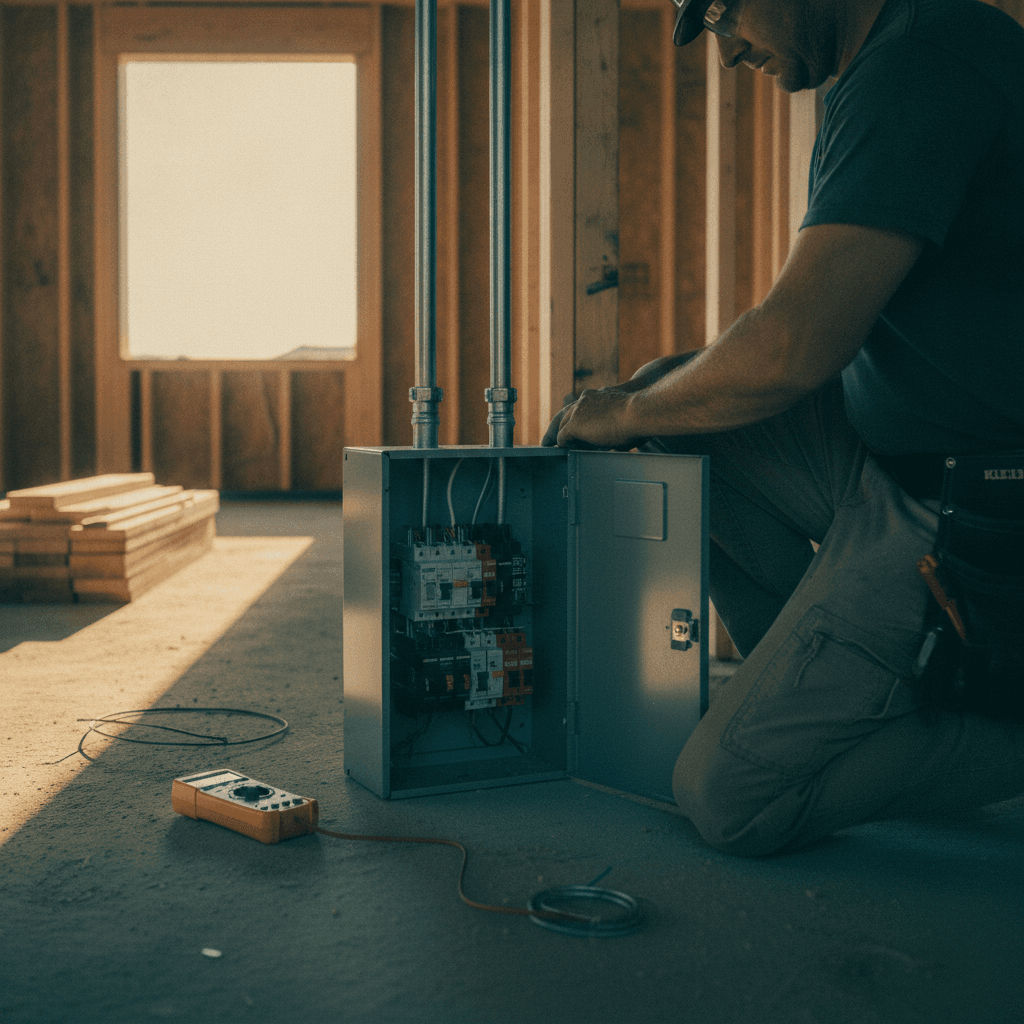
Project proof posts. A before-and-after panel upgrade post works when it carries real scope clarity: a 1960s-era 100-amp panel with obsolete breakers and damaged conductor insulation, replaced with a 200-amp loadcenter, new grounding and bonding per NEC 250.94, and a load calc attached. Other proven formats include a 48-amp EV charger install on a 60-amp branch circuit sized at 125 percent of continuous load per NEC 625, and a tenant improvement showing new receptacle circuits, LED troffer retrofits, and occupancy sensors.
Dispatch win posts. Average response time on service calls, or how you handled an emergency call at 7 a.m. alongside scheduled remodel work.
Invoicing proof points. This is where most contractors leave credibility on the table. When your electrical invoice app sends invoices from the field on completion day, and QuickBooks Accounting Sync pushes them straight into your books, you can post defensible claims: invoices out same day, time and material billing backed by timestamped labor lines and attached material receipts, fewer billing disputes because the customer saw documented hours rather than a rounded lump sum. Shops that invoice at closeout instead of batching at month end routinely collect weeks faster, and that is a story commercial clients respect.
5. How to Turn LinkedIn Engagement Into Booked Electrical Jobs
Engagement only becomes revenue when it moves into a tracked pipeline. Treat every comment and DM as a lead that enters your AI-powered CRM with a next step and an owner, the same way a phone call would.
Practical moves that convert: close project posts with a specific offer tied to your systems, such as job walks scheduled this week with estimates returned within 24 hours. Spend fifteen minutes commenting on GC groundbreaking posts and property management updates, because those comments get seen by exactly the decision makers you want. Tag partner companies with permission, since the lighting distributor and the GC each bring their own audience. And use the channel for hiring: a post about training apprentices on proper bonding or on Arc Fault requirements under NEC 210.12 attracts tradespeople, and a fully staffed crew is what lets you accept the commercial work your LinkedIn presence generates.
6. Common Mistakes Electrical Shops Make on LinkedIn
- Posting only when work is slow. Buyers read gaps as feast-or-famine instability, the opposite of what you want them to conclude.
- Generic business advice. Motivational quotes position you as anyone. A photo of a properly torqued and labeled panel positions you as an electrician.
- Unsafe or sloppy photos. Electricians will spot missing knockouts left open (a violation of NEC 408.7), absent PPE, or unmarked breakers, and commercial buyers sometimes will too.
- Claiming speed without systems. If you post about fast estimates but quotes take a week, the first GC who tests you will tell others.
- Ignoring comments and DMs. A shop that posts about professionalism but replies in four days contradicts itself.
- Selling in every post. Roughly one post in five should ask for work. The rest should prove you can do it.
7. A Practical LinkedIn Cadence for Solo Electricians and Growing Electrical Teams
Three posts per week, 30 to 45 minutes total, all pulled from data already inside your job management software for electricians:
- Post 1: Project proof. One job, before and after, with the scope notes pulled from your job walk documentation and photos from job tracking.
- Post 2: Operations insight. An estimating turnaround, a dispatch decision, or a billing practice such as T&M tickets with attached receipts.
- Post 3: Customer education. Why two panel upgrade bids differ by $1,500, what AFCI protection means for a remodel, or what a homeowner needs before installing an EV charger.
Batch drafting on Friday afternoon using voice notes converted into outlines. Consistency is the entire game: the contractor whose most recent post is two days old wins the trust check that the contractor posting twice a year loses.
The Underlying System Makes the Content Possible
LinkedIn consistency stops being a burden when your content source is your operations data. AI Estimating gives you turnaround stories. Automated Follow-Up gives you response-time proof. Job Tracking and dispatch records give you project narratives. Voice documentation and field invoicing with QuickBooks sync give you scope clarity and payment performance worth posting about. Build the operational backbone first, and the marketing writes itself.